
 KOR
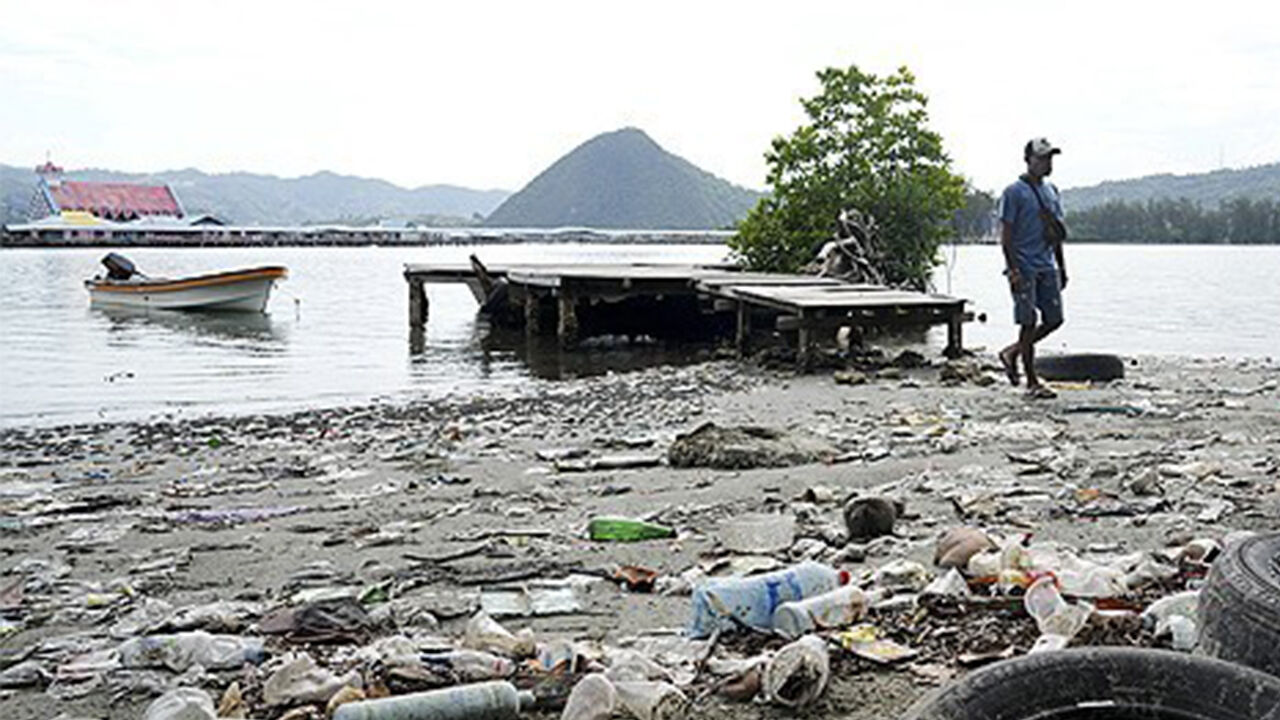
▲ Plastic waste litters a beach in Jayapura, Indonesia.
A vast expanse of the Pacific Ocean between Hawaii and California has grown progressively bluer and brighter over the last 20 years, and scientists suggest that light reflection and scattering caused by accumulated microplastics in the water may be to blame.
According to CNN, scientists at the University of Bergen in Norway made the claim in a study published November 5 in the journal Communications Earth & Environment.
Analyzing satellite data from 2002 to 2022 for the area known as the Great Pacific Garbage Patch, the researchers found a noticeable increase in the brightness of blue and green wavelengths in and around the region.
This area is a convergence zone for all kinds of plastic waste flowing into the ocean, ranging from discarded fishing nets to food and beverage packaging.
The color of the ocean literally reflects what is inside it, with everything from phytoplankton to marine debris playing a role.
However, there has been a gap in research regarding how microplastics might affect ocean color, according to Dan Costner, an optical oceanographer and co-first author of the study.
Through simulations, the research team found that the increased blue and green brightness in the color of the Great Pacific Garbage Patch aligns with the hypothesis that the amount of microplastics has increased.
Scenarios assuming that the changes were caused by natural biogeochemical shifts, such as an increase in the volume or change in the type of phytoplankton, had a low probability of producing such changes.
However, the study does not directly prove that the shift in ocean color in the region is caused by microplastics.
Shea Cheatham, a Ph.D. student at the University of Bergen and co-first and corresponding author of the paper, explained, "We were able to confirm that there is a specific light spectrum, or color, that microplastics tend to create."
Still, she noted that additional research is needed to prove that the colors appearing in satellite data are "directly and solely caused by plastics."
Doing so requires traveling out to the garbage patch for direct measurements, which is a difficult and costly undertaking.
Scientists have estimated that up to approximately 13 million tons of plastic enter the ocean every year, yet only about 250,000 tons have been identified floating on the surface.
This discrepancy is sometimes referred to as the "missing plastic paradox."
While it is suspected that the breakdown of plastics into hard-to-detect microplastics could be part of the reason, Cheatham stated, "We still cannot clearly explain where the plastic is going."
Costner remarked, "If microplastics are accumulating to the point where they are actually changing the color of the ocean, that is quite concerning."
(Photo: AP, Yonhap News)
※ Please note: This article was translated by AI and may contain errors.


 Video News
 Video News


 Video News