
 KOR
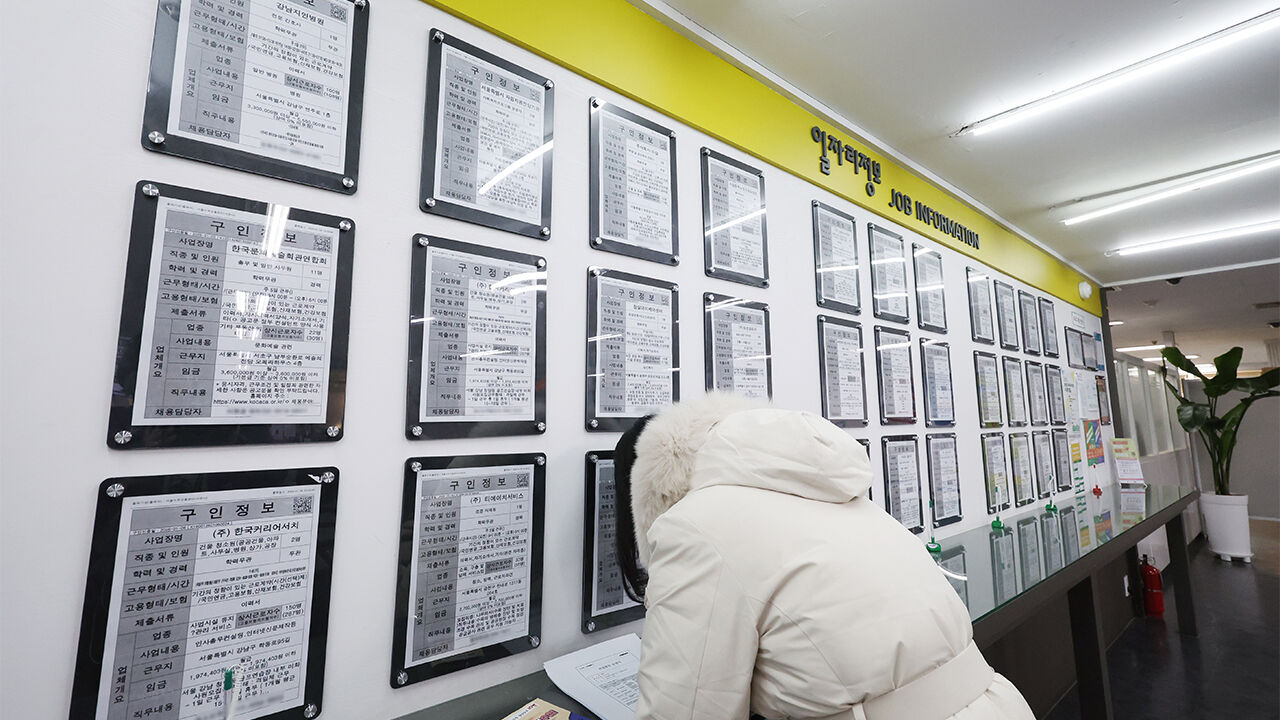
▲ Seobu Employment and Welfare Plus Center Job Information Bulletin Board (File Photo)
The number of people who are simply resting without any clear reason—neither working nor actively looking for a job—has reached an estimated 2.55 million.
In particular, among those in their 20s and 30s who should be entering the job market and preparing to serve as the economic backbone, 680,000 were found to be in the "resting" status.
Among the younger generation, the proportion of those resting due to a lack of desired jobs has grown larger, indicating a deepening job mismatch.
The proportion of the economically inactive population with intentions to find employment or start a business within a year has dropped to an 8-year low.
The Korea Data Administration announced these findings today through the "August 2026 Supplementary Survey on the Economically Inactive Population."
Among the population aged 15 and older, the economically inactive population—those capable of working but not engaging in job searches or unable to work—stood at 16.297 million, an increase of 77,000 from a year ago.
Accountable for 35.4% of the population aged 15 and older, the ratio of the economically inactive population remained the same as last year.

By gender, the proportion of the economically inactive population was higher among women (61.5%) than men (38.5%).
The number increased by 55,000 for men and 21,000 for women.
Looking at age groups, the proportion of the economically inactive population was high mainly among older or younger brackets, such as those aged 70 and older (29.4%), those in their 60s (19.0%), and those aged 15 to 19 (13.1%).
Compared to a year ago, the economically inactive population increased among those aged 70 and older (232,000), those in their 60s (53,000), and those aged 15 to 19 (30,000).
Conversely, it decreased among those in their 50s (-115,000), those in their 40s (-71,000), and those in their 20s (-43,000).
The activity status of the economically inactive population was surveyed in the order of "housework" (37.0%), "attending school or taking courses" (20.6%), and "resting" (15.7%).
Among the economically inactive population, the "resting" population—those not engaging in job searches without any particular reason—was tallied at 2.551 million.
This is a decrease of 89,000 compared to last year (2.641 million), which was an all-time high.
By age group, the numbers were highest in the order of those in their 60s (966,000), those in their 20s (377,000), and those in their 50s (366,000).
Those in their 30s followed with 303,000, while those aged 70 and older and those in their 40s were surveyed at 257,000 and 264,000, respectively.
Narrowing it down to those in their 20s and 30s, it means 680,000 people are simply in a resting state.

The main reasons for "resting" were high in the order of "in poor health" (34.4%), "continuing to rest after leaving a job (retirement)" (19.9%), and "difficulty finding a desired job" (18.9%).
By age group, for those aged 15 to 29 and those in their 30s, "difficulty finding a desired job" was the highest at 35.2% and 32.3%, respectively.
These proportions expanded by 1.1 percentage points and 5.0 percentage points, respectively.
The resting population was tallied at 139,000 for those aged 15 to 29 and 98,000 for those in their 30s.
Compared to a year ago, it decreased by 13,000 for those aged 15 to 29, but increased by 8,000 for those in their 30s.
(Photo: Provided by Korea Data Administration, Yonhap News)
※ Please note: This article was translated by AI and may contain errors.


 Video News
 Video News
 Video News
 Video News
 Video News