
 KOR
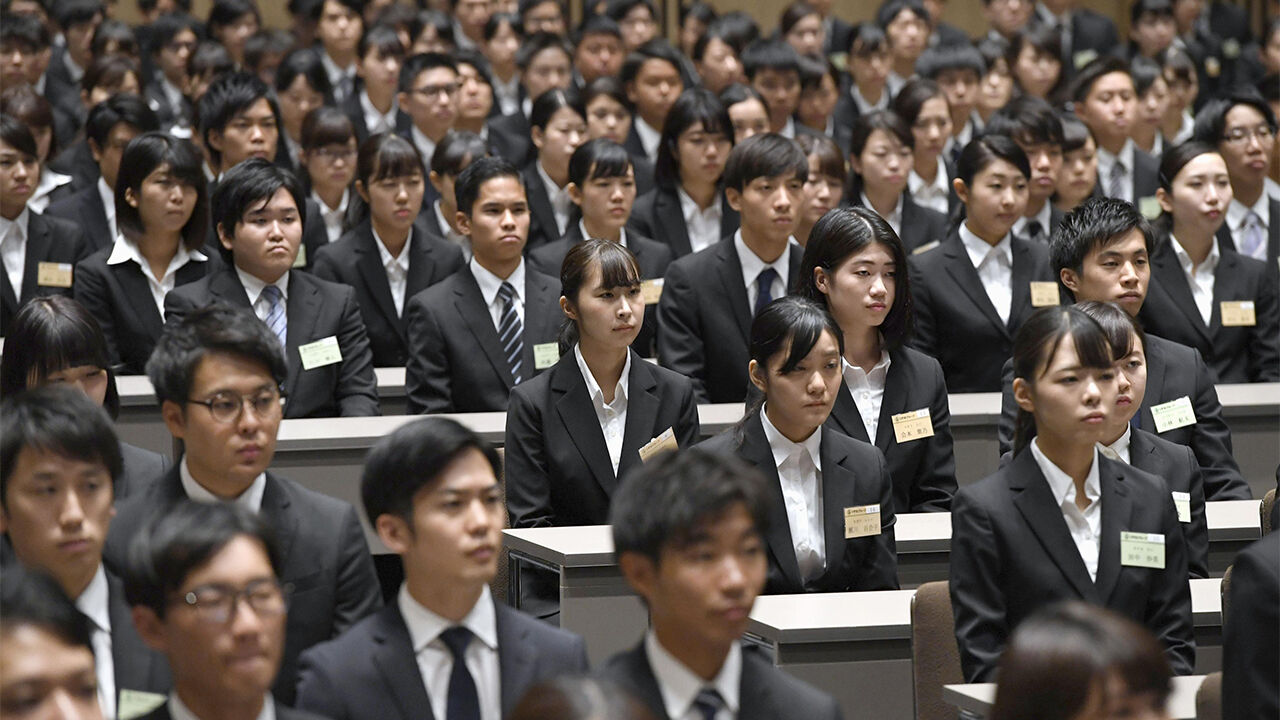
▲ A job informal offer ceremony for prospective university graduates in Japan (file photo)
A major Japanese company has decided to eliminate the starting salary gap between high school and university graduates, judging that the ability to adapt to change is more important than educational background in the artificial intelligence (AI) era.
According to the Nihon Keizai Shimbun (Nikkei) on November 3, Misumi Group headquarters started implementing a system this month to hire high school and university graduates under the same framework, removing the "degree premium" previously given to university graduates.
Regardless of educational background, the starting salary is set equally at 303,000 yen (approx. 2.57 million won) per month, and other conditions such as allowances and corporate welfare are applied identically.
Misumi Group is a major corporation that manufactures and supplies machine parts and tools, with a market capitalization of 1 trillion yen (approx. 8.5 trillion won) and over 10,000 employees.
It is quite rare in Japan to apply the same wage level to university and high school graduates.
According to data compiled by the Ministry of Health, Labour and Welfare, the average monthly salary for new university graduate hires last year was 262,300 yen (approx. 2.23 million won), which was 26 percent higher than the 207,300 yen (approx. 1.763 million won) for high school graduates.
Nikkei explained, "With the spread of AI, problem-setting skills and the ability to adapt to change are being emphasized rather than educational background," adding, "Amid changes in the quality of talent demanded by companies, the premium that favored university graduates in employment has begun to waver."
Tsukasa Kato, Chief Human Resources Officer (CHRO) of Misumi Group, explained, "As AI is now able to handle most of the document creation and information gathering previously done by young employees, the duties required of them have also changed," and added, "The attitude of continuously taking on new challenges and the ability to discover problems have no relation to educational background."
The company, which is focusing on the factory automation (FA) related equipment business, is accelerating the development of services responsive to new work processes utilizing AI, and is therefore primarily evaluating AI-related knowledge and adaptability to change during the recruitment process.
Previously, Misumi Group provided identical treatment for two years after joining the company regardless of performance, but moving forward, it plans to evaluate employees one year after joining and differentiate wages accordingly.
Yumiko Kawashima, editor-in-chief of the job-hunting site Todai Campus, analyzed, "Opportunities to acquire knowledge and skills outside of universities are increasing," and "Driven by the spread of AI, there is a growing tendency to emphasize capabilities and potential that cannot be measured by educational background alone."
(Photo: Yonhap News)
※ Please note: This article was translated by AI and may contain errors.


 Video News

 Video News
 Video News
 Video News