
 KOR
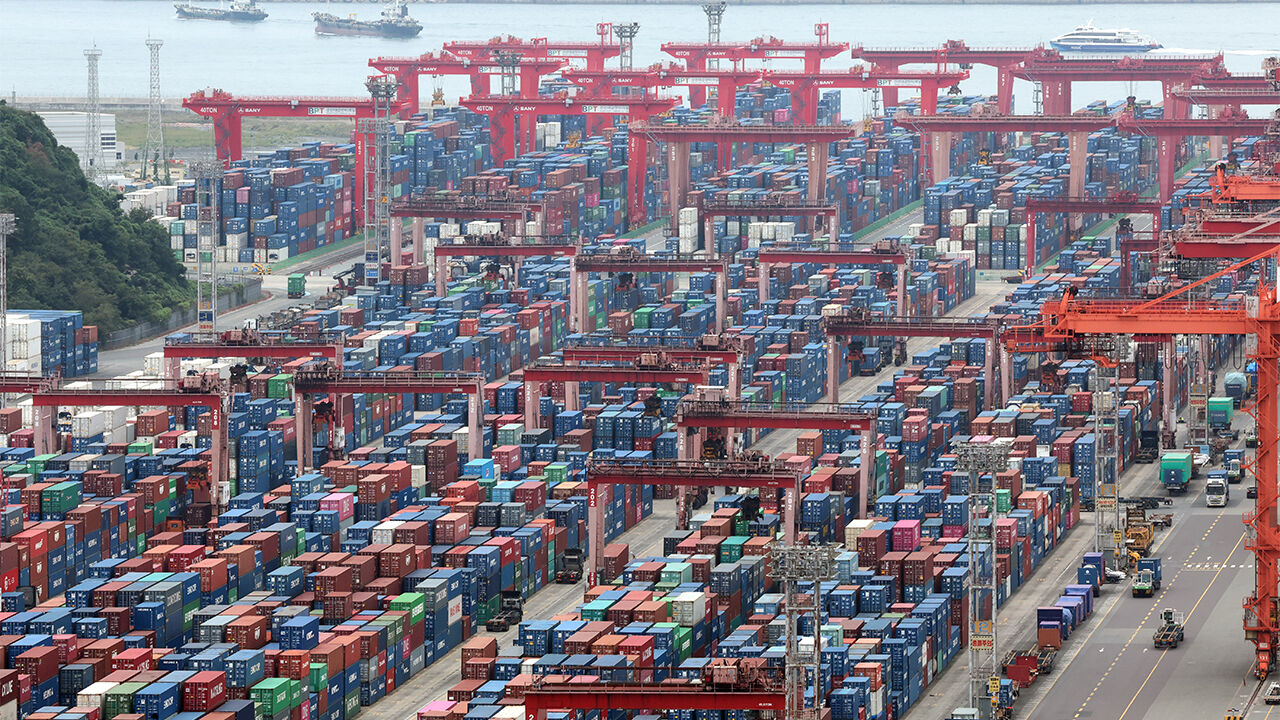
▲ Export and import cargo is piled high at the Sinseondae Pier in Busan Port. (Photo: Yonhap News)
South Korea's exports in October reached $115.3 billion, pushing this year's cumulative exports past the $900 billion mark for the first time in history.
With only $70,000 million remaining to reach the annual export target of $1 trillion, South Korea is expected to achieve the so-called "dream $1 trillion" milestone this month, becoming the fourth country in the world to do so following the United States, China, and Germany.
The Ministry of Trade, Industry and Energy announced today (November 1) that October exports rose 93.7% from the same period last year to $115.28 billion.
Following September ($121.1 billion), this marks the second-highest monthly export figure on record.
Average daily exports, factoring in the number of working days, surged 76.0% to $5.24 billion, staying above the $5 billion mark for the second consecutive month.
As a result, cumulative exports for the January–October period reached $930 billion, surpassing $900 billion for the first time ever.
South Korea's exports first crossed $100 billion in 1995, followed by milestones of $200 billion in 2004, $300 billion in 2006, $400 billion in 2008, $500 billion in 2011, and $600 billion in 2018.
Having reached the $700 billion threshold for the first time last year with an all-time high of $703.9 billion, South Korea's exports have consecutively shattered the $800 billion and $900 billion barriers this year.
If the current trend continues, the Ministry of Trade, Industry and Energy projected that the country will achieve the unprecedented feat of $1 trillion in annual exports within this month.
Once again, semiconductors led October's exports.
Semiconductor exports last month skyrocketed 259.4% from the same period last year to $56.44 billion.
This is the second-largest monthly export figure on record, following September ($60.3 billion).
The strong performance was driven by continued facility investments by global big tech companies to secure leadership in the artificial intelligence (AI) industry, which sustained high semiconductor prices and shipment volumes.
Exports grew not only in semiconductors, but also in 18 out of the top 20 flagship export categories.
Computer exports jumped 496.6% to $5.85 billion.
This is analyzed to be the result of expanded server infrastructure investments following the spread of AI services and increased demand for server-use solid-state drives (SSDs).

Driven by an increase in working days due to the shift in the Chuseok holiday timing (from October 2025 to September 2026) and strong hybrid vehicle exports, the figures broke the record for the highest performance ever for an October.
Petroleum products and petrochemicals reached $6.92 billion and $4 billion, increasing by 80.0% and 27.5%, respectively.
This was because selling prices for petroleum and petrochemical products rose due to prolonged high oil prices stemming from the protracted war in the Middle East.
However, export volumes for petroleum products and petrochemicals decreased by 7.5% and 6.8%, respectively.
Cosmetics, agri-fishery food, and bio-health all recorded their highest performances ever for an October.
Cosmetics rose 57.5% to $1.44 billion, agri-fishery food increased 11.6% to $1.11 billion, and bio-health grew 30.2% to $1.53 billion.
Conversely, ships ($2.64 billion, down 43.6%) experienced a temporary decline due to the base effect from offshore plant exports recorded last year.
By region, exports increased in 7 out of the 9 major markets.
Exports to China surged 133.6% to $26.98 billion, bolstered by strong performances in semiconductors and petrochemicals, exceeding $20 billion for the fifth consecutive month.
Exports to the United States also climbed 185.8% to $24.9 billion due to soaring demand for AI-related items.
Exports to ASEAN countries jumped 128.0% to $21.33 billion, staying above $20 billion for two straight months.
Exports to the European Union (EU) ($8.1 billion, up 56.4%) also maintained an upward trend for 11 consecutive months, backed by strong performances across multiple categories including automobiles, semiconductors, and general machinery.
Exports to the Middle East ($1.67 billion, up 11.0%) posted a slight increase as exports of items such as automobiles, petrochemicals, and electrical equipment improved due to an increase in working days from the shifting Chuseok holiday, despite difficulties in navigation through the Strait of Hormuz.
Imports last month rose 36.0% to $72.78 billion.
Energy imports increased 63.1% to $16.49 billion, while non-energy imports also grew 29.7% to $56.29 billion.
The trade balance, calculated by subtracting imports from exports, showed a surplus of $42.5 billion last month.
It exceeded $40 billion for the second consecutive month.
The cumulative trade surplus for the January–October period of this year stood at $294.9 billion, an increase of $239.1 billion compared to the same period last year.
Minister of Trade, Industry and Energy Kim Jeong-kwan stated, "With our exports maintaining a robust growth momentum of over $110 billion in October as well, achieving $1 trillion in annual exports during November is becoming certain." He added, "The government will concentrate all policy capabilities on strengthening trade cooperation with major countries so that small and medium-sized enterprises can also broadly enjoy the fruits of export growth."
(Photo: Yonhap News)
※ Please note: This article was translated by AI and may contain errors.


 Video News


 Video News