
 KOR
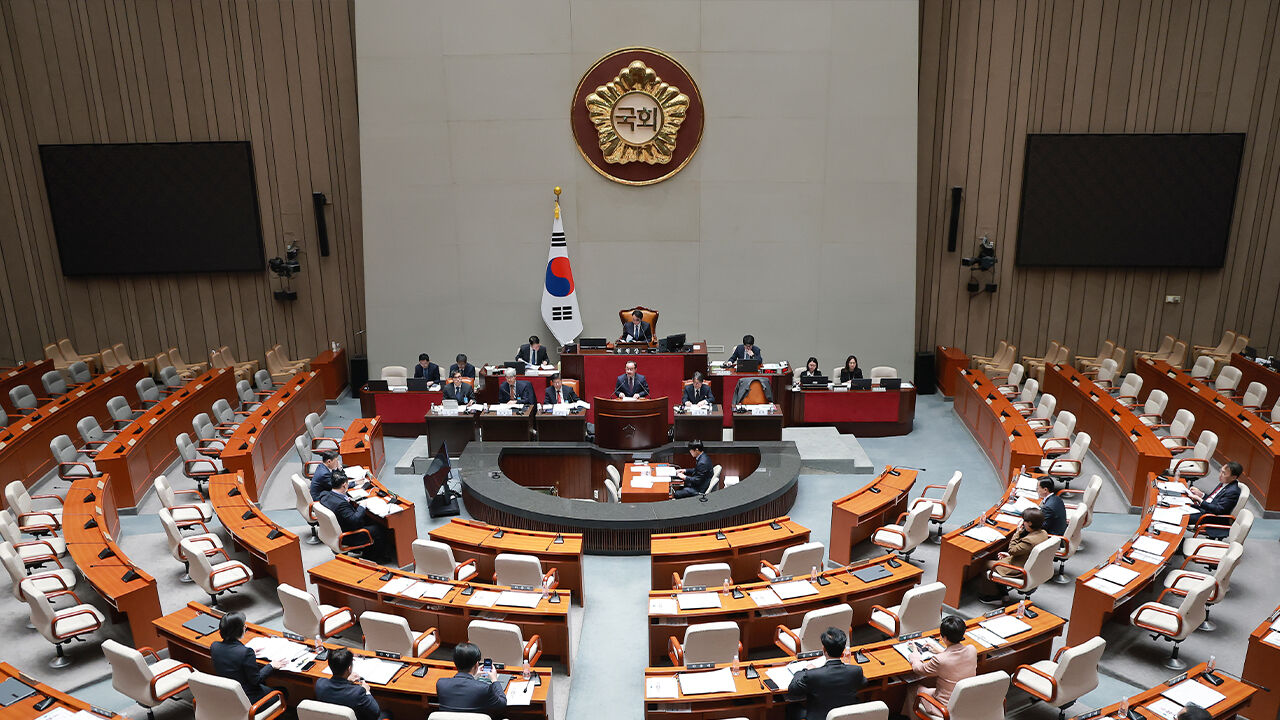
▲ National Assembly's Special Committee on Budget and Accounts
Following the conclusion of their monthlong parliamentary audit, rival parties in the National Assembly are set to enter a fierce budgetary standoff this week as deliberations begin on next year's government budget bill, valued at 820 trillion won.
In particular, intense clashes are expected between the Democratic Party, which aims to preserve the 162 trillion won Future Response Fund as originally proposed, and the People Power Party, which has vowed to push for drastic cuts.
The National Assembly's Special Committee on Budget and Accounts officially launched the review process by holding a public hearing on October 30, following the conclusion of the audit, regarding the 2027 budget bill and fund management plan.
Starting with the government's parliamentary policy speech scheduled for 10 a.m. tomorrow, the budget committee will conduct comprehensive policy questioning on November 4 and 5.
In addition, budget deliberations by individual standing committees will gather momentum, beginning with the Agriculture, Food, Rural Affairs, Oceans and Fisheries Committee on November 5 and the Science, ICT, Broadcasting and Communications Committee on November 6.
From November 9 to 12, two days of department-by-department reviews each will be held for economic and non-economic ministries, followed by the operation of the Budget Adjustment Subcommittee starting November 16.
Once the subcommittee passes the bill, it will be finalized in a full meeting of the Special Committee on Budget and Accounts before moving to the plenary session.
The statutory deadline for the plenary session to process the budget bill is December 2.
The primary battleground in this budget review is the 162.3 trillion won Future Response Fund.
The Democratic Party and the government plan to utilize surplus tax revenues driven by the semiconductor boom to foster future growth industries and strengthen support for youth, regional development, and education.
In contrast, the People Power Party insists that surplus tax revenue must first be used to pay down national debt, making a head-on collision seem inevitable.
The People Power Party aims to eliminate all 104.4 trillion won allocated as surplus reserves in the Future Response Fund to repay debt, while also cutting 26.9 trillion won from individual projects.
Factoring in roughly 3 trillion won in interest savings from debt repayment, the party plans to reduce the budget by a total of 134.3 trillion won.
Meanwhile, attention is focused on whether adjustments will be made amid growing backlash from both ruling and opposition local governments over concerns about reductions in local allocation tax linked to the creation of the Future Response Fund.
The Korea Institute of Local Finance estimated that if tax revenues boosted by the semiconductor boom are first deposited into the Future Response Fund before calculating local allocation taxes, the funding for local allocation taxes could decrease by about 30.5 trillion won.
Ahead of the budget review, tensions between the floor leadership of the rival parties are escalating.
Han Byung-do, floor leader of the Democratic Party, declared at a Supreme Council meeting on October 30, "We will thoroughly secure a budget that protects the people and accelerate legislation on livelihood issues identified during the parliamentary audit."
In response, Jeong Jeom-sig, floor leader of the People Power Party, signaled a strong offensive, stating, "President Lee must use this policy address to declare a break from populist policies that plunder future generations."
(Photo: Yonhap News)
※ Please note: This article was translated by AI and may contain errors.




 Video News
 Video News