
 KOR
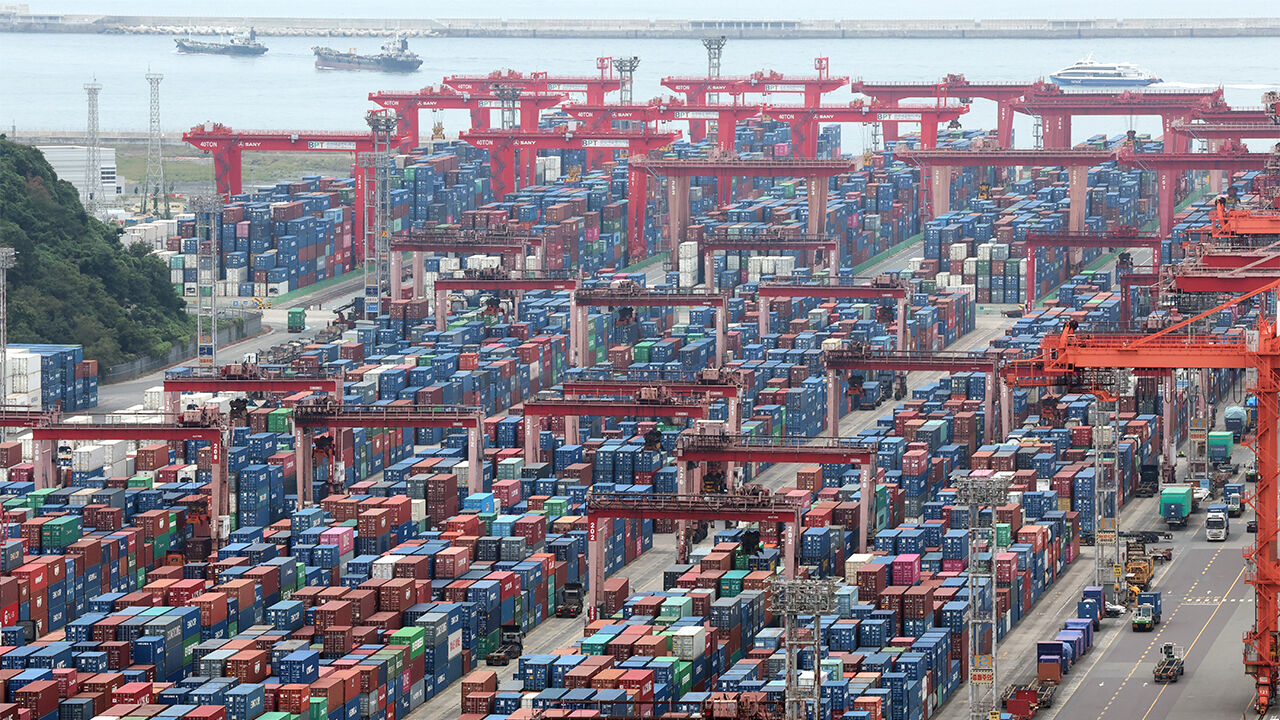
▲ Import and export cargo is piled up at the Sinseondae Pier of Busan Port on the 1st. (Photo: Yonhap News)
Domestic production, consumption, and investment all increased in September, driven by strong semiconductor performance, the end of auto strikes, and the effects of new vehicle releases.
This marks the first "triple rise" in three months since June.
All-industry production recorded its largest increase in 15 years and 6 months.
According to the "September Industrial Activity Trends" released by Statistics Korea today (the 30th), the total industry production index (seasonally adjusted, 2020=100) stood at 122.7 last month, up 3.0% from the previous month.
Last month's growth rate is the largest since March 2011 (3.4%).
The all-industry production growth rate stood at 2.6% in June and 0.1% in July before shrinking and retreating by 1.2% in August, but it quickly rebounded.
Mining and manufacturing production increased by 9.0%.
In particular, manufacturing production led the upward trend with a 9.9% surge.
Manufacturing production also marked its largest increase since February 2009 (10.5%).
Within manufacturing, gains were steep in semiconductors (19.2%) and automobiles (39.9%).
Driven by sustained demand for memory semiconductors, semiconductor production saw its highest increase since February of this year (28.2%).
Automobiles, which experienced a notable decline in August, saw production rise as factory operation rates jumped following the end of strikes and the conclusion of summer holidays.
Auto production also posted its largest increase since March 2020 (46.6%).
The retail sales index, which reflects consumer goods consumption, rose by 3.6%.
The retail sales index increased for the first time in three months since June (2.7%).
The growth rate is the highest in 3 years and 7 months since February 2023 (5.1%).
Sales increased across all categories: durable goods such as passenger cars (4.4%), non-durable goods such as food and beverages (4.2%), and semi-durable goods such as clothing (0.6%).
In particular, passenger car retail sales turned from a 13.3% drop in August to an 18.3% increase in September.
Statistics Korea analyzed this as the combined result of a base effect and new vehicle launches.
Lee Doo-won, Director General for Economic Trends Statistics at Statistics Korea, explained, "The biggest factor [in the increase in retail sales] was the recovery in auto sales," adding, "Sales of non-durable goods like food and beverages expanded due to increased holiday demand, and food sales rose in line with large-scale discount events at supermarkets."
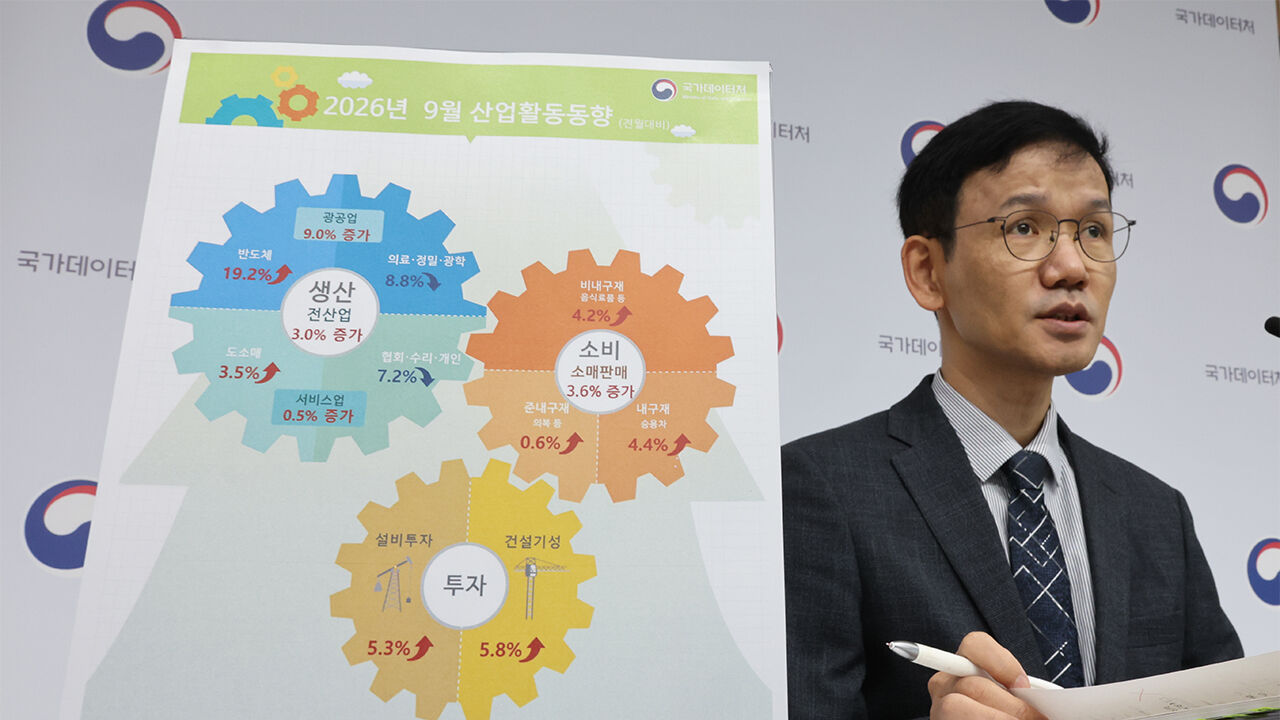
Service industry production, which indicates service consumption, rose by 0.5%.
Facility investment increased by 5.3%.
Facility investment also turned upward, rebounding from a 9.7% decline in the previous month.
Machinery such as electrical equipment and devices (4.7%) and transportation equipment including other transport equipment (7.4%) led the upward trend.
Construction completion (constant), which shows the domestic construction performance of builders, increased by 5.8% from the previous month.
Construction work for buildings (5.1%) and civil engineering (7.4%) both increased across the board.
The cyclical component of the coincident index, which reflects current economic conditions, rose by 0.5 points (p) from the previous month.
The cyclical component of the leading index, which forecasts future economic conditions, fell by 0.1p.
Meanwhile, third-quarter all-industry production increased by 1.9% from the previous quarter, bolstered by favorable conditions in semiconductors and machinery equipment.
All-industry production showed its largest increase since the fourth quarter of 2021 (2.7%).
Mining and manufacturing production increased by 3.9%.
On the other hand, the retail sales index decreased by 1.0%.
The retail sales index followed a downward path for the second consecutive quarter, following the previous quarter (-1.8%).
Facility investment grew by 6.3% as investments in semiconductor manufacturing machinery and other sectors increased.
(Photo: Yonhap News)
※ Please note: This article was translated by AI and may contain errors.


 Video News
 Video News
 Video News
 Video News
 Video News