
 KOR
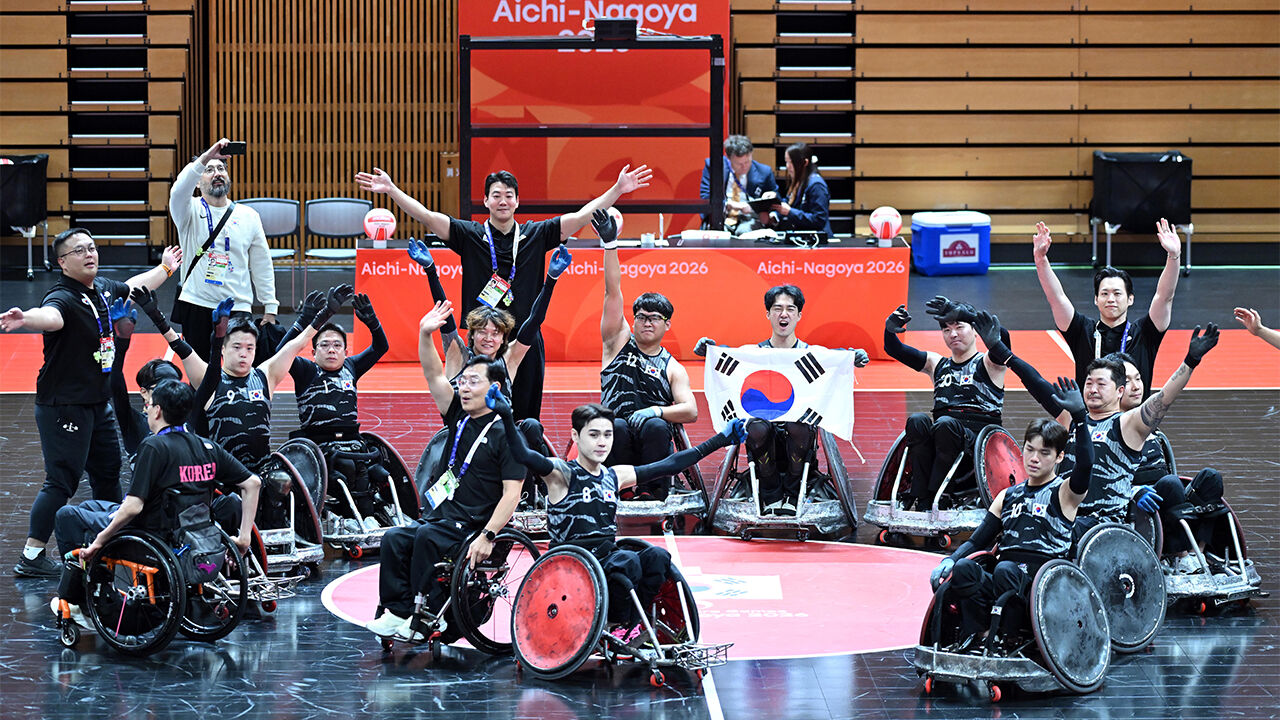
▲ South Korean athletes celebrate and pose for a photo after winning the wheelchair rugby final against Japan at the 2026 Aichi-Nagoya Asian Para Games held at Wing Arena Kariya in Aichi Prefecture, Nagoya, Japan, on the 23rd.
South Korea's national wheelchair rugby team, ranked 16th in the world, has captured its first-ever gold medal in the history of the Asian Para Games by defeating tournament host and world No. 1 Japan.
The national team triumphed over Japan with a score of 53-50 (14-13, 12-13, 14-12, 13-12) in the wheelchair rugby final of the 2026 Aichi-Nagoya Asian Para Games held at Wing Arena Kariya in Aichi Prefecture, Japan, on the 23rd.
Spearheaded by Park Woo-chul (Gyeongbuk Wheelchair Rugby Association) and Lee Sung-hee (Chungbuk Wheelchair Rugby Association), South Korea engaged in a fierce battle against a Japanese side led by Katsuya Hashimoto.
Having finished the first half tied at 26-26, the national team secured a two-point lead in the third quarter. Early in the final fourth quarter, they capitalized on a successful defensive play to widen the gap to four points, maintaining their lead until the very end.
After defeating Japan twice during the preliminary rounds of the tournament, the national team sealed their victory in the final to sweep all three encounters against Japan.
Although they settled for a silver medal after losing to Japan at the Wheelchair Rugby Championship held in Japan last year, they successfully achieved complete redemption in about a year.
In particular, South Korea also washed away the disappointment of taking home the silver medal after losing to Japan in the final of the 2014 Incheon Asian Para Games.
Wheelchair rugby, which first debuted at the Asian Para Games in 2014, returned as an official event for the first time in 12 years at this tournament, and South Korea climbed to the top for the first time.
Wheelchair rugby is a sport where a team of four players scores points when a player in possession of the ball crosses the opponent's goal line.
Players are assigned classifications ranging from 0.5 to 3.5 points based on their physical functions, and the total classification points of the four players on the court generally cannot exceed 8 points.
When a female player takes the court, the team's total allowed limit increases by 0.5 or 1 point depending on the player's classification.
Players with greater physical limitations primarily play roles in blocking opponents or securing attacking routes for teammates, while players with relatively fewer functional limitations lead the offense, making player combinations and teamwork key factors in determining the outcome of a match.
(Photo: Photo Joint Press Corps, Yonhap News)
※ Please note: This article was translated by AI and may contain errors.




 Video News
