
 KOR
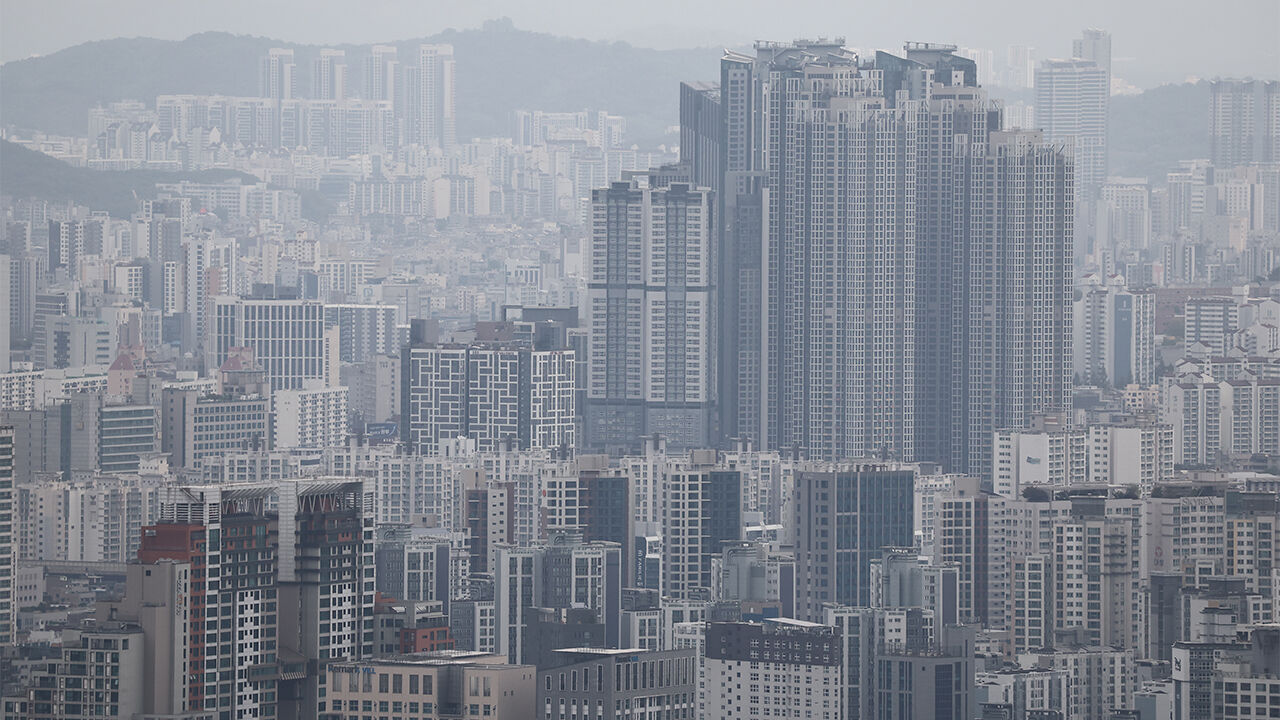
▲ Apartments viewed from Namsan in Seoul
The growth rate of apartment sales prices in Seoul has slowed slightly compared to the previous week.
While the downward trend continued in the Gangnam area, which is affected by policy uncertainties regarding taxation, mid-to-lower tier areas maintained their upward momentum. Preferred areas in southern Gyeonggi Province also remained strong, driving the overall upward trend in the Seoul metropolitan area.
According to the weekly apartment price trend data for the third week of October (as of October 19) released by the Korea Real Estate Board today (the 22nd), apartment sales prices in Seoul rose by an average of 0.13% compared to the previous week.
The growth margin decreased by 0.03 percentage points, contracting for the first time in three weeks.
The Korea Real Estate Board stated, "While downward-adjusted transactions were closed in some regions, prices rose across Seoul as a whole, driven by large-scale complexes, station-area properties, and small-to-medium-sized homes with favorable residential conditions and continuous demand."
The downward trend continued in the Gangnam 3 districts (Seocho, Gangnam, and Songpa districts), where the possibility of increased burdens for holding taxes and capital gains taxes stemming from tax code revisions continued to act as selling pressure.
Seocho District (-0.32%) widened its decline by 0.05 percentage points compared to the previous week, while Gangnam District also fell by 0.31% this week, extending its downward streak to 11 weeks.
Songpa District (-0.13%) also showed a weak trend for the seventh consecutive week.
On the other hand, mid-to-lower tier areas such as Seongbuk District (0.36%), Seodaemun District (0.36%), Jung District (0.35%), Dobong District (0.33%), Jungnang District (0.31%), Gangseo District (0.27%), Gwanak District (0.27%), and Geumcheon District (0.26%) maintained upward trends, although their growth margins contracted somewhat.
In Gyeonggi Province (0.26% to 0.21%), the overall growth rate also narrowed slightly, but southern areas such as Byeongjeom-gu in Hwaseong (0.65%), Dongtan-gu in Hwaseong (0.57%), and Dongan-gu in Anyang (0.56%) still exhibited strong momentum.
As prices in southern Gyeonggi surged significantly, centered around Suwon where Samsung Electronics' in-house housing loan factor is at play, a "catch-up" phenomenon is also occurring in surrounding areas.
Uiwang, which has relatively lower preference, rose 0.47% this week, and Gunpo, a non-regulated area, recorded a high increase of 0.53%.
Nam Hyuk-woo, a real estate analyst at Woori Bank, said, "As the strength of popular residential areas backed by the semiconductor industry in southern Gyeonggi, including Suwon, continues, tenants whose lease terms have expired and homebuyers with lower purchasing power are moving to neighboring areas, causing the price strength phenomenon to spread."
Incheon rose 0.02%, and the Seoul metropolitan area as a whole rose 0.13%.
In non-metropolitan areas (0.01%), the four major metropolitan cities (0.00%) remained flat, while Sejong (0.04%), Jeonnam and Gwangju (0.03%), and seven provinces (0.01%) saw increases.
Nationwide sales prices rose by an average of 0.08%.
The nationwide apartment jeonse (lump-sum lease) prices rose by an average of 0.11% compared to the previous week.
In Seoul, prices increased by 0.16%, centered around large-scale complexes and station areas with solid jeonse demand.
Seocho District (-0.10%), affected by incoming supplies of large-scale complexes, fell for the 10th consecutive week, while Gangnam District (0.12%) turned to an upward trend for the first time in eight weeks.
Mid-to-lower tier areas continued their upward momentum, including Seongbuk District (0.36%), Nowon District (0.31%), Dobong District (0.28%), Jungnang District (0.27%), Geumcheon District (0.27%), Seodaemun District (0.24%), and Gwanak District (0.21%).
In Gyeonggi Province (0.18%), high growth rates were observed in areas such as Dongtan-gu in Hwaseong (0.57%), Sujeong-gu in Seongnam (0.50%), and Yeongtong-gu in Suwon (0.39%).
Incheon rose 0.13%, and the overall metropolitan area increased by 0.17%.
Non-metropolitan jeonse prices rose by an average of 0.05%.
The four major metropolitan cities rose 0.06%, Sejong 0.27%, Jeonnam and Gwangju 0.02%, and seven provinces 0.03%, respectively.
(Photo: Yonhap News)
※ Please note: This article was translated by AI and may contain errors.


 Video News
 Video News
 Video News
 Video News
 Video News