
 KOR
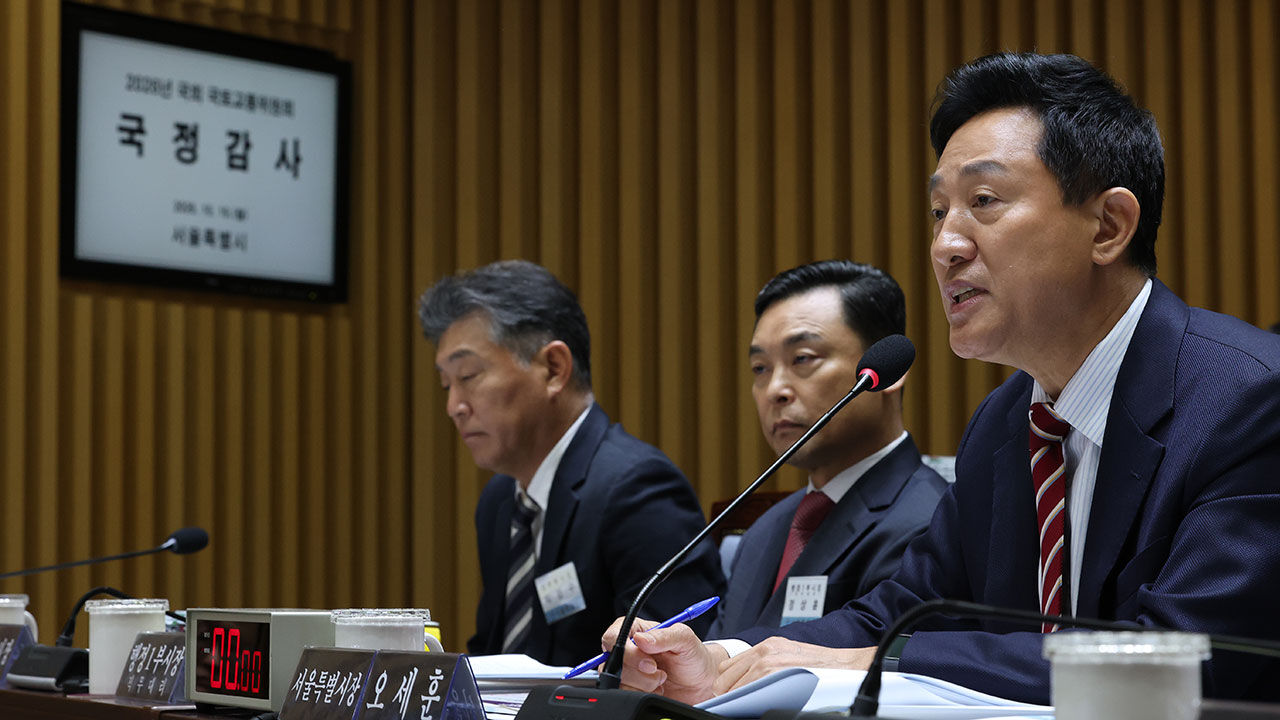
▲ Seoul Mayor Oh Se-hoon answers questions from lawmakers during a parliamentary audit of the Seoul Metropolitan Government by the National Assembly's Land, Infrastructure and Transport Committee at Seoul City Hall on October 19.
Seoul Mayor Oh Se-hoon projected that housing prices in Seoul are highly likely to maintain an upward trend through the end of this year or early next year.
Mayor Oh made the remarks during a parliamentary audit conducted by the National Assembly's Land, Infrastructure and Transport Committee at the Seoul Metropolitan Government, in response to a question from People Power Party lawmaker Um Tae-young regarding government officials' forecasts for housing market stabilization.
"The general consensus among real estate experts is that rather than a probability of housing prices dropping by the end of the year or early next year, it is more likely that they will continue on an upward trajectory," Oh said.
"Jeonse [lump-sum housing deposits] supplies are currently depleted in Seoul, and both jeonse and monthly rent prices are rising," Oh analyzed. "Even people who do not necessarily need to buy a home are joining in on speculative demand out of a desperate sense of urgency that they must purchase one now."
He added, "The upward trend in apartment prices in outer areas of Seoul's northeastern and southwestern regions will be difficult to curb for the time being."
Mayor Oh repeatedly emphasized the severity of the jeonse and monthly rent crunch during a Q&A session with People Power Party lawmaker Chung Dong-man.
"In the case of Seoul's northeastern and southwestern regions, jeonse supplies have not just decreased by 10 to 20 percent, but by 70 to 80 percent," Oh said, adding, "The suffering of ordinary citizens has reached its peak."
He urged the government to shift its policy stance, stating, "As long as the current jeonse and monthly rent crisis persists, increases in housing purchase prices in Seoul's outer districts are a foregone conclusion."
Mayor Oh particularly expressed concern that the government's regulations on multi-home owners and policies centered on owner-occupancy could dampen the supply of rental housing.
"Another name for a multi-home owner can be a private rental business operator," he explained. "While there are people who hold multiple homes for speculative purposes, those units are being provided to citizens in the form of rentals such as jeonse."
He added, "Many experts are gravely concerned about whether the jeonse and monthly rent crises can be resolved if policies continue to focus heavily on owner-occupancy," and said, "I hope President Lee Jae-myung will make a paradigm shift and thoroughly deliberate on the policy direction."
He further emphasized, "We must move away from a policy stance obsessed with owner-occupancy and come up with measures to resolve the jeonse and monthly rent crunch to the extent that it stimulates housing purchase prices."
During the audit, a clash also broke out between Democratic Party lawmakers and Mayor Oh over responsibility for housing supply shortages and rising home prices.
Democratic Party lawmaker Chang Jong-tae pointed out that before and after Mayor Oh took office, the monthly average completion volume increased by 11.5 percent in the three southern Gangnam districts, while dropping by 43 percent in the remaining 22 autonomous districts.
Lawmaker Chang criticized, "You claim the increase in completions in Gangnam as your own achievement while blaming the previous mayor for the decrease in areas outside Gangnam," adding, "If everything ruined is Park Won-soon's fault and everything that needs help is the government's responsibility, what is the Seoul Metropolitan Government going to do?"
He also criticized the Seoul Metropolitan Government's decision in February of last year to lift land transaction permission zones in areas including Jamsil, Samsung, Daechi, and Cheongdam, only to reverse it 35 days later, calling it a policy failure that ignored warning signs in the real estate market.
In response, Mayor Oh countered that reports had emerged at the time indicating the housing market was in a slump and that regulatory easing was necessary.
Regarding the decline in housing supply, he argued that it was the aftermath of past policies, stating, "During Mayor Park Won-soon's tenure, 389 redevelopment and reconstruction maintenance zones were forcibly lifted, causing about 430,000 housing units of supply to vanish."
He stressed, "It takes two to five years just for pre-approval procedures such as zone designation and association establishment in maintenance projects," and added, "It is wrong to view the decline in approval volumes as a result of the Seoul Metropolitan Government neglecting its duties."
Mayor Oh also stated his position that the government must actively cooperate in supplying housing through redevelopment and reconstruction.
In response to a question from People Power Party lawmaker Shin Sung-범, he said, "Usable land in Seoul is depleted, and about two-thirds of new housing supply is achieved through redevelopment and reconstruction. You cannot solve Seoul's housing shortage while ignoring this aspect."
Regarding a proposal by People Power Party lawmaker Um Tae-young to convert suspended semi-industrial zone knowledge industry center sites into residential use to additionally supply 20,000 to 30,000 units, Mayor Oh stated that he plans to meet with the Minister of Land, Infrastructure and Transport soon to discuss related measures.
(Photo: Yonhap News)
※ Please note: This article was translated by AI and may contain errors.


 Video News
 Video News
 Video News
 Video News
 Video News