
 KOR
KOR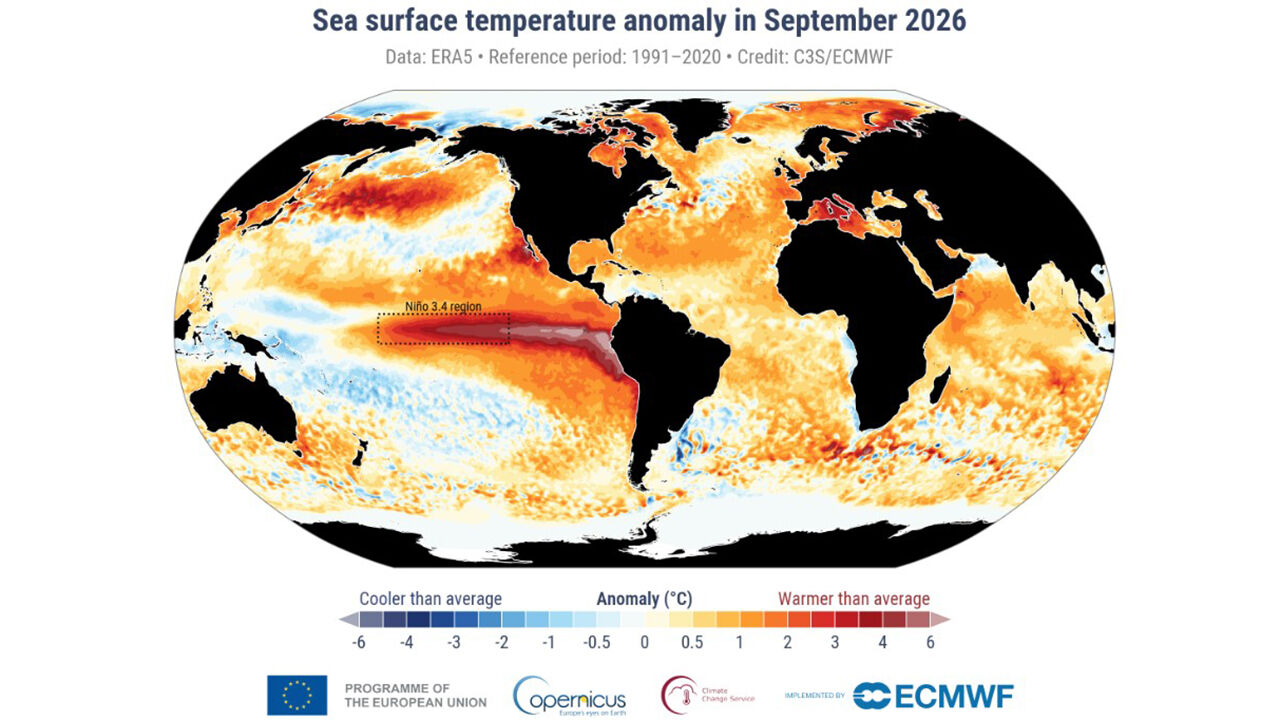
▲ Deviation of average sea surface temperature from normal in September 2026
As the El Niño phenomenon intensifies, the average sea surface temperature in the observation zone used as its benchmark hit a record high last month, the Copernicus Climate Change Service (C3S) announced on the 12th local time.
According to C3S announcements reported by AFP, the average sea surface temperature in September 2026 for the central and eastern equatorial Pacific region known as the "Niño 3.4 zone" (5 degrees south to 5 degrees north, 170 degrees west to 120 degrees west) reached 29.70 degrees Celsius, the highest ever recorded.
C3S explained that this is higher than the monthly average peaks during the periods of 1982 to 1983, 1997 to 1998, and 2015 to 2016, when El Niño was exceptionally strong, demonstrating that the currently ongoing El Niño is unusually powerful.
However, C3S stated that it cannot yet be asserted whether the ongoing El Niño is the strongest on record.
C3S explained that because climate change raises ocean temperatures, recent El Niño events can sometimes appear stronger than past ones, complicating historical comparisons.
The intensity of El Niño is indicated not by the average sea surface temperature itself in the Niño 3.4 zone at a specific time or in a specific month, but by the "anomaly," which shows how much higher this average temperature is compared to the normal period (currently the 1991 to 2020 average).
However, detailed criteria for determination vary by institution.
C3S, the European Union's climate monitoring agency, stated that according to a new index adopted by the agency reflecting warming in tropical oceans and other factors, results indicate that the ongoing El Niño is not necessarily the strongest on record.
Nevertheless, C3S told AFP that the observation value for September of this year shows "an already exceptionally strong El Niño," and this is especially true "considering that [this El Niño] has not yet reached its peak."
Previously, the Japan Meteorological Agency announced on the 9th that El Niño had reached "the strongest intensity on record" according to its criteria, reporting that the anomaly of the average sea surface temperature in the Niño 3.4 zone compared to normal reached plus 4.0 degrees Celsius last month.
This is the highest ever recorded since record-keeping began in 1949, surpassing the previous record of plus 3.6 degrees Celsius in December 1997.
According to C3S, the global average sea surface temperature last month was a record-high 21.05 degrees Celsius.
The previous monthly average record was 20.92 degrees Celsius in September 2003.
Overall, the global average surface temperature last month was 16.27 degrees Celsius, ranking as the second highest on record, with an anomaly of plus 1.63 degrees Celsius compared to the pre-industrial average (1850 to 1900).
Experts warn that due to the currently ongoing strong El Niño, global average temperatures in 2027 are highly likely to break records once again.
El Niño generally occurs on a cycle of 2 to 7 years, and its duration typically lasts 9 to 12 months.
(Photo: C3S website capture, Yonhap News)
※ Please note: This article was translated by AI and may contain errors.




