
 KOR
KOR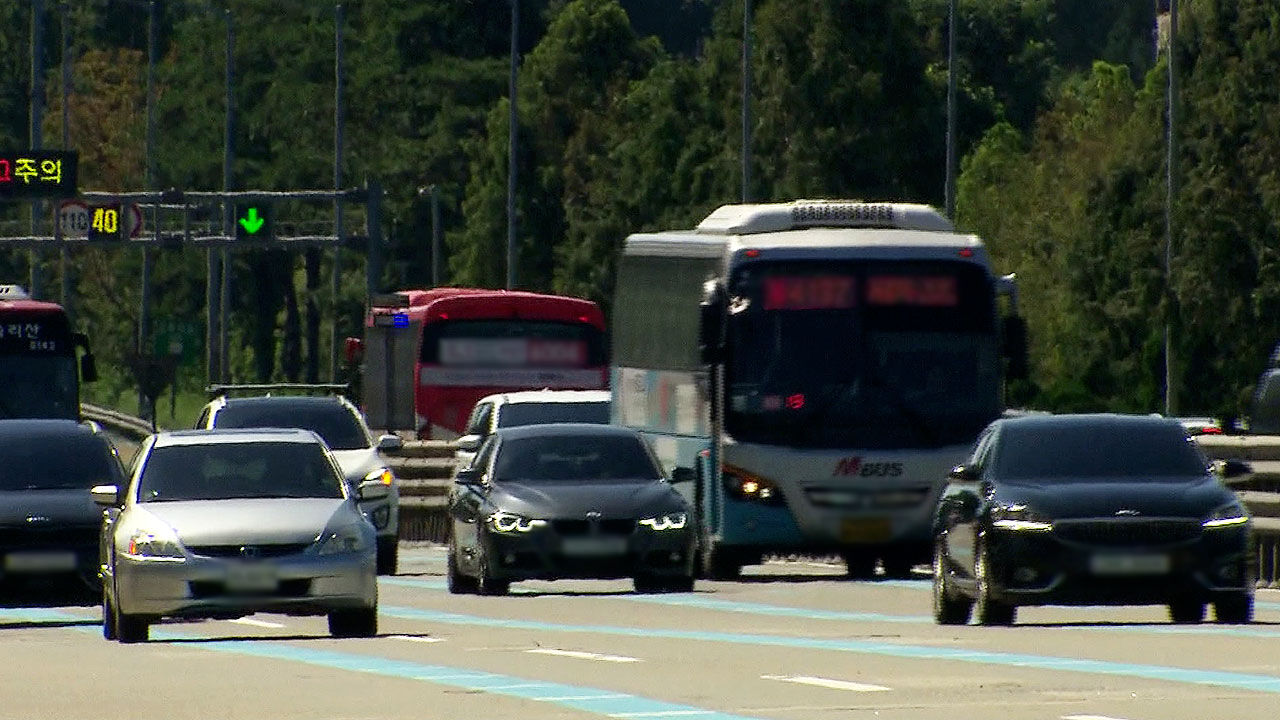
▲ Highway congestion during Hangeul Day holiday
Traffic congestion built up in various sections of expressways heading toward Seoul on the afternoon of the 11th, the final day of the Hangeul Day holiday.
However, the situation is not as severe as during the previous Chuseok holiday.
According to the Korea Expressway Corporation, as of 4:00 PM, the estimated travel times from major cities nationwide to the Seoul Tollgate are 5 hours from Busan, 4 hours and 40 minutes from Ulsan, 4 hours and 20 minutes from Mokpo, 4 hours and 10 minutes from Gwangju, 4 hours from Daegu, and 2 hours and 30 minutes from Daejeon.
Conversely, the travel times from Seoul to each city are 4 hours and 40 minutes to Busan, 4 hours and 20 minutes to Ulsan, 3 hours and 40 minutes to Mokpo, 3 hours and 40 minutes to Daegu, 3 hours and 20 minutes to Gwangju, and 1 hour and 40 minutes to Daejeon.
Compared to around 9:00 AM, the travel times to Seoul from each city have increased by about 10 minutes.
The corporation previously projected that congestion would peak around 4:00 PM today, but estimated travel times have not surged drastically.
However, as of 4:00 PM today, a heavy volume of vehicles traveling from the east coast toward Seoul has caused severe congestion in those sections.
As of 4:00 PM, traveling from Gangneung to the Seoul Tollgate takes 4 hours and 50 minutes, which is expected to take over two hours longer than the 2 hours and 40 minutes required in the opposite direction toward Gangneung.
The travel time from Yangyang to Namyangju has also increased to 3 hours and 50 minutes.
On the other hand, the travel time from Namyangju to Yangyang is estimated at 1 hour and 50 minutes, which is about half that.
Major congested sections heading toward Seoul include a 14-kilometer stretch on the Gyeongbu Expressway from Oksan to Cheongju Rest Area, a 15-kilometer stretch on the Seoul-Yangyang Expressway from near Seorak to near Hwado, and an 18-kilometer stretch on the Seohaean Expressway from Dangjin to near Poseung Junction.
The corporation projected that 4.81 million vehicles will be in transit nationwide today.
It is estimated that 360,000 vehicles will move from the metropolitan area to provincial regions, and 480,000 vehicles from provincial regions to the metropolitan area.
While traffic toward provincial regions is generally flowing smoothly, traffic heading toward Seoul is expected to remain congested to some degree until late afternoon.
As numerous vehicles return home one after another, congestion has also appeared on major roads in downtown Seoul since the afternoon.
According to the Seoul Transport Operation and Information Service (TOPIS), inbound traffic on Gangbyeonbuk-ro is congested overall from the north end of Hangang Bridge to the north ends of Wonhyo, Mapo, Seogang, Yanghwa, and Seongsan bridges.
Outbound traffic is also moving slowly around Gayang Bridge and from Wonhyo Bridge to Hangang Bridge.
Olympic-daero is likewise experiencing congestion on inbound sections from the south end of Yeongdong Bridge to the south ends of Seongsu, Dongho, and Hannam bridges.
Outbound traffic is relatively smooth.
※ Please note: This article was translated by AI and may contain errors.




 Video News