
 KOR
KOR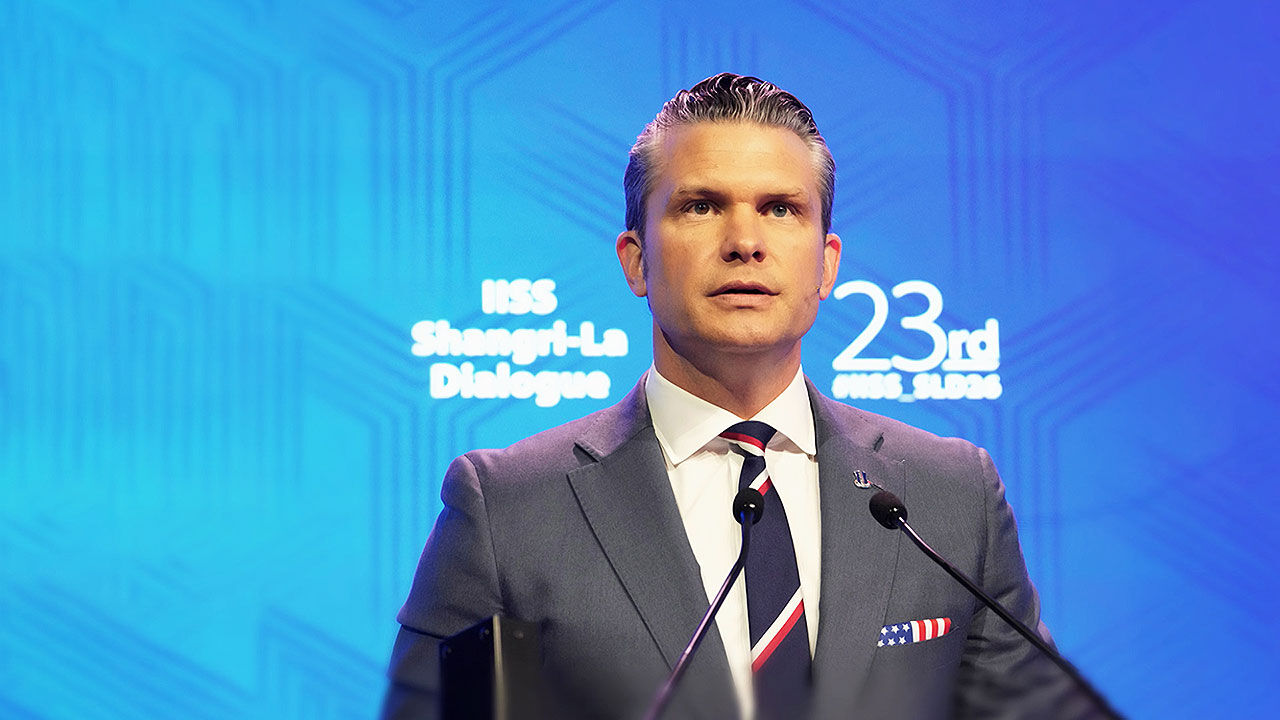
▲ U.S. Secretary of Defense Pete Hegseth
The United States, the United Kingdom, and Australia have embarked on a cooperative effort to develop unmanned underwater vehicles (UUVs) as part of the AUKUS security pact.
U.S. Secretary of Defense Pete Hegseth, UK Secretary of State for Defence John Healey, and Australian Deputy Prime Minister and Minister for Defence Richard Marles held a joint press conference on September 30 (local time) on the sidelines of the Shangri-La Dialogue security summit in Singapore to announce the plan.
"This critical project will deliver highly adaptable, multi-mission UUV payloads designed to support subsurface operations and maintain our collective advantage in the maritime domain," Secretary Hegseth stated.
Secretary Healey said, "This will enable us to rapidly field the most advanced battlefield technology to our forces by jointly developing state-of-the-art sensors and weapon systems for underwater drones."
He added, "In AUKUS, for too long, we have talked too much and acted too little."
Formed by the three nations in 2021, AUKUS consists of two main pillars: "Pillar 1," which involves the joint development of nuclear-powered submarines, and "Pillar 2," which aims to develop advanced defense technologies such as artificial intelligence, quantum computing, underwater capabilities, hypersonics, and cyber technology.
This UUV project falls under Pillar 2.
Previously, last year, the second Donald Trump administration reviewed the AUKUS agreement signed during the preceding Joe Biden administration before deciding to maintain it.
Accordingly, starting next year, the U.S. military is scheduled to deploy Virginia-class nuclear-powered attack submarines (SSNs) to Australia, and in the early 2030s, Australia plans to acquire Virginia-class submarines from the United States.
In addition, the UK and Australia plan to jointly develop the AUKUS-class nuclear-powered attack submarines incorporating U.S. advanced technology, building them in their respective domestic shipyards. The first submarines are slated to be delivered to the UK in the late 2030s and to Australia in the early 2040s.
To this end, the Australian government has decided to initially invest 3.9 billion Australian dollars (approximately 4.22 trillion KRW) in Osborne, near Adelaide in South Australia (SA), to construct facilities for building AUKUS-class nuclear submarines for the Australian military.
The U.S. Department of Defense approved the establishment of a naval organization this month to support Submarine Rotational Force-West (SRF-West) in Western Australia, and starting late this year, the first U.S. Navy personnel are scheduled to be rotationally deployed to HMAS Stirling in Perth, Western Australia (WA).
Over the next decade, 12 billion Australian dollars (approximately 12.3 trillion KRW) is planned to be invested around this base to establish an AUKUS nuclear submarine maintenance and repair complex.
In a joint statement, the three defense ministers evaluated that "SRF-West will directly support submarine deployment and accelerate Australia's readiness to possess, operate, maintain, and regulate its own sovereign conventionally armed, nuclear-powered submarine capability."
Separately from AUKUS, Australia is also investing 1.7 billion Australian dollars (approximately 1.84 trillion KRW) to advance the development and acquisition of "Ghost Shark," a large reconnaissance and strike UUV capable of long-range autonomous navigation and operations.
※ Please note: This article was translated by AI and may contain errors.


 Video News

 Video News
 Video News
 Video News