
 KOR
KOR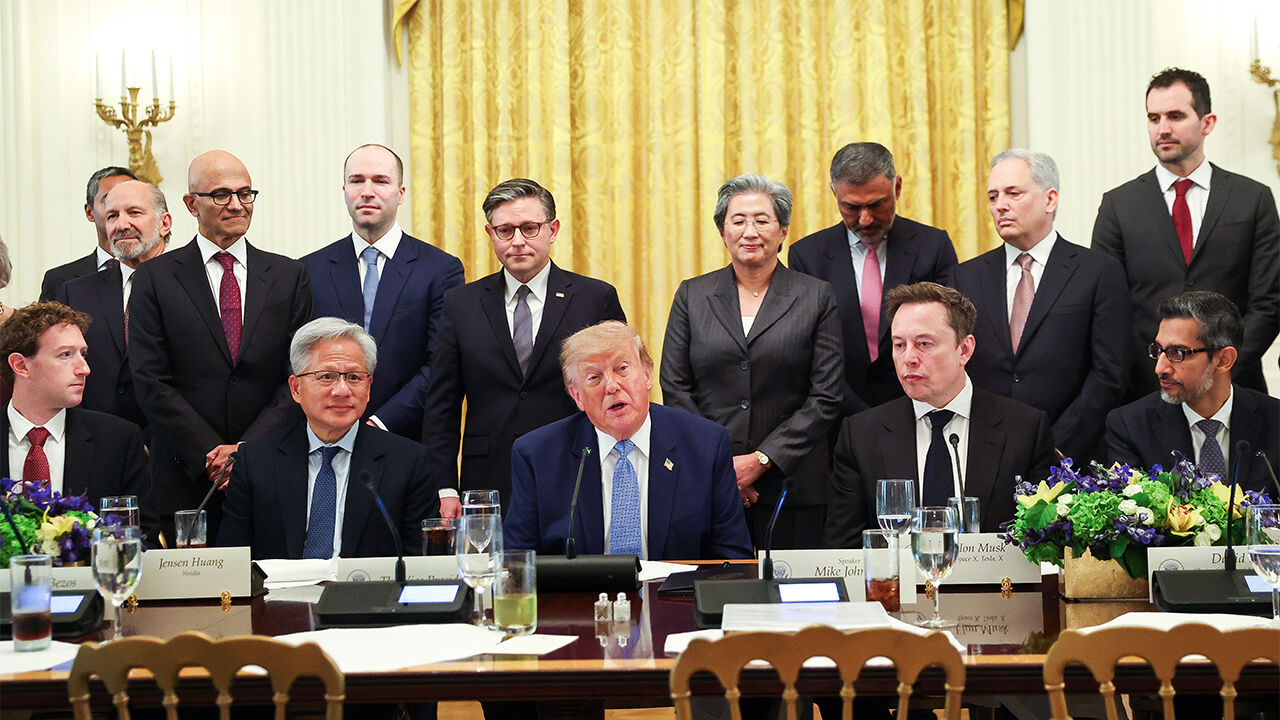
▲ U.S. President Donald Trump and heads of major AI companies at a luncheon
U.S. President Donald Trump has drawn the line against introducing new government or congressional regulations despite warnings over the potential emergence of artificial intelligence (AI) completely beyond human control, opting instead for industry "self-regulation."
Speaking to reporters during a luncheon with chief executive officers (CEOs) of major U.S. AI companies at the White House on the 29th (local time), President Trump said, "I believe there has to be a tremendous level of self-regulation."
He continued, "Regulation happens automatically through the Department of Justice, the FBI, and other means, but self-regulation is very important."
President Trump's remarks are interpreted as signaling that during the luncheon, a consensus was reached that AI can be controlled solely through industry self-regulation, despite concerns and demands from some quarters to curb the rapid pace of development through federal regulations alongside scenarios of human extinction caused by AI.
The intention is that humanity can be protected from the potential risks posed by AI when existing laws are enforced by the government to punish violators, combined with industry self-regulation.
Bloomberg reported, "President Trump dismissed the prospect of introducing new federal regulations after meeting with industry CEOs at the White House, amid growing global concerns over the threats posed by AI technology."
President Trump said on this day, "In a little while, we're going to put out a statement that summarizes some of the things that we've done."
Later, President Trump released a document titled the "White House Superintelligence Agreement," featuring a "Joint Commitment on Frontier Responsibility," via the social media platform Truth Social.
The second page of this document contains the signatures of President Trump, Google CEO Sundar Pichai, Anthropic CEO Dario Amodei, Meta CEO Mark Zuckerberg, OpenAI President Greg Brockman, and SpaceX AI CEO Elon Musk.
The agreement states, "To build a positive future for Americans and the world, we believe that all companies have a responsibility to develop their technology safely and in a way that builds customer and public trust."
It continues, "This begins with all companies that train and deploy frontier models having robust internal processes and controls to ensure that technology performs as intended, and to quickly identify and resolve issues," while committing to the introduction of four control and auditing systems.
First, participating companies decided to establish robust internal controls during the model training and deployment process across areas such as cyber and bio-security, and chemical threats, to monitor model capabilities and alignment, and to prevent models from hacking or accessing technological systems in unintended ways.
In addition, they agreed to strengthen the capabilities of internal teams to verify that all controls, monitoring, and detection operate as intended and to resolve any issues, while cooperating with independent external auditors or evaluators to assess whether these controls function properly.
Finally, to review and receive reports from internal control teams, external auditors, and evaluators to ensure that issues are identified and remediated, they decided to designate an independent committee under the board of directors.
The agreement stated, "These measures will give companies, their customers, and the public confidence that the technology operates as intended," adding, "Participating companies will meet regularly to develop standards and best practices for improving system safety."
In particular, it added, "Over time, it may make sense to codify these steps into laws or regulations. Regardless of whether these measures become legal obligations, we believe implementing these controls and audits is crucial to ensuring a safe future for everyone."
In addition, regarding the construction of AI data centers, which has led to accumulating voter grievances ahead of the midterm elections, President Trump stated, "We will work with local communities and try to make sure they are happy," and added, "Data centers are going to be very popular."
President Trump previewed that he would sign an executive order changing the term "artificial intelligence" to "superintelligence" at around 5 p.m. Eastern Time on this day.
A large number of major AI company heads attended the luncheon.
When President Trump spoke to the press, NVIDIA CEO Jensen Huang sat to his right, CEO Musk sat to his left, and U.S. House Speaker Mike Johnson and AMD CEO Lisa Su stood behind them.
Also in attendance were CEO Amodei, who first publicized the need to slow down AI development, along with CEO Zuckerberg, President Brockman, CEO Pichai, and Amazon founder Jeff Bezos.
(Photo: Getty Images)
※ Please note: This article was translated by AI and may contain errors.


 Video News


 Video News
 Video News