
 KOR
KOR!['Seoul to Busan in 7.5 Hours': Who Predicted It and How? [Reporter's Notebook]](https://img.sbs.co.kr/newimg/news/20260919/202224009_1280.jpg)
First, the general approach utilizes "big data." It makes use of past records. To forecast this year's Chuseok traffic volume, they first look for past holiday periods with similar patterns.
Analysis Based on Traffic Volume Data from Past Similar Holidays
This year's holiday period is relatively short at four days, whereas last year it was around 10 days, right? Because traffic flow varies depending on whether traffic volume is dispersed or concentrated, they first examine the traffic volume data and trends of years with similar holiday patterns.
Another important factor is weather conditions. Typically, because the Expressway Corporation must submit these forecast data to the Ministry of Land, Infrastructure and Transport about a month in advance, it is set based on "clear days." Therefore, the method involves finding past dates with clear weather and similar holiday periods, and then examining the traffic volume and travel times from back then.
The Clue is the "Median Value"… Including Rest Stop Times
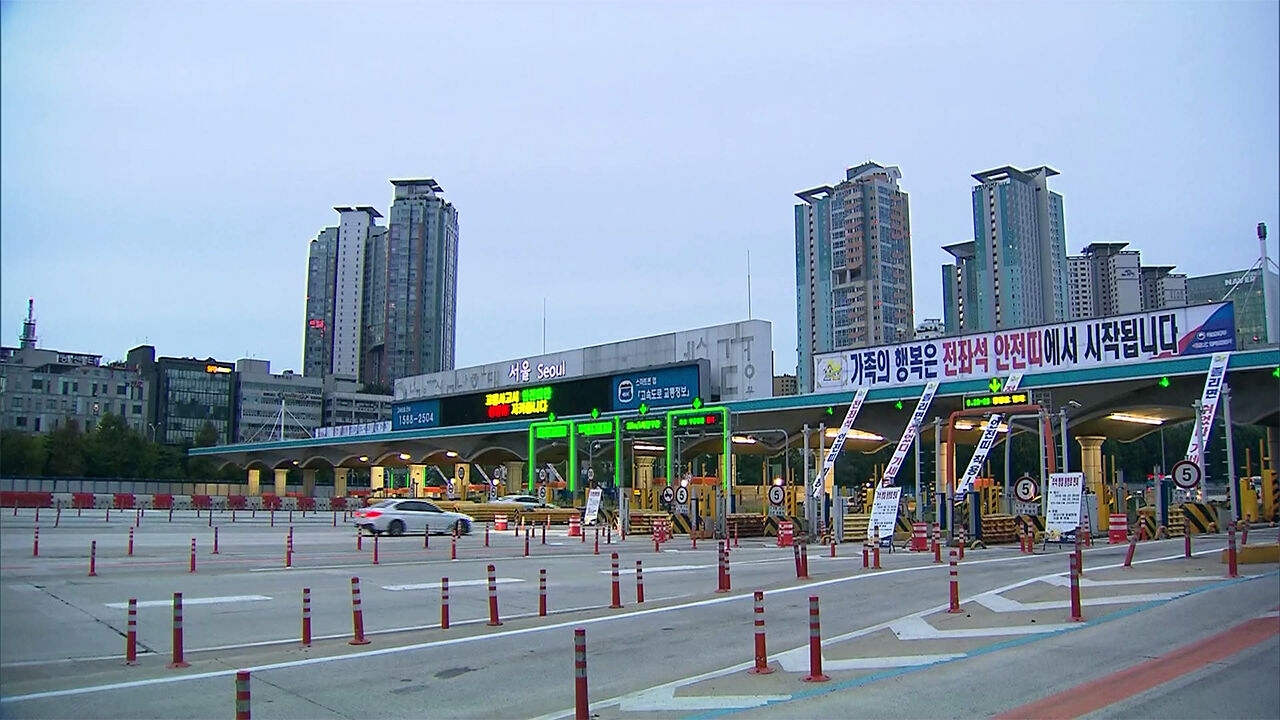
Then how exactly is the travel time from Seoul Tollgate to Busan Tollgate calculated?
It surely cannot be by attaching speedometers to specific vehicles, nor would it be by taking a simple average. The clue was the "median value."
For example, if there are 50 vehicles that traveled from Seoul to Busan at 9:00 AM, the departure and arrival times of each vehicle are recorded at the tollgates. The travel time for each respective vehicle is thus obtained. At this point, the travel times are lined up in order from the vehicle that took the longest to the one that arrived the fastest, and the value right in the middle—namely the median value—is used to calculate the travel time. The reason for using the median value is to reduce the impact of extreme values, such as vehicles that arrived unusually quickly or took an exceptionally long time, and to represent the traffic flow of that specific time band. Based on this data, the estimated arrival times for tollgates in each region are derived.
Of course, current conditions of the day are also reflected. Forecasters at the Expressway Corporation forecasting office calculate traffic volume and congestion conditions of the day through an automated prediction algorithm to produce additional congestion times, and so forth. Based on this, the predicted travel times are announced hourly on the Expressway Corporation website.
You might also be curious about the differences from navigation systems. The biggest difference from the predicted times announced by the Expressway Corporation is whether "rest stop times" are reflected. As explained earlier, because the past data utilized by the Expressway Corporation lines up the actual travel times of vehicles to extract the median value, it is a value that reflects all rest stop usage times, accidents, and congestion situations of vehicles during that time slot. It is reportedly not a method of separately adding or subtracting rest stop times.
Relatively Short Holiday… Traffic Volume Expected to Peak on Chuseok Day
As this holiday period is relatively short, those traveling by car are likely concerned about congestion. The Korea Expressway Corporation announced that a daily average of 6.05 million vehicles are expected to be on the move during this Chuseok holiday period. This is an 11.8% increase compared to last year's 5.41 million vehicles. In particular, Chuseok Day (the 25th) is forecasted to see the highest traffic volume at 6.84 million vehicles. The most congested return trip to hometowns is forecasted for Thursday (the 24th) morning, and the trip back for Friday (the 25th) afternoon, so avoiding these times could be a good strategy. Expressway tolls will be waived for four days from the 24th to the 27th.
※ Please note: This article was translated by AI and may contain errors.


 Video News

 Video News
 Video News
