
 KOR
KOR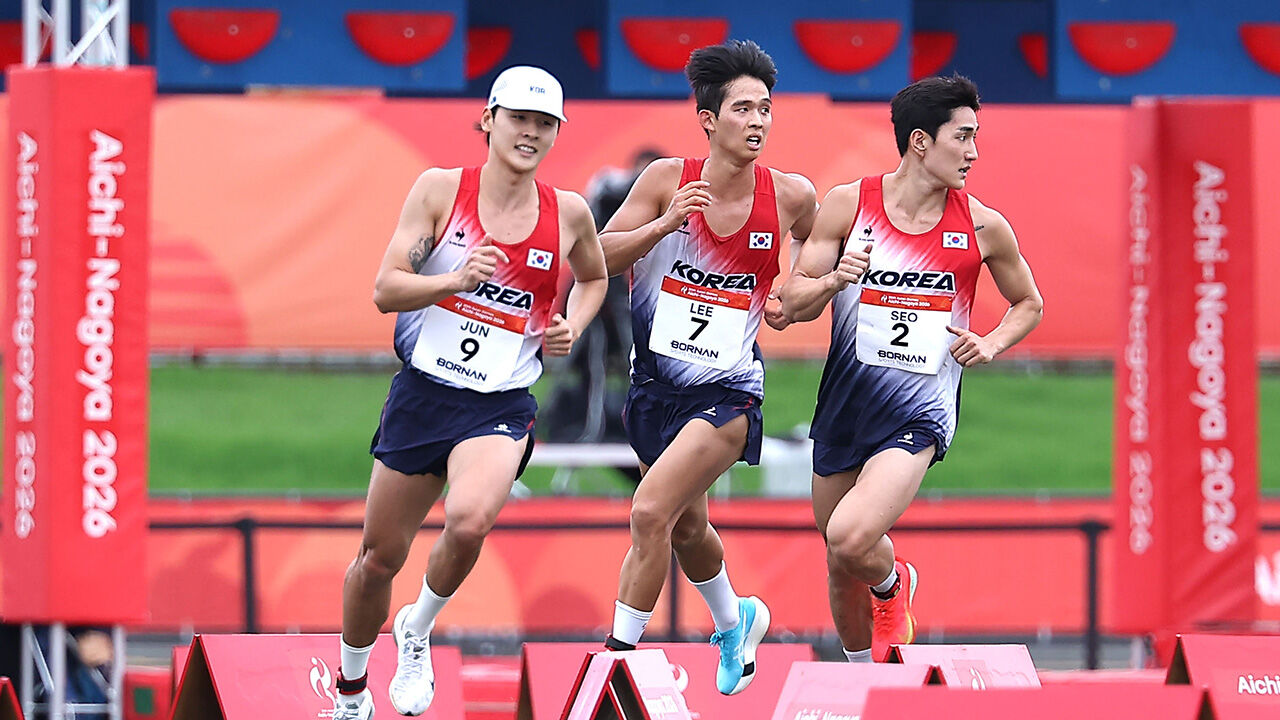
▲ South Korea's Jeon Woong-tae (from left), Lee Jong-hyun, and Seo Chang-wan race during the laser run event of the men's individual final in modern pentathlon at the 2026 Aichi-Nagoya Asian Games at Anjo Sports Park in Aichi Prefecture, Japan, on the 20th. (Photo: Yonhap News)
The South Korean men's modern pentathlon team captured the nation's second gold medal of the 2026 Aichi-Nagoya Asian Games in the team event.
Jeon Woong-tae (Gangwon State Council), Lee Jong-hyun (Daejeon Metropolitan City Hall), and Seo Chang-wan (South Jeolla Provincial Office) claimed victory with a combined total of 4,779 points across the individual fencing, swimming, obstacle, and laser run (running plus shooting) events at the Anjo Sports Park in Aichi Prefecture, Japan, on the 20th.
This marks South Korea's second gold medal of the Games, following Seong Seung-min (Korea National Sport University) earlier in the day in the women's individual modern pentathlon.
South Korea successfully defended its men's team title in modern pentathlon for the second consecutive time, following the 2022 Hangzhou Games held in 2023 (featuring Jeon Woong-tae, Jung Jin-hwa, and Lee Ji-hun).
With both the individual and team finals held on the same day, 18 athletes who advanced through the semifinals competed for individual medals, while team rankings were determined by combining the scores of the top three athletes from each country in the individual standings.
In the individual event, veteran Jeon Woong-tae secured the silver medal with 1,595 points behind China's Li Liuchang (1,598 points), while Lee Jong-hyun claimed the bronze with 1,593 points.
Seo Chang-wan finished fifth with 1,591 points, propelling South Korea past China (4,768 points) to the top of the podium in the combined team standings.
Although Jeon's bid for a third consecutive Asian Games individual title following Jakarta and Hangzhou fell short—having won the previous two—he demonstrated his resilience even after horse riding was replaced by the obstacle event in modern pentathlon, leading the team to victory. Meanwhile, Lee Jong-hyun picked up two medals in his first Asian Games appearance.
In fencing, conducted as an épée 16-round robin tournament where the first to score five points within a minute or score the most hits wins, Seo Chang-wan achieved the best performance among South Koreans, ranking third overall with 238 points.
Jeon Woong-tae struggled in the fencing round of 16, getting eliminated and finishing 9th overall with 218 points. Combined with an 11th-place finish in the obstacle event (366 points), his intermediate ranking dropped outside the top 10.
Jeon bounced back in swimming by finishing fourth overall (55.23 seconds, 324 points) to lift his intermediate ranking to ninth. However, his overall ninth-place standing after three events meant he had to start the laser run—where starting times are staggered based on points—a massive 35 seconds behind the leader.
Instead, Seo Chang-wan held second place after the first three events, starting just five seconds behind leader Ma Yiyang of China, making his prospects for a strong individual finish much brighter.
Seo surged to the front from the middle phase and appeared to widen the gap against chasing competitors, but suffered leg cramps and hyperventilation toward the end, failing to maintain his momentum.
This led to a fierce battle between South Korean and Chinese athletes. The experienced Jeon Woong-tae crossed the finish line first among the South Koreans, followed closely by Lee Jong-hyun, completing the team's "golden dash."
The competition was so tight that South Korean and Chinese athletes swept the top six positions in the individual event. Confusion briefly arose when a groundless rumor spread through the venue after the athletes finished their mixed-zone interviews, claiming that China had won. However, the final results were quickly sorted out, allowing the South Korean delegation to celebrate their gold medal freely.
Operational flaws continued to surface even after the awarding ceremony, as the organizing committee's information website incorrectly listed Seo Chang-wan as the silver medalist and Kim Young-ha (who finished 12th in the individual event) as the bronze medalist in the men's individual medal tally.
During the team medal ceremony, the venue announcer introduced the champion team South Korea as the "Republic of China" before hastily correcting it to "Korea."
South Korean modern pentathlon proved its enduring strength in the "obstacle era" as Seong Seung-min became the first South Korean female athlete to win gold in the women's individual event earlier in the day, followed by a team silver medal shared with Kim Eun-ju (Gangwon State Council) and Shin Su-min (LH), alongside a gold, silver, and bronze haul from the men's division.
※ Please note: This article was translated by AI and may contain errors.




 Video News