
 KOR
KOR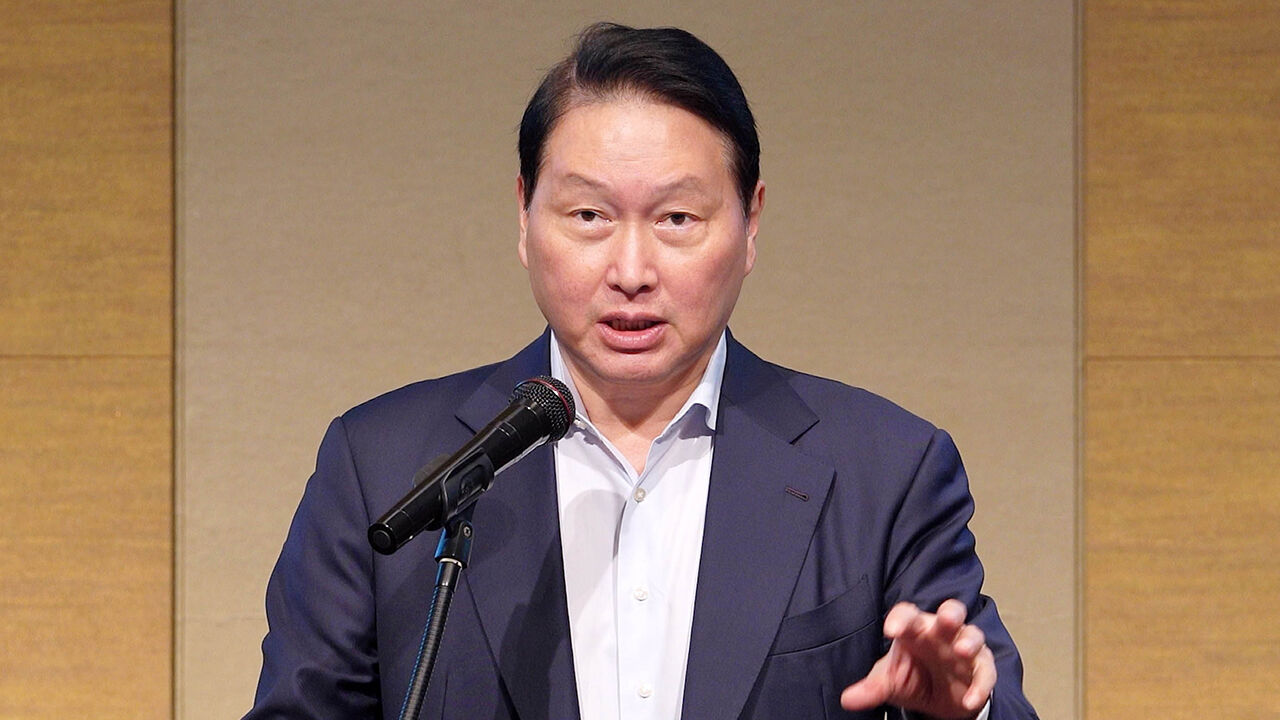
▲ Chey Tae-won, chairman of the Korea Chamber of Commerce and Industry, delivers an opening address at the 15th Korea-Japan Chamber of Commerce and Industry Presidents Meeting held at the Westin Hotel Sendai in Japan on August 31.
SK Group Chairman Chey Tae-won, who has recently taken proactive steps regarding cooperation with Japan, has once again argued that South Korea and Japan should form an economic community to secure stronger negotiating power, greater a voice, and reduced costs.
In an interview with the Asahi Shimbun published today, Chairman Chey diagnosed the current situation by stating that protectionism and the U.S.-China conflict are dividing markets through supply chains and other means, noting that larger markets are advantageous in such circumstances.
He explained, "If South Korea and Japan unite, we can form an economic bloc worth about 6 trillion dollars, ranking fourth in the world, which would allow us to secure stronger negotiating power and a greater voice." He added, "This would lay the foundation not only to accept international orders and rules, but also to actively participate in the process of shaping them."
Chairman Chey emphasized that an economic community between South Korea and Japan is also necessary from a cost perspective.
"Both countries are experiencing low birth rates and aging populations, which entails heavy cost burdens," he said. "I believe it would be ideal to link the South Korean and Japanese markets, jointly utilize major infrastructure and services to lower baseline costs, and simultaneously foster new industries and services."
Regarding the top priority for cooperation in advancing the South Korea-Japan economic community, he singled out the energy sector.
"If both countries jointly design everything from energy purchasing and stockpiling to usage and manage to cut costs by even 3 to 5 percent, the effect will be massive," he stressed, adding, "In the future, we will need to connect power grids and gas pipelines so that we can mutually share electricity."
He further added, "At the same time, we should allow people to travel freely, much like Europe's Schengen Agreement."
The Schengen Agreement is a system that guarantees the free movement of people and goods by exempting travelers from border control procedures, such as passport checks, when crossing the borders of 29 European countries.
At the private enterprise level, he cited examples such as financial institutions from both countries launching joint funds or new insurance products, as well as cooperation in the healthcare sector.
Regarding artificial intelligence, which has recently drawn significant attention, he noted, "SK is also continuously exploring related investments and frameworks with many Japanese partners," while mentioning companies like NTT and Tokyo Electron.
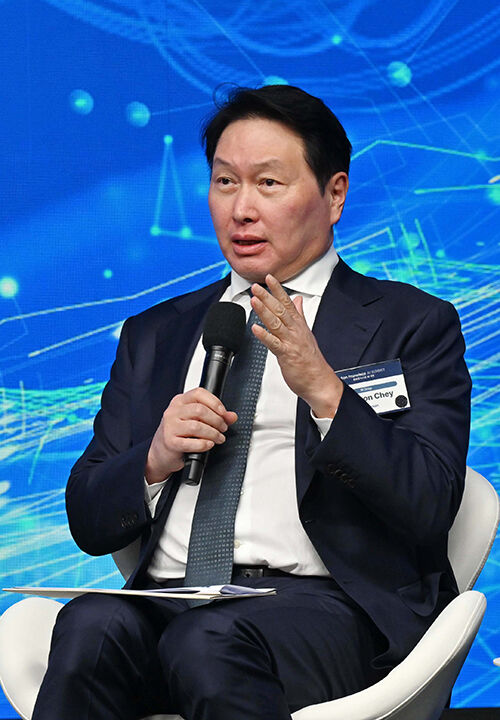
Chairman Chey has been advocating for South Korea-Japan economic cooperation and the establishment of an economic community for several years.
In this interview as well, he remarked that it is "an idea I have harbored for quite a long time," sharing that he reached this conclusion following a lecture he gave to Seoul National University engineering students in 2002.
"Since then, rather than letting it remain a mere theory, I sought to put it into practice by having the SK Group I lead increase investments in Japan," he added. "For the past 6 to 7 years, thinking that it was time to materialize this vision in earnest, I have been visiting Japanese economic organizations to hold ongoing meetings and discussions."
While acknowledging institutional differences as potential constraints in the process of pursuing a South Korea-Japan economic community, Chairman Chey noted, "In the past, there was political animosity on both sides, but favorable feelings toward each other are growing, particularly among the younger generation."
Dismissing Japan's past tightening of export controls on key semiconductor materials against South Korea during the administration of former Prime Minister Shinzo Abe, he stated, "That is now a thing of the past and has essentially become void."
"I believe we have learned the lesson that retaliating against each other benefits no one," Chairman Chey explained. "Politicians in both countries must also realize that such things should be avoided. This sentiment is particularly strong among businesspeople."
Regarding relations with China, he stated, "As a large neighboring country, its presence cannot be factored out," while adding, "I want to emphasize that from a geographical standpoint rather than a political one, South Korea should remain closer to Japan than to China."
He further noted, "Even if South Korea and Japan cooperate, it will not reach a scale that surpasses or threatens China. If a framework is created where South Korea and Japan can create synergy, it will actually generate advantages in building relations with China, promote growth, and help lower costs."
Regarding plans for investment in Japan, he premised that the semiconductor sectors of South Korea and Japan are mutually complementary, diagnosing that "due to the AI boom, semiconductor supplies are falling short, and this situation is likely to persist for a long time."
"SK Hynix has drawn up extensive investment plans within South Korea, but it is still not enough," he said, adding, "We are reviewing locations worldwide that possess the land, electricity, talent, and ecosystems capable of building semiconductor plants."
He concluded, "A decision will be reached soon regarding which locations we will prioritize and how we will proceed."
(Photo: Yonhap News)
※ Please note: This article was translated by AI and may contain errors.



 Video News
 Video News
 Video News
 Video News
 Video News