
 KOR
KOR
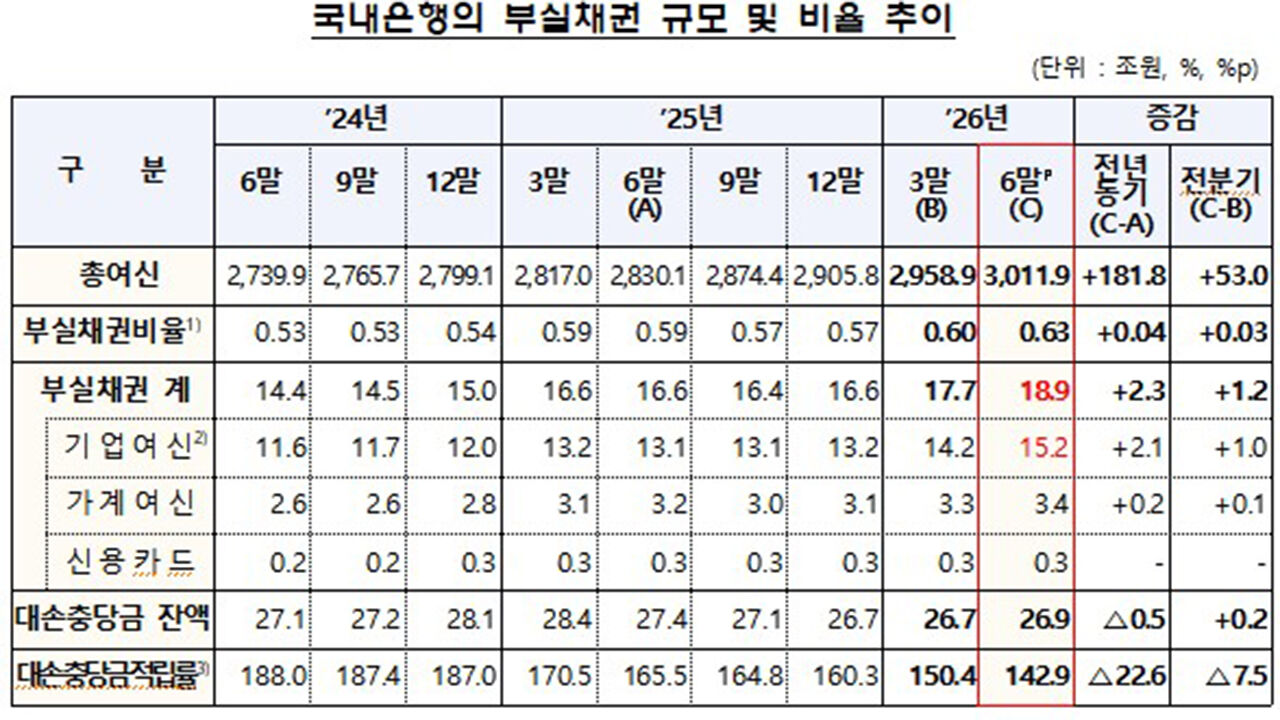
According to the "Status of Non-Performing Loans of Domestic Banks at the End of June 2026" released by the Financial Supervisory Service today (Sept. 2), the bad loan ratio for domestic banks stood at 0.63%, up 0.03 percentage points from the end of March (0.60%).
The volume of bad loans reached 18.9 trillion won, an increase of 1.2 trillion won from the end of March (17.7 trillion won), marking the highest level in eight years since June 2018 (19.4 trillion won).
In particular, non-performing corporate loans rose to 15.2 trillion won, an increase of 1 trillion won from the previous quarter, leading the overall upward trend.
This marks the largest scale in 7 years and 3 months since March 2019.
Household bad loans increased by 100 billion won to 3.4 trillion won, while credit card receivables remained unchanged from the previous quarter at 300 billion won.
Newly incurred bad loans were tallied at 7.2 trillion won, up 1.7 trillion won from the previous quarter.
New non-performing corporate loans increased by 1.6 trillion won from the previous quarter to 5.7 trillion won, while new household bad loans rose by 100 billion won to 1.4 trillion won.
In particular, new bad loans for small and medium-sized enterprises (SMEs) increased by 1.2 trillion won from the previous quarter to 4.5 trillion won, whereas large corporations saw a modest increase of 400 billion won to 1.2 trillion won.
The amount of bad loans written off or disposed of during the second quarter stood at 6.1 trillion won, an increase of 1.7 trillion won compared to the end of March this year.
By sector, the non-performing loan ratio for corporate credit rose 0.03 percentage points from the previous quarter to 0.77%.
This is the highest figure since March 2021.
Over the same period, the bad loan ratio for large corporate credit (0.53%) and SME credit (0.92%) rose by 0.03 percentage points and 0.04 percentage points, respectively.
The ratio for small businesses incorporated as legal entities rose 0.05 percentage points to 1.08%, and the ratio for sole proprietors (0.67%) also climbed 0.01 percentage points, continuing the upward trend.
The bad loan ratio for household credit edged up 0.01 percentage points to 0.33%.
The ratio for mortgage loans (0.22%) remained at the level seen at the end of March, while other loans including credit loans (0.67%) rose 0.01 percentage points.
The bad loan ratio for credit card receivables (1.88%) rose 0.06 percentage points.
The balance of loan-loss reserves increased by 200 billion won from the previous quarter to 26.9 trillion won, but the loan-loss reserve coverage ratio, calculated by dividing the reserve balance by bad loans, fell 7.5 percentage points over the same period to 142.9%.
The Financial Supervisory Service stated, "Considering the long-term average of the bad loan ratio and the loss-absorbing capacity of the banking sector, soundness remains sound," while adding, "However, preemptive management is necessary given the continued upward trend in bad loan ratios in some vulnerable sectors, as well as the prolonged situation in the Middle East and the possibility of rising domestic and international interest rates."
(Photo: Financial Supervisory Service, Yonhap News)
※ Please note: This article was translated by AI and may contain errors.



 Video News
 Video News
 Video News
 Video News
 Video News