
 KOR
KOR
Growth requires strength. Strength not to waver, and strength to reach higher. "Take Care of Culture," the knowledge news that makes you smarter the more you listen, empowers you to grow as a cultured person alongside the best Spf contributors.
Bae Kyung-hoon, Contributor
Deputy Prime Minister and Minister of Science and ICT
Former Head of LG AI Research
Current Vice Chairman of the National AI Strategy Committee
Deputy Prime Minister and Minister of Science and ICT
Former Head of LG AI Research
Current Vice Chairman of the National AI Strategy Committee
These days, I have two major concerns: how to ensure world-class AI technologies and services emerge from South Korea so that the entire world uses South Korea's AI, and how to carry out initiatives such as AI education and providing opportunities for the public to easily access AI in order to bridge the growing AI digital divide. How can we effectively narrow this gap?
Can South Korea Truly Become an AI Powerhouse?
Q. While Nvidia in the U.S. seems to have it all and China is pouring all its national efforts into AI, South Korea appears to lack both capital and infrastructure. Can we hold our ground?
South Korea ranks first in the world in the adoption rate of industrial robots. And in terms of per capita ratio, South Korea has the highest usage rate of generative AI globally.
Sam Altman | CEO of OpenAI (July 24, 2026)
The South Korean economy and its people have adopted AI very quickly. The changes happening in South Korea are truly astounding.
The South Korean economy and its people have adopted AI very quickly. The changes happening in South Korea are truly astounding.
South Korea has immense interest in the era of artificial intelligence. It is true that AI-related investments require staggering costs. In the United States, Big Tech has long led AI investments, and China has also invested heavily in AI over the past decade to keep pace in the U.S.-China tech hegemony race. While South Korea has less capital, it is also true that we have shown tremendous interest in AI. What comes to mind when you think of South Korea? A powerhouse in semiconductors and manufacturing. The government is investing heavily, companies have a strong drive for AI transformation, and our foundation is solid, so I believe we can build AI successfully on top of that foundation.
I do not think having a large population or vast differences in capital is the decisive factor. LLMs are the product of training on massive amounts of data. While researchers worldwide use Nvidia GPUs for AI training, China faces export restrictions. Yet, Chinese AI models are producing current results even in poor AI infrastructure environments. While investment is correlated to some extent, the core to making AI smarter lies in data. So the question is how to gather high-quality data. Most of the general knowledge required for the LLM era has already been trained. Now is the time when we must create differentiation. In that sense, I believe the manufacturing-based data and capabilities possessed by South Korea will play a crucial role in the AI era.
Q. Will we be competitive if we develop our own?
I can explain this divided into AI model competitiveness and AI service competitiveness. What happens if we do not possess proprietary AI model competitiveness? Recently, the U.S. government restricted other countries from using Anthropic's top-tier AI. If researchers are working with the latest AI model and the supply of that model is suddenly cut off, it becomes difficult to continue the research. If you use outdated AI models, you inevitably fall behind in competition. This kind of thing can happen at any time. There have also been news reports that China will restrict overseas supplies. Since cutting-edge AI models are the result of massive investments, restrictions might be placed for profitability reasons, or they might not be disclosed as core assets for national security and defense. Then the gap between countries that have cutting-edge AI models and those that do not will widen immensely. That is why we must possess the competitiveness to create AI models of a certain standard, and South Korea is also seeking to secure competitiveness through its sovereign AI foundation model* project.
*Foundation Model: An artificial intelligence (AI) model trained on vast amounts of data that can be adapted to various tasks
In fact, the U.S.-China rivalry can create a good opportunity for South Korea. AI technology seems somewhat different from physical products. Because it can be described as a trained combination of vast knowledge, relying entirely on someone else for AI can be dangerous. For this reason, South Korea is investing heavily in AI as a third alternative, and in fact, many countries believe that aside from the U.S. and China, South Korea is the only country capable of developing its own AI. OpenAI CEO Sam Altman once said, "There is no AI revolution without South Korea."
Sam Altman | CEO of OpenAI (July 25, 2026)
Without South Korea, the incredible AI revolution we see today would not have been possible. It is truly remarkable, and I am confident there will be even more changes ahead.
Without South Korea, the incredible AI revolution we see today would not have been possible. It is truly remarkable, and I am confident there will be even more changes ahead.
South Koreans have the highest rate of AI usage in the world. Thus, South Korea is leading the current AI revolution. Jensen Huang of Nvidia also said, "Now is South Korea's golden age of AI."
Jensen Huang | CEO of Nvidia (July 25, 2026)
Now is Korea's golden age. As you know, Korea's semiconductor business is booming, and its industry is flourishing.
Now is Korea's golden age. As you know, Korea's semiconductor business is booming, and its industry is flourishing.
That shows how well South Korea can serve as an AI production base, backed by strong competitiveness in memory semiconductors, AI chips, and AI models. However, rather than seeking AI monopoly, South Korea is engaging in many discussions to cooperate among middle powers . As South Korea is seen as a nation that possesses a complete AI full stack and can cooperate to build an AI ecosystem together, many countries are seeking cooperation discussions.
*Middle Power: A nation in international politics that holds an intermediate level of national power or influence between superpowers and small powers
*AI Full Stack: Encompassing the entire spectrum of related industries, from equipment infrastructure including GPUs to software, cloud services, and AI solutions
Physical AI, the 'Ultimate Boss' of AI... Why South Korea Aims to Be the World's Best
Q. You pointed to Physical AI as the ultimate destination in the AI race. Why do you see Physical AI as the next battleground for the AI industry, and what is South Korea's greatest competitive edge in that process?
I believe Physical AI is the ultimate boss of artificial intelligence. Conventional AI existed only inside computers, accessed via smart devices. That AI is now stepping out into the physical world to operate. Beyond humanoid robots, Physical AI can be applied across diverse fields including autonomous vehicles, drones, and robots—not just robots working in factories, but also agricultural robots and care robots assisting the elderly. If generative AI signaled the start of the AI revolution, Physical AI is what will make it bloom. It will create massive industrial impact, and accordingly, there is much to prepare.
The reason I believe South Korea can excel in Physical AI is data. LLM technology, represented by generative AI, was trained by gathering vast amounts of human-accumulated data. Generative AI was built by incorporating the books, research papers, and know-how we created. The current results were achieved through more than a decade of collecting foundational data, defining data attributes, and labeling them.
However, Physical AI requires action data for robots to accomplish missions, and such data is scarce. While robots can learn human actions from videos and mimic behaviors, they are only at the stage of performing specific tasks. South Korea possesses the entire spectrum of manufacturing industries necessary for Physical AI—automobiles, semiconductors, shipbuilding, biotech, and more—so we can build the foundation for Physical AI based on that data.
To fully operate Physical AI, such industrial data is drastically lacking. Without sufficient data, Physical AI cannot operate. Compared to the enormous amount of data trained to create generative AI, we do not even have one-millionth or one-ten-millionth of that data. Skilled experts in each field need to work alongside AI or robots to generate this data.
Take a tennis ball and a table tennis ball. Their weights are different. Their sizes are different. If you throw them, which one goes farther? The tennis ball. Why? It weighs more and has a higher coefficient of friction with the hand (a numerical measure of slipperiness), creating a reaction force that propels it further. Data must be created taking all these laws of physics into account. We live in the physical world considering various laws of gravity and reaction forces. AI must also develop a physical understanding in the real world to perform actions or missions like a human.
Understanding the physical world is not the end of the story; it has to execute actions. It needs to learn from someone. For example, a robot that learns table tennis from me would lose 100 out of 100 times. (Laughs) But if it trains on action data obtained from a professional table tennis player, it will quickly become a robot capable of playing table tennis. Those things are what matter.
To excel in Physical AI, we must systematically collect relevant Physical AI data and establish robust systems to secure data. Because South Korea has already laid the groundwork, we can surge ahead quickly. In the field of Physical AI, let South Korea aim to be the world's best.
Q. Having manufacturing master craftsmen comparable to star pitchers is itself a global competitive advantage. It means we can secure data rapidly.
Systems for collecting data by industry sector, and actions where humans wear task suits to operate robots to gather data to achieve missions in each sector, will be possible. I consider this an entry-level stage of Physical AI. For Physical AI to be fully realized, robots must not only accomplish tasks set by humans, but also understand situations, make judgments, and make decisions on their own. To advance to that level, experts must participate in creating data for Physical AI. Securing high-difficulty, high-quality data is seen as the core of competitiveness in Physical AI.

What we are envisioning now is turning entire factories into Physical AI. When people think of humanoid robots, they usually only imagine carrying goods and performing tasks. When an entire factory becomes Physical AI, AI designs production independently, orders components independently, and assigns respective missions to each robot in the factory. AI makes optimal decisions through comprehensive judgment, and performs one-stop inspections of product quality and overall facilities. South Korea will create factories that are themselves AI. We are currently running demonstration projects, and we are aiming to export whole AI factory packages. This is for real.
Making Money with AI You Created? A New Future Transformed by the 'Token Economy'
Q. For us to become the global top 1 in Physical AI, the term "token economy" has been coming up a lot lately. Does the token economy mean selling data created by manufacturing masters?
It could involve assigning value to data created by master craftsmen in each industry and paying compensation, or paying for know-how when masters participate in creating synthetic data for Physical AI. But the concept of the token economy as I see it is that tokens can be understood as the basic unit AI comprehends and produces. You can think of an AI data center essentially as a factory that generates tokens—a token factory*.
*Token Factory: A system that combines GPUs, high-speed networks, storage devices, and AI software to produce tokens (the output of intelligence) on a massive scale
Physical AI also requires tokens to operate. In AI services, the amount of tokens is fixed, and once used up, you cannot use any more. You can think of all of that as tokens. Currently, everyone merely consumes tokens. However, if a Physical AI or AI agent created by me performs meaningful activities and the output receives meaningful feedback or compensation, then while we consume AI, we can also become producers of tokens through AI. I would describe this as intelligence token economics*.
*Intelligence Token Economics: An economic structure where 'intelligence' generated by AI is produced and consumed in token units, driving the economy through its costs and values
The reason people in the U.S. talk about an AI bubble right now is whether the returns match the investments. That is why the stock market keeps fluctuating. It is because a positive virtuous cycle is not turning. People invest in memory, AI chips, and GPUs, but are productive results emerging proportionally? Ultimately, I believe building this AI ecosystem properly is crucial. A virtuous cycle economy is created when the AI ecosystem involves not just specific companies creating AI infrastructure, models, or services, but also users participating directly in socioeconomic activities as creators—such as generating content through AI—and receiving rewards and feedback.
Through 'AI for All'* launching this year, our goal is not only for all citizens to use AI for All, but also to build a token economy where they receive rewards for data and content generated through AI for All, allowing them to use additional tokens to continue utilizing AI services. Globally, this concept is not yet fully established. South Korea is keenly focused on quickly adopting and making a success of this model.
*AI for All
-A homegrown AI service available to all citizens for free without usage limits
-Universal AI chatbot and public AI agent scheduled for launch
Q. Given the current internal circumstances in South Korea, do we have the feasibility and competitiveness?
I believe we do. A thought I have had since my time in the corporate sector is that transitioning AI from inside computers to on-site applications involves numerous trials and errors. In fact, most quit at this stage. But AI models are fundamentally probabilistic models. They might not score 100 points from the start. Most AI model services require a process of starting at 70 to 80 points and gradually building up to 80, 90, and 100 points. It requires time and sustained investment. When I was in the private sector, I worried about this a lot. Investors want short-term results, and without going through this process sufficiently, creating a final product is difficult.
However, as I formulate AI policy now, I am hopeful. Interest and investment in AI are increasing this year compared to last year, and will increase further next year. It will be reinforced. When the government announced three mega projects, the announced investment amount alone exceeded 4,000 trillion won. At the recent San Francisco AI Summit, the investment discussed between Big Tech and leading South Korean AI companies alone reached 950 billion dollars. Tremendous investments and bets are centering on South Korea.
Early this year, a credible institution evaluated that 'South Korea clearly possesses top-three global AI capabilities,' showing that we are building AI model competitiveness as well. While model competitiveness is important, we now need service competitiveness to create AI that citizens and enterprises can widely use, and citizens and companies have reached the stage where they must use it. By utilizing it extensively and providing valuable feedback, AI for All becomes something we build together, rather than something the government simply provides. We can build the playing field together, expand its scale, and position ourselves not just as consumers, but as producers. If such a success story is created in our country, it will spread worldwide. Now, practical usage is what matters.
"In the AI Era, the Gap Widens": What Solution Is South Korea Preparing?
Q. In the AI era, the gap between those who utilize AI effectively and those who do not could widen. How do you view this AI divide?
I view it very seriously. In reality, I believe the gap will widen even further. The gap between those who use AI and those who do not, and between those who utilize advanced AI and those who utilize low-level AI, will grow even larger because the output is distinctly different. We have entered a world where we can no longer think, 'I can live without AI.' Everyone needs to utilize AI, yet many people lack access points or opportunities.
I believe AI models and outputs should essentially become global public goods. They should be integrated into life and used like electricity. However, because we are still at the beginning of the great AI transition and huge investments need to be recouped, the gap between those who supply AI and use it adeptly, those who use it passively, and those who have no access at all is bound to grow. If we do not bridge that gap, I believe massive social problems will arise. Therefore, to ensure no South Korean citizen is left behind from AI benefits, we are deeply focused on providing AI that all citizens can use free of financial burden, while simultaneously fostering a virtuous AI token economy.
Everyone uses ChatGPT or Gemini, right? You probably do not use Korean AI. It is not because Korean AI models do not exist, but perhaps because popularized services have not emerged yet. Therefore, the government and private sector are working together to launch a service called 'AI for All' starting late this year. Currently, people have to search for and apply for community center tasks or government programs individually. To make such tasks easier by creating public AI agents, we plan to launch AI for All this December, combining generative AI services with public AI agent services to create differentiation so that all citizens can use it. While it may have shortcomings compared to foreign AI services, our citizens need to actively use homegrown AI services. With more usage, the nature of AI models allows data to continuously accumulate and improve. Both the government and many enterprises are preparing this together with keen interest.
The government also provides and educates through many programs. For instance, through the 'AI for All Competition' or 'AI for All Learning Centers,' it is crucial to give all citizens diverse experiences through AI and help them experience doing many things they previously could not imagine through AI. Thus, one of our goals is to enable all citizens to participate without being marginalized. While the gap will grow, pondering how to narrow it, formulating policies, and strengthening AI literacy education are critical.
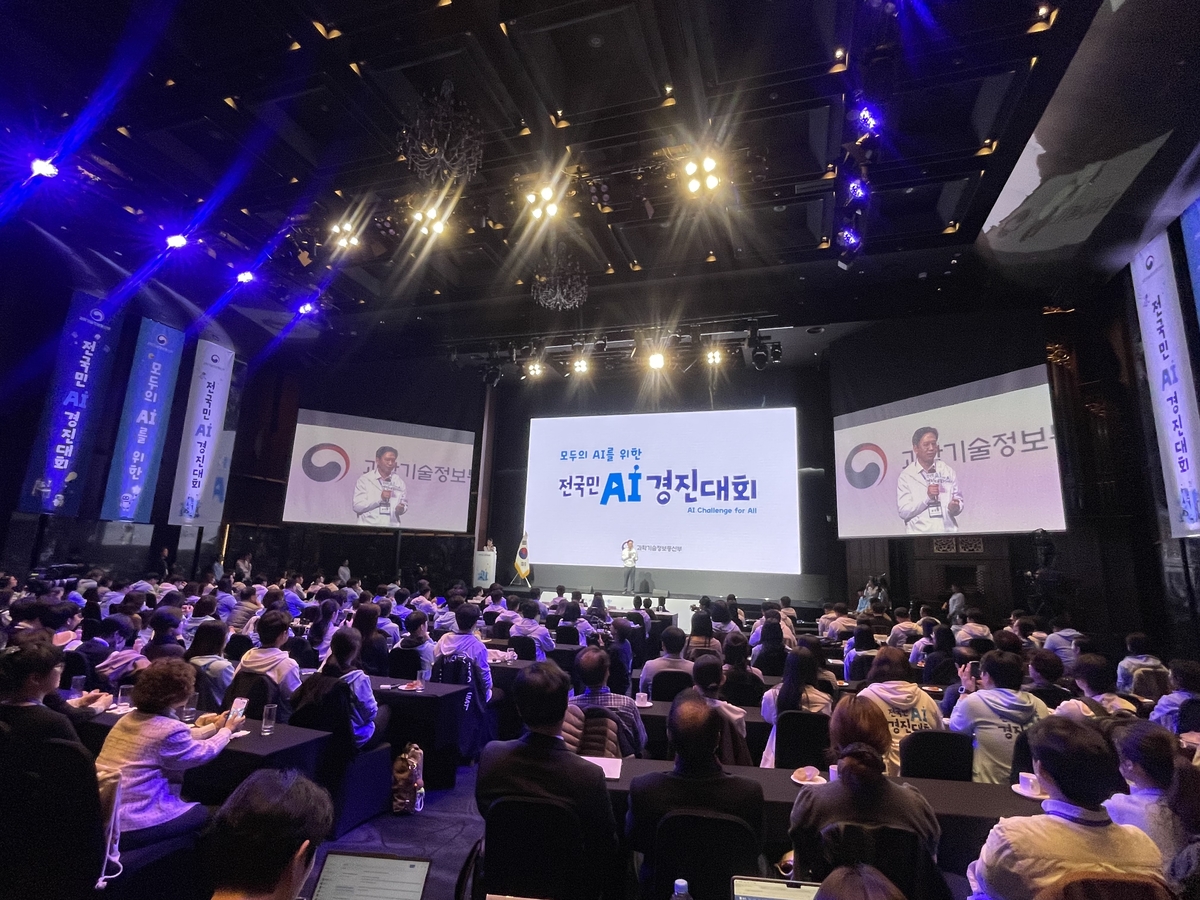
Q. When people hear "AI competition," it might feel like an event only for developers. How is this Nationwide AI Competition different, and what kind of event is it?
People are afraid simply because they have never used AI before. We want to provide an experience where artificial intelligence enriches and adds value to life. The AI for All Competition has already surpassed this year's target of 2 million participants and will continue to provide educational opportunities and proceed forward. We will increase our target next year to build a foundation where more people can experience AI.
Ko Tae-hyun | Department of Taxation and Accounting, Hyupsung University
While using various AI tools, I learned about this 'AI Rookie' competition (for university students) this year and decided to enter because I wanted to build finance-related AI.
While using various AI tools, I learned about this 'AI Rookie' competition (for university students) this year and decided to enter because I wanted to build finance-related AI.
Lim Chan-young | Department of Computer Software, Korean Bible University
I took on the challenge because I wanted to write a research paper through this project.
I took on the challenge because I wanted to write a research paper through this project.
Seniors over 70 have published books and are active as YouTubers based on AI content. Elementary school students are also creating AI outputs and participating in the AI for All Competition. They gain new learning and a great sense of accomplishment. 'Can I really create something like this?' If they wanted to publish a book about their life story, it would take tremendous time without AI. But with AI, they can craft their stories and easily create illustrations. Through these experiences, people say, 'I am truly living in a whole new world.'
What is certain is that the era of the great AI transition is coming. The AI revolution is already underway, and I believe the AI revolution will create a new world several times—hundreds of times—greater than the past ICT revolution, semiconductor revolution, and internet revolution. Rather than worrying 'Will AI take my job?', I hope young professionals in their 20s and 30s as well as those in their 30s to 50s will first try using AI in fields they are curious about or interested in. I hope we can contemplate together how to learn through AI in the AI era, and how to solve problems and grow with AI. The government will deliberate and support alongside you, and we will run hand in hand so that South Korea navigates the era of the great AI transition successfully.
https://youtu.be/KKX3J2TPapo
Subscribe to the <Take Care of Culture> YouTube channel for more content.
※ Please note: This article was translated by AI and may contain errors.




 Video News

 Video News
