
 KOR
KOR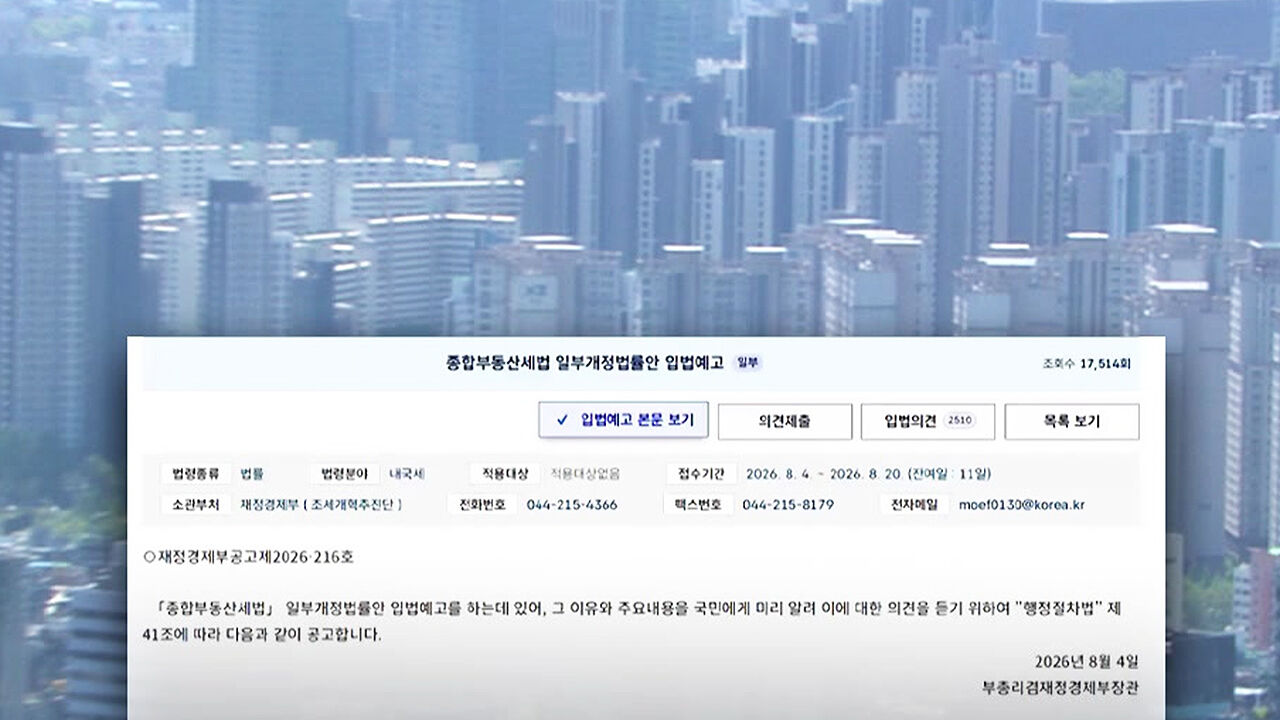
[Anchor]
A week has passed since the government announced its tax revision plan, but the backlash remains strong. To ensure the effectiveness of the revision, a complicated situation is unfolding where exceptions to existing regulations are inevitably continuing.
Reporter Lee Seong-hoon has the details.
[Reporter]
An apartment complex in Songpa-gu, Seoul.
Since the announcement of the tax revision plan, some homeowners have shown intentions to put their properties on the market, but the atmosphere suggests it is not easy to lead to actual transactions due to various restrictions.
[Real Estate Agent in Songpa-gu, Seoul: You could say there are situations where sellers cannot sell their homes even if they want to because a significant amount of lease term is left. There are many such cases. You can see that many people cannot sell due to those circumstances even if they want to.]
In this tax revision plan, the government announced a policy to temporarily lower the heavy capital gains tax rate for owners of multiple homes in order to increase housing supply on the market.
However, in land transaction permit zones, including all of Seoul and 15 areas in Gyeonggi Province, buyers must move in and live there directly within four months of receiving permission.
As complaints mounted that it is difficult to find buyers for homes with remaining tenant lease terms even if owners want to sell, the government is belatedly considering extending the grace period for the actual residency obligation for rented homes within permit zones until 2028.
This means tinkering once again with the actual residency obligation regulations, which had already been postponed once until the end of the year last May ahead of the heavy taxation on multiple homeowners.
The same goes for single homeowners who do not reside in their properties.
Amid strong opposition to the residency recognition requirements, authorities are discussing adding cases such as caring for grandchildren and expanding the recognition scope of the residency period, which is currently set at three years.
Abolishing the carryover limit for general Individual Savings Accounts (ISAs) and shortening the contract period are also being reviewed for supplementary adjustments.
[Woo-cheol Kim / Professor of Tax Department, University of Seoul: It is a shape of increasing exception clauses as criticisms follow, but if you keep increasing exceptions, it really becomes impossible to know why this was done in the first place. Trust in government policies is bound to be significantly weakened.]
As a series of revisions and complementary measures became necessary just a week after the announcement, criticisms are rising over whether the preparation was insufficient.
The ruling party and the government plan to collect opinions until the end of this month and finalize the tax revision plan.
(Video Editing: Kim Jong-mi, VJ: Jeong Han-wook)
※ Please note: This article was translated by AI and may contain errors.
Series of 'Exceptions' Spark Patchwork Controversy Over Tax Revision



Trending Now
-
 Video News
'Multi-Home' Cheong Wa Dae Secretary Earns Monthly Rent from Illegally Expanded Villa
-
Video News
70,000 Migrants Flood Spanish Enclave in 'Global Shock' Amid Growing Fallout
-
Video News
Boy Who Visited Police Before Death Had Abuse Reports Dating Back 5 Years
-
Video News
Residents Shocked As 60-Year Drought Leaves Streams Dry
-
Video News
"Over Half Will Die in 2–3 Days"… '150,000 Fish' Released into the Sea
 Video News
 Video News
 Video News
 Video News
 Video News