
 KOR
KOR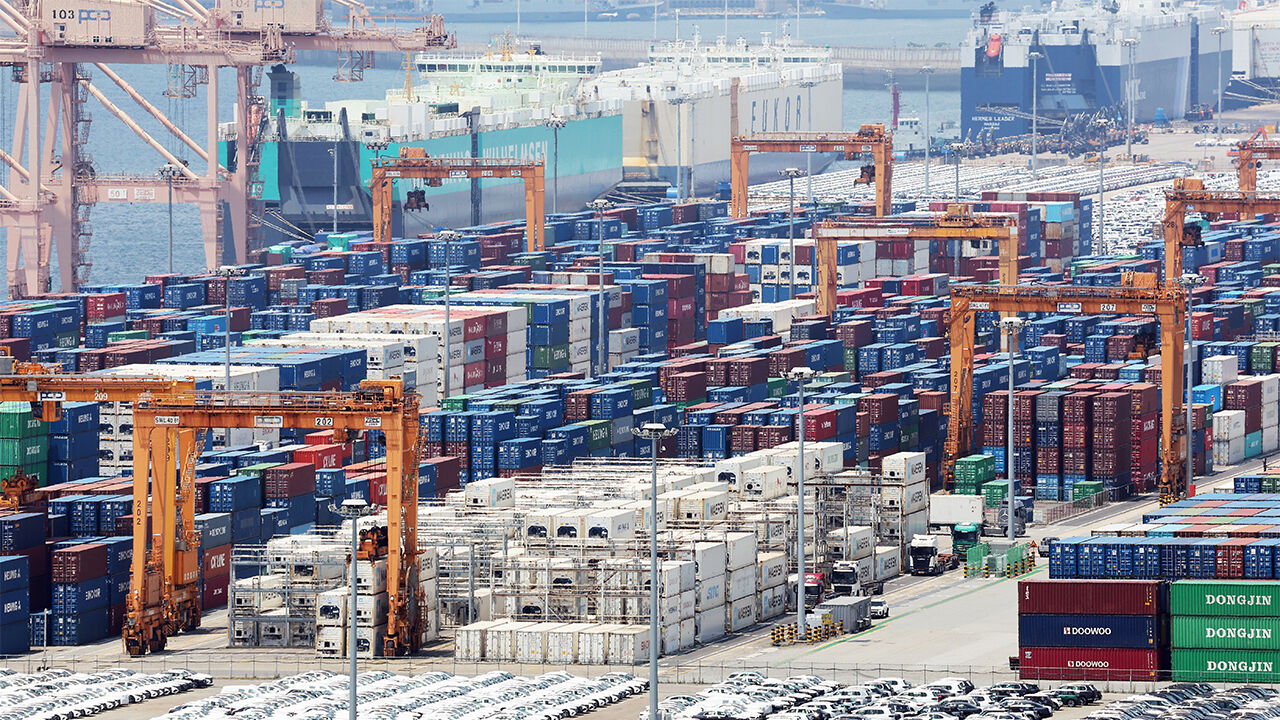
▲ Containers are stacked at Pyeongtaek Port in Gyeonggi Province.
Driven by strong semiconductor exports, South Korea recorded its largest-ever monthly current account surplus in June, exceeding 70 trillion won.
According to the preliminary balance of payments statistics released by the Bank of Korea (BOK) today (the 6th), the current account surplus for June stood at $49.73 billion (approx. 70.8 trillion won).
Following the previous record high set in May ($38.61 billion), the country extended its record for the largest surplus for two consecutive months.
The current account has maintained a surplus trend for 38 consecutive months starting from May 2023.
This marks the second-longest surplus streak since the 83-month consecutive surplus period that began in March 2019.
The cumulative current account surplus from January to June reached $191.01 billion, breaking the all-time record for a first half of a year.
This is about four times the figure from the same period last year ($47.87 billion).
The figure far exceeded the BOK's projection of $151.5 billion for the first-half surplus announced in May.
More than three-quarters of the annual projected target ($250 billion) was achieved in just half a year.
Kim Young-hwan, head of the Economic Statistics Department I at the BOK, evaluated, "Except for April, which saw massive dividend payouts, a favorable current account trend has continued, breaking all-time surplus records consecutively since February."
He analyzed, "Powered by an unprecedented semiconductor export boom, the expansion in the goods balance surplus accounted for the vast majority of the overall current account surplus growth."
Regarding the outlook for the July current account, he said, "Although the customs-based trade surplus for July decreased compared to June, the strong semiconductor export momentum continued," adding, "We expect the largest surplus for the month of July, centered around the goods balance."
Park Sung-gon, head of the Balance of Payments Team at the BOK, added, "It is still difficult to make international comparisons for the first-half current account surplus scale, but we rank around second among OECD countries."
Breaking down the June current account by item, the goods balance surplus reached a record high of $47.89 billion.
The previous record was $37.86 billion in May.
Exports ($112.37 billion) surged 84.5% compared to a year earlier.
While strong export growth continued for semiconductors and information and communications equipment, machinery, precision equipment, and passenger cars also turned to growth.
This is the first time that monthly goods exports have exceeded $100 billion.
By item, customs-based figures showed high growth rates for computer peripherals (SSDs, 282.7%), semiconductors (196.9%), and wireless communication devices (60.6%).
By region, exports increased to Southeast Asia (105.7%), China (92.0%), the United States (78.6%), Central and South America (36.1%), the European Union (EU, 31.8%), and Japan (15.8%).
Imports ($64.48 billion) also rose by 38.6%, but the growth rate was lower than that of exports.
The services account recorded a deficit of $1.29 billion.
Within the services account, the travel balance posted a surplus of $440 million.
Regarding this, Kim Young-hwan explained, "The number of foreign arrivals has increased significantly recently, maintaining a monthly flow of around 2 million, and foreigners are spending actively upon entry."
In direct investment, outbound investments by Koreans increased by $8.01 billion, while inbound investments by foreigners grew by $4.63 billion.
In securities investment, outbound investments by Koreans rose by $3.56 billion, centered on stocks, while inbound investments by foreigners dropped by $26.32 billion, also centered on stocks.
Foreign investment in domestic stocks plummeted by $31.61 billion, marking the largest decline on record.
(Photo: Yonhap News)
※ Please note: This article was translated by AI and may contain errors.





 Video News
 Video News