
 KOR
KOR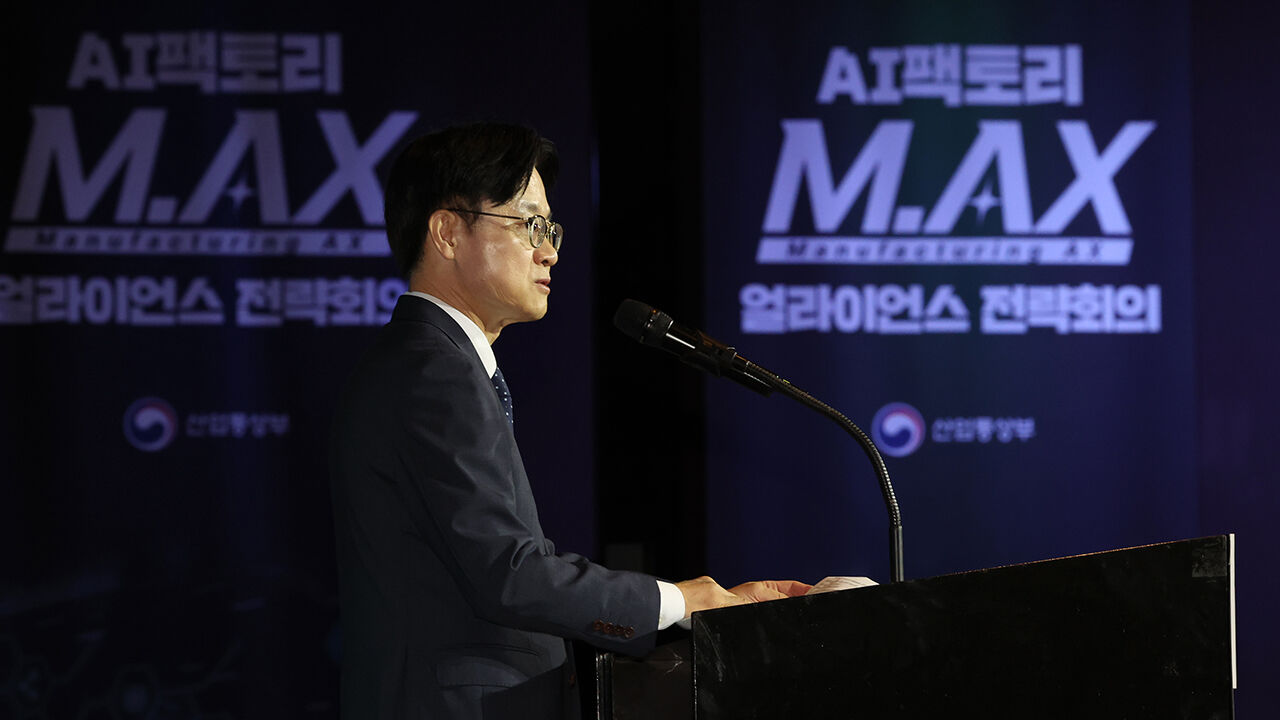
▲ Minister of Trade, Industry and Energy Kim Jung-kwan delivers opening remarks at the "AI Factory Manufacturing AI Transformation (M.AX) Alliance Strategic Meeting" held at The Plaza Hotel in Jung-gu, Seoul, on October 1 of last year.
The Ministry of Trade, Industry and Energy (MOTIE), which has been pushing for the artificial intelligence (AI) transformation (M.AX) of the manufacturing industry, announced that it has confirmed concrete results in actual manufacturing fields such as semiconductors, automobiles, and shipbuilding.
Ahead of its second-half ministerial work report today (August 4), the ministry announced key M.AX achievements and future implementation plans.
MOTIE explained that through its leading AI factory project, it has supported the AX of around 170 business sites so far. An inspection of 42 business sites that started the project relatively early showed that productivity increased by an average of 30.1%.
The defect rate was found to have decreased by an average of 15.5%.
In the semiconductor sector, SurplusGlobal applied AI to processes such as equipment dismantling and parts sorting and recovery for semiconductor equipment recycling, boosting productivity by 66.7%. In the automotive sector, Asan Seongwoo Hitech reduced quality inspection time by 90% through an unmanned, autonomous manufacturing system for electric vehicle batteries.
In the shipbuilding sector, HD Hyundai Samho introduced an AI-based autonomous welding and inspection solution to the rudder trunk welding and production process—which supports the connecting shaft between the steering gear and the rudder of a ship—increasing productivity by 50%.
Building on these achievements, the ministry plans to help small and medium-sized enterprises (SMEs) with insufficient AI adoption experience and capabilities utilize field-tested AI models and solutions.
In the product AX sector, the development and demonstration of humanoids and on-device AI semiconductors embedded in innovative products are getting into full swing, MOTIE explained.
In September of last year, the ministry launched the M.AX Alliance, a cooperative body involving about 1,000 organizations, including manufacturing and AI companies, universities, and research institutes. In February of this year, it established a system of 11 AX divisions—covering AI factories, AI semiconductors, and more—anchored in industrial complexes.
MOTIE plans to build 500 AI factories by 2030 and expand AX demonstration complexes to 25.
In addition, it will develop core technologies for full-stack AI factories where AI operates the entire manufacturing process without human intervention, while pursuing commercialization and export productization.
It will carry out manufacturing tacit knowledge projects that combine the experience and know-how of skilled workers with AI, and build a national manufacturing data library to store, manage, and utilize high-quality manufacturing data.
It will also pursue the localization of vulnerable robot parts and the development of humanoids specialized in 10 major industries, including shipbuilding, automobiles, and steel.
Minister of Trade, Industry and Energy Kim Jung-kwan said, "As results of increasing productivity and lowering defect rates have been actually verified in the field, we will ensure that verified models spread rapidly to small and medium-sized enterprises and regional industrial complexes."
He added, "We will actively support South Korea in leaping forward to become an M.AX powerhouse by 2030 by accumulating and utilizing manufacturing data and the know-how of skilled workers, and implementing full-stack AI factories."
(Photo: Yonhap News)
※ Please note: This article was translated by AI and may contain errors.



 Video News


 Video News