
 KOR
KOR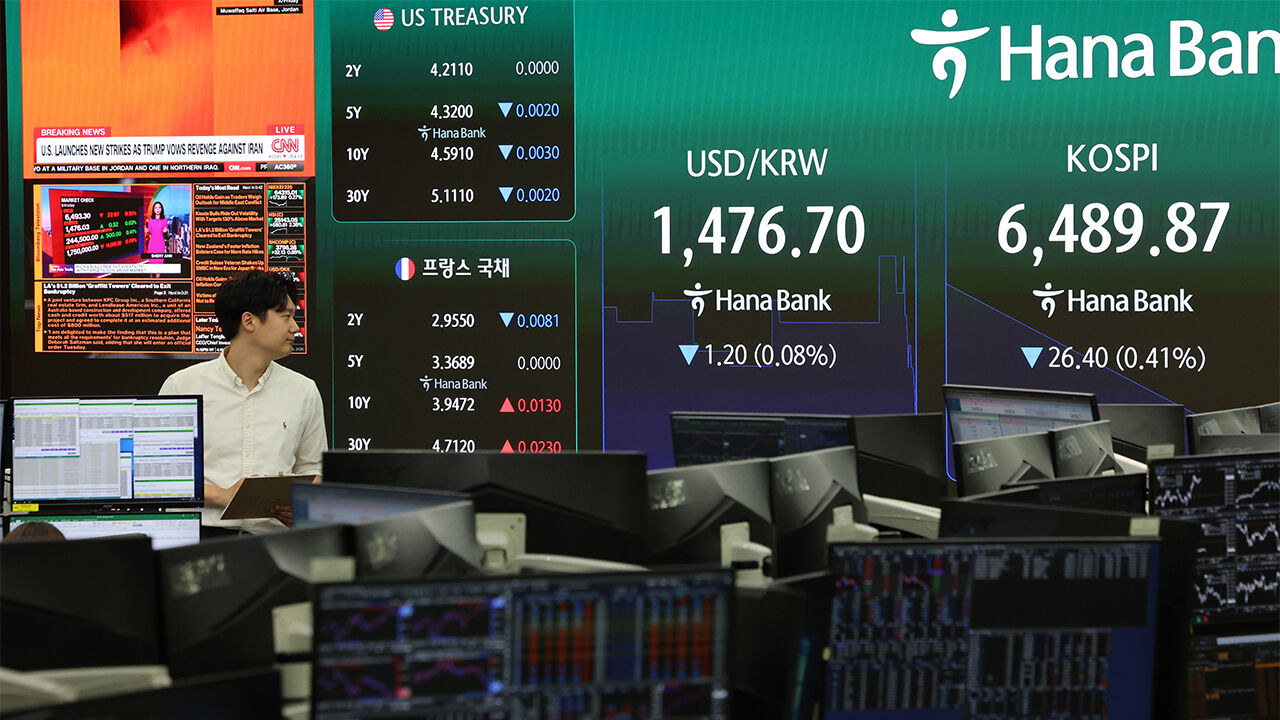
▲ Employees work at the dealing room of Hana Bank's headquarters in Jung-gu, Seoul, on July 21. The KOSPI opened higher and is moving within a consolidation range today.
Global investment bank JPMorgan analyzed on July 21 that the recent sharp decline in the KOSPI was driven by increased volatility from leveraged exchange-traded funds (ETFs), with approximately 75% of the leveraged ETF liquidation process now complete.
In its report titled "Trends in the Deleveraging Process of the Korean Stock Market," JPMorgan stated, "While the corporate fundamentals of the Korean market remain robust, intense deleveraging has dragged down stock prices."
The KOSPI index has fallen by approximately 28% from its June peak (9,385.59 on June 19) to this day.
In just one month, the market has surrendered most of its gains, undergoing a rapid adjustment in a short period.
Regarding this, JPMorgan analyzed, "The correction, which began with typical fundamental concerns and sector rotation, was amplified through leveraged ETFs, and recently, we are seeing strong signs of position liquidation by hedge funds."
It added, "As the Korean stock market rose sharply over the past year, leveraged capital from retail investors, long-short hedge funds, and macro funds became concentrated."
JPMorgan explained, "In this process, high volatility and foreign selling emerged, triggering the market's self-correcting mechanism."
The bank stated, "About 75% of the deleveraging process has been completed toward the target level of approximately $18 billion (about 26.55 trillion KRW), and it is estimated that more than half of the hedge fund deleveraging has also been carried out."
In particular, it identified the leveraged ETF market as a key factor that has exacerbated recent stock market volatility.
JPMorgan explained, "The net assets of leveraged ETFs based on Korean assets increased to $50 billion (about 73.76 trillion KRW) at the end of June, reaching about four times the U.S. level relative to market size," adding, "In this process, forced deleveraging occurred during every downturn, and the Korea Volatility Index (VKOSPI) expanded to about five times the level of the U.S. VIX."
It further forecasted, "Due to the recent market correction, the scale of leveraged ETFs based on Korean assets has decreased to the $26 billion (about 38.35 trillion KRW) level," and "With tightened regulations such as the financial authorities' increase in minimum deposits and the suspension of new listings for single-stock leveraged ETFs, further reduction will continue."
JPMorgan also assessed that leverage among hedge funds is declining rapidly.
JPMorgan stated, "While brokers' swap supply capacity was insufficient due to global investors' increased investment in Korean stocks and the concentration on memory semiconductor stocks, these constraints have been significantly eased by the recent market correction," adding, "The long-short ratio based on JPMorgan's prime book has fallen from over 5.5 times to currently under 4 times."
It also analyzed, "Although foreign net selling of Korean stocks this year is expected to exceed $110 billion, about 90% of it occurred in memory semiconductor stocks," and "As the weight of memory stocks has recently decreased, foreign selling pressure is also gradually easing."
However, it maintained a positive mid-to-long-term outlook for the Korean stock market, centered on artificial intelligence (AI).
JPMorgan said, "AI investment and data center investment remain robust, and a slowdown in memory demand has not yet been confirmed in the actual market," adding, "Improvements in the performance of industrial, financial, and consumer goods sectors, as well as improvements in corporate governance, will also be positive factors for the stock market."
It continued, "We maintain our 'Overweight' opinion on Korean stocks and keep the 12-month KOSPI target at 12,500."
In this report, JPMorgan maintained the 12-month KOSPI target presented in last month's "Korea Equity Strategy" report.
At the time, JPMorgan had presented an optimistic outlook for the Korean stock market, suggesting a base case of 12,500, a bull case of 15,000, and a bear case of 8,000.
(Photo: Yonhap News)
※ Please note: This article was translated by AI and may contain errors.


 Video News
 Video News
 Video News
 Video News
 Video News