
 KOR
KOR
▲ The photo above is not related to the content of this article.
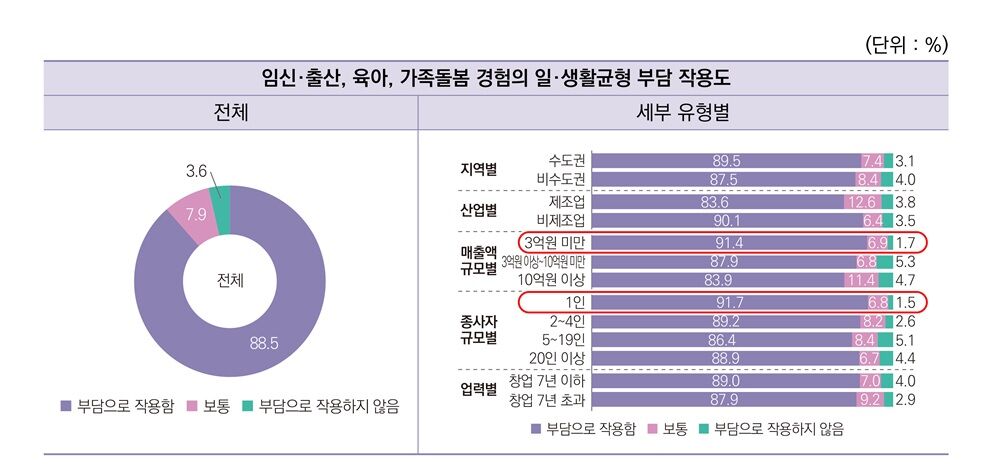
A survey has found that 9 out of 10 female entrepreneurs feel burdened by the challenge of balancing work and life due to pregnancy, childbirth, and childcare.
According to the report titled "Current Status of Work-Life Balance for Female Entrepreneurs and Policy Implications," published on July 21 by the Women’s Economy Research Institute, an affiliate of the Women’s Business Support Center, 88.5% of female entrepreneurs responded that they feel burdened in maintaining a work-life balance due to pregnancy, childbirth, childcare, and family care responsibilities.
The most cited reason why female entrepreneurs face greater difficulties in work-life balance compared to their male counterparts was the social atmosphere where family caregiving roles are concentrated on women (65.3%), followed by the burden of childcare (54.6%).
Regarding specific types of care, the biggest difficulty during pregnancy and childbirth was identified as disruptions to business operations due to the absence of the representative (24.3%).
Consequently, the most preferred support policy was the provision of short-term auxiliary personnel to handle management gaps (23.6%).
In terms of childcare, the biggest difficulty was identified as temporary gaps in care due to children's illnesses or the closure of daycare centers and schools (36.5%), while for family care such as for parents, the biggest challenge was accompanying family members to hospital visits, medical examinations, hospitalizations, and rehabilitation treatments (38.0%).
In response, female entrepreneurs stated that policies such as subsidies for childcare and daycare services (19.3%) and support for assistants to accompany them to hospital visits and medical examinations (26.0%) are necessary.
97.1% of female entrepreneurs responded that support policies for work-life balance are necessary.
The Women’s Economy Research Institute emphasized, "Current work-life balance support systems are designed primarily for wage earners, which can leave female entrepreneurs in a blind spot when they themselves are the ones needing to manage pregnancy, childbirth, childcare, and family care." They added, "It is urgent to establish effective support systems and measures that go beyond short-term solutions, allowing female entrepreneurs to grow sustainably and maintain stable business operations."
This report was based on a survey conducted from June 8 to 17 targeting 645 female-owned businesses that have received a female enterprise verification certificate.
(Photo: Provided by Korea Women Entrepreneurs Association and Women’s Business Support Center, Yonhap News)
※ Please note: This article was translated by AI and may contain errors.


 Video News
 Video News
 Video News
 Video News
 Video News