
 KOR
KOR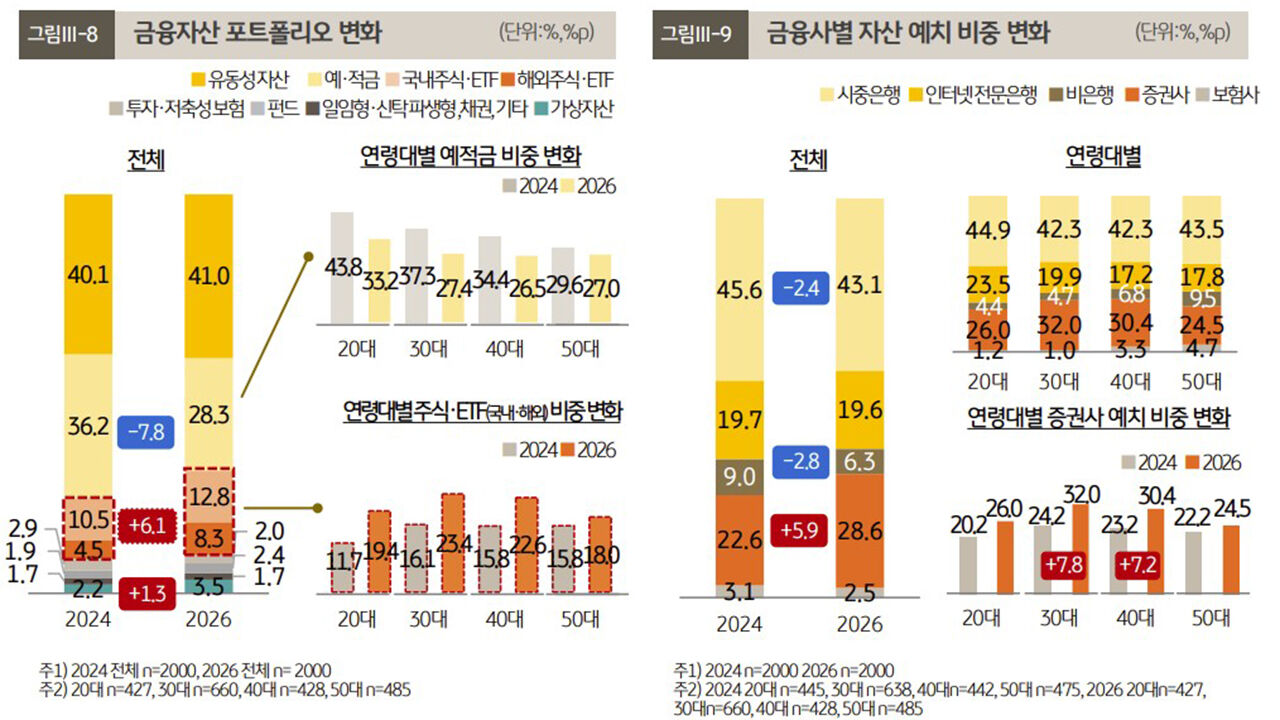
▲ Changes in Financial Asset Portfolios of Single-Person Households
Financial assets of single-person households are rapidly shifting from savings and deposits toward investment assets such as stocks and exchange-traded funds (ETFs).
According to the 2026 Korea Single-Person Household Report released by the KB Financial Group Management Research Institute on July 19, the share of savings and deposits in the financial asset portfolios of single-person households stood at 28.3% this year, down 7.8 percentage points (p) from 36.2% in 2024.
Conversely, the proportion of domestic and international stocks and ETFs rose by 6.1 percentage points from 15.0% to 21.1% during the same period.
The share of virtual assets also expanded from 2.2% to 3.5%.
The financial institutions where these assets are held have also shifted from banks to securities firms.
The share of deposits in commercial banks decreased by 2.4 percentage points from 45.6% to 43.1%, while the share in securities firms increased by 5.9 percentage points from 22.6% to 28.6%.
While savings and deposits remained the most common financial products held at 63.9%, this figure represents a 9.9 percentage point decline from 73.8% in 2024.
The ownership rate of overseas stocks and ETFs rose by 10.3 percentage points from 24.1% to 34.4%, while the rate for domestic stocks and ETFs increased by 5.4 percentage points from 40.4% to 45.7%.
This money move does not appear to have reached its peak yet.
Domestic stocks and ETFs were cited as the most preferred products for future investment within the next year, at 42.1%.
This is an 18.7 percentage point surge compared to 2024.
The intention to invest in overseas stocks and ETFs also rose by 13.0 percentage points from 24.8% to 37.8%.
A rise in so-called 'debt-financed investment' was also confirmed.
Among single-person households with loans, 34.0% of respondents said they had experience investing borrowed money into financial products, an increase of 5.2 percentage points from two years ago.
The proportion of those currently managing financial products using loan funds increased from 11.3% to 15.5%.
The average investment amount using loans was approximately 30 million won, and the rate of men who had experienced such investments was 42.4%, about double that of women (21.7%).
The institute noted, "Leveraged investment is not a phenomenon across all single-person households but is skewed toward men," adding, "As investments involving loans expand, the risk for male single-person households may also increase."
In terms of housing, a notable trend was the rapid decline in jeonse (lump-sum deposit rental) and an increase in monthly rent.
Monthly rent was the most common form of housing occupancy for single-person households at 48.8%, followed by home ownership (23.8%), jeonse (23.4%), and others (4.1%).
Compared to 2024, the share of jeonse decreased by 6.6 percentage points, while monthly rent and home ownership increased by 3.7 percentage points and 2.0 percentage points, respectively.
Among those living in rented homes, 10.7% of respondents reported having experienced difficulty paying monthly rent on time, an increase of 2.8 percentage points from 7.9% in 2024.
The delinquency rate for men was 14.5%, about three times that of women (4.9%).
In particular, the delinquency rate for monthly rent among men in their 50s reached 25.6%.
Satisfaction with living alone has increased.
The response that they are satisfied with their current life as a single-person household was 73.5%, up from 71.2% two years ago.
58.3% of respondents expressed a high intention to continue living alone in the future, with 61.4% citing "the comfort of living alone" as the primary reason.
However, 33.4% of single-person households reported feeling significant loneliness, and 32.0% reported feeling significant depression, revealing emotional challenges.
Additionally, participation in side jobs, or so-called 'N-job' activities, increased from 42.0% in 2022 to 54.8% in 2024, and 59.6% this year.
The most common side job activity among N-job participants was 'app-tech' (75.1%), such as checking attendance on apps or accumulating points.
This was followed by 'social creators' such as bloggers (11.7%), service workers at convenience stores (8.0%), and delivery riders (5.5%).
This report was based on a survey of 2,000 economically active single-person households aged 25 to 59 living in major cities across the country, conducted from February 25 to March 23.
(Photo: Courtesy of KB Financial Group, Yonhap News)
※ Please note: This article was translated by AI and may contain errors.


 Video News
 Video News
 Video News
 Video News
 Video News