
 KOR
KOR
Now, that workplace stands at a crossroads of survival. Store shelves emptied by the day, and her colleagues left the company one by one. She found it hard to look up when an 80-something regular customer, with tears in their eyes, asked, "Where should I go if this place closes down?" What was most frustrating was that she had not received a proper explanation about future plans from the company she had worked at for nearly 20 years. The majority of employees agreed that they would even accept restructuring if it meant saving the company. Holding onto the single hope that they could revive the business if they waited and endured, they kept stocking shelves and sweeping and cleaning the store.
However, as time passed, hope turned into despair. Song, who supports her husband battling terminal liver cancer, a child preparing for employment, and another in college, said, "What worries me most is how we will survive going forward." Around her, quite a few colleagues left the company voluntarily to use their severance pay for living expenses after wages went unpaid for several months. The reality is that there are few suitable jobs available for those who have left. Homeplus employees say that many who resigned are scraping by, moving from job to job in cleaning, restaurants, or short-term part-time work.
Rehabilitation Proceedings Halted After 1 Year and 4 Months... "A Company That Slowly Aged"

The Seoul Bankruptcy Court halted the rehabilitation proceedings of Homeplus, which began in March last year, after one year and four months. This was because the company failed to secure 200 billion won, the minimum operating capital required to implement the rehabilitation plan. MBK Partners, the major shareholder that acquired Homeplus in 2015, and Meritz Financial Group, the largest creditor, have struggled to find common ground over who should bear how much of the funding. With its operating funds depleted, Homeplus abruptly announced the closure of 67 stores nationwide on July 13, just 10 minutes before opening hours. The sudden declaration of closure left both customers visiting the stores and employees preparing to welcome them utterly bewildered.
The Homeplus branch of the Mart Union criticized, "MBK and the management claimed it was a measure to continue business operations in connection with a 50% discount event on items, but they showed their true colors as soon as the weekend passed." They added, "They once again made a surprise notification of the catastrophic decision to temporarily close all stores without a single word of notice to the union and employees."
MBK Acquired Homeplus with Debt... Fails to Keep Up with Pace of Change
"We Want to Save the Company Even If It Means Cutting Our Salaries"... Urging Government Intervention

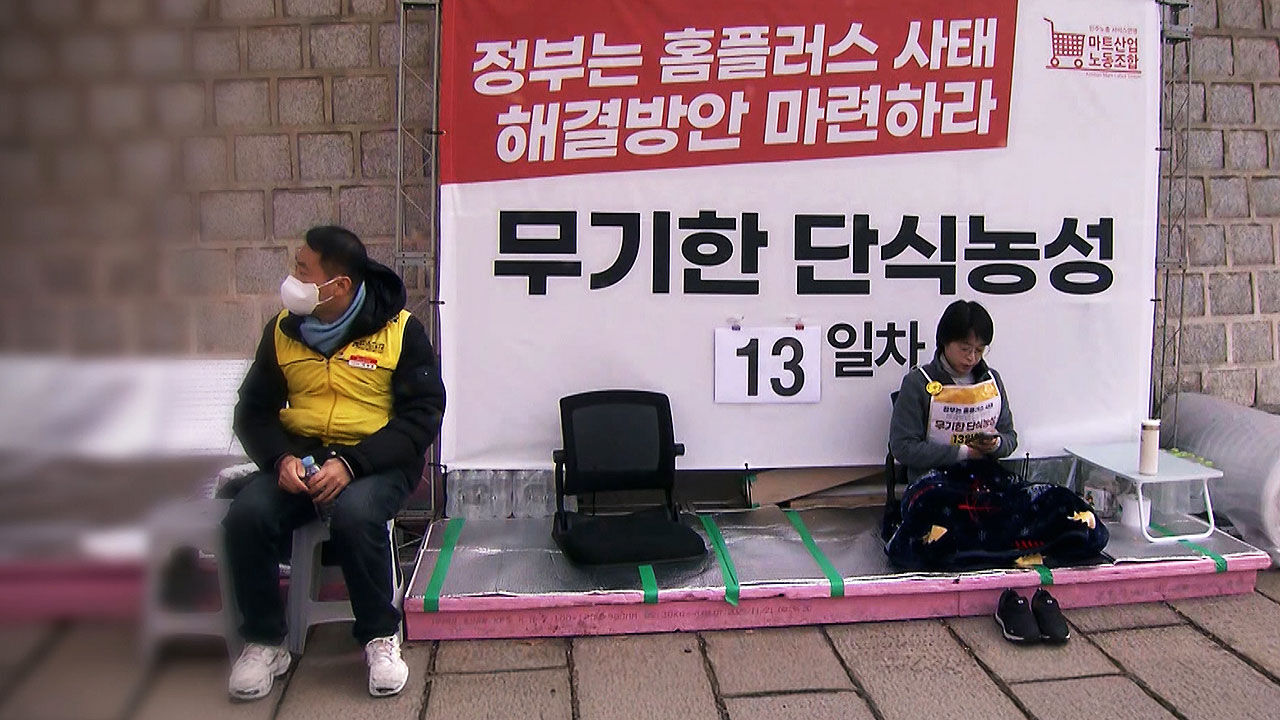
The Mart Industry Union is urging active government intervention, claiming that the major shareholder, MBK Partners, is failing to fulfill its responsibility to normalize Homeplus. The union laments that, in contrast to when the president himself stepped up during his candidacy to promise the normalization of Homeplus, it is now difficult to find any measures from the political sphere. Although politicians and financial authorities rushed to announce private equity control measures after the Homeplus crisis erupted, critics point out that the prepared regulations lack sufficient controlling power. Some view these measures as mere "showpiece" actions that do not require legislative amendments, such as strengthening inspections and supervision of private equity funds by the Financial Supervisory Service or establishing voluntary internal control standards. All bills aimed at regulating private equity funds remain pending, having failed to pass the threshold of their respective standing committees. Lee Han-jin, a research fellow at the Democratic Labor Institute, criticized, "The reduction of the leverage limit (from 400% to 200%), which was a major point of contention, lost its regulatory effectiveness as it was modified through coordination by the Financial Services Commission to impose a post-reporting obligation when exceeding 200%." He also criticized that measures to protect workers, who were the primary victims of private equity funds, remained at the level of "notifying worker representatives of the impact on employment."
Regulatory Mechanisms for Private Equity Needed... "Strictly Ban Capital Outflow Activities"
Transparent communication between labor and management is also crucial. In Europe, if a private equity fund acquires 10% or more of a non-listed company's shares, it is legally mandated to notify stakeholders, including the company's workers, of detailed information such as future business strategies and the impact on employment. This provides a minimal mechanism for employees to be aware of and respond to corporate changes in advance. Earlier this year, the structural innovation-type rehabilitation plan submitted by Homeplus to the court included store closures and workforce reductions. Although opinions within the union were divided, many workers said, "Let's endure restructuring if it means saving the company." Some even voiced, "I want to save the company even if it means giving up several months of salary." There was a desperate sentiment that "we can only survive if the company survives." Ultimately, however, even this plan was not properly implemented.
Corporate Failure: The Pain Starts from the Very Bottom
(Reference) Lee Han-jin, Research Fellow, Democratic Labor Institute Issue Paper <Problems and Improvement Measures of Private Equity Regulation Directions After the MBK Homeplus Crisis>
(Photo: Yonhap News)
※ Please note: This article was translated by AI and may contain errors.


 Video News
 Video News
 Video News
 Video News
 Video News