
 KOR
KOR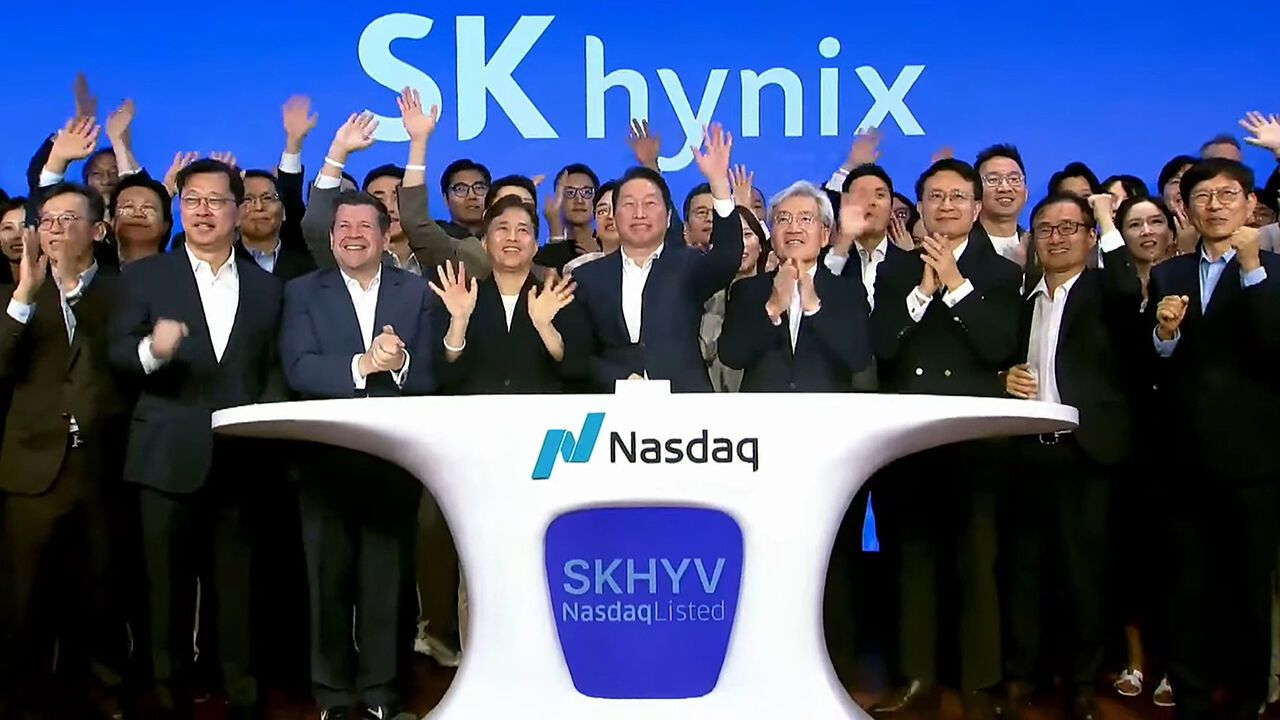
▲ SK Group Chairman Chey Tae-won, SK Hynix CEO Kwak Noh-jung, and SK Hynix Independent Director and Board Chair Ko Seung-beom, along with other employees, mark the start of ADR trading at the opening bell ceremony held at the Nasdaq MarketSite in New York on the morning of the 10th (local time).
As pressure from the U.S. government for investment in the United States intensifies, SK Hynix, which has successfully listed on the Nasdaq, has officially left the door open for potential semiconductor production facility investments in the U.S.
Observers suggest that if the establishment of a U.S. production base becomes a reality, it could be followed by investments in the U.S. worth hundreds of trillions of won over the long term.
In an interview with CNBC at an ADR listing commemorative event held in New York on the 10th (local time), SK Group Chairman Chey Tae-won stated, "We are considering additional investments beyond the advanced packaging facility in Indiana," adding, "If conditions such as power, water, workforce, and supply chains are met, the construction of a memory production plant is also possible."
He further added that, separate from a memory plant, investments worth tens of billions of dollars could also be made in AI data centers, related technologies, and joint ventures.
Currently, SK Hynix is building a semiconductor advanced packaging production base in West Lafayette, Indiana, with an investment of 3.87 billion dollars (approximately 5.6 trillion won), and established an AI solution company, tentatively named AI Company, in the U.S. earlier this year.
Chairman Chey's remarks regarding additional investment are drawing attention as they came immediately after U.S. Secretary of Commerce Howard Lutnick publicly urged Samsung Electronics and SK Hynix to expand memory production within the United States the previous day.
At an event for the New York plant of competitor Micron Technology, Secretary Lutnick said, "I want to bring Samsung and SK Hynix to the U.S. and have them build production facilities."
Within the industry, there have been observations that the U.S. government is likely to continue demanding further investment expansion, especially as SK Hynix recently announced large-scale domestic investment plans centered on the Yongin Semiconductor Cluster, Cheongju, and the Honam region.
In particular, there is an interpretation that the U.S. could use tools such as semiconductor tariffs as negotiating leverage to pressure global semiconductor companies to expand local production.
At the end of last month, SK Hynix unveiled a plan to build an AI memory production belt in Korea worth 1,100 trillion won, centered on the Yongin Semiconductor Cluster, Cheongju, and the Honam region.
Industry insiders believe that the U.S. government is highly likely to demand an expansion of investment, citing the relatively smaller scale of U.S. investment compared to such large-scale domestic investments.
The U.S. government's demand for the expansion of memory production facilities is rooted in a strategy to reorganize the core semiconductor supply chain for the AI era around its own country.
The Trump administration is pursuing policies to expand its domestic semiconductor manufacturing base and reorganize the core AI supply chain with the U.S. at the center.
As Chairman Chey has left open the possibility of building a memory production plant in the U.S., attention is focused on whether concrete investment plans will emerge in the future.
(Photo: Yonhap News)
※ Please note: This article was translated by AI and may contain errors.


 Video News
 Video News

 Video News
 Video News