
 KOR
KOR
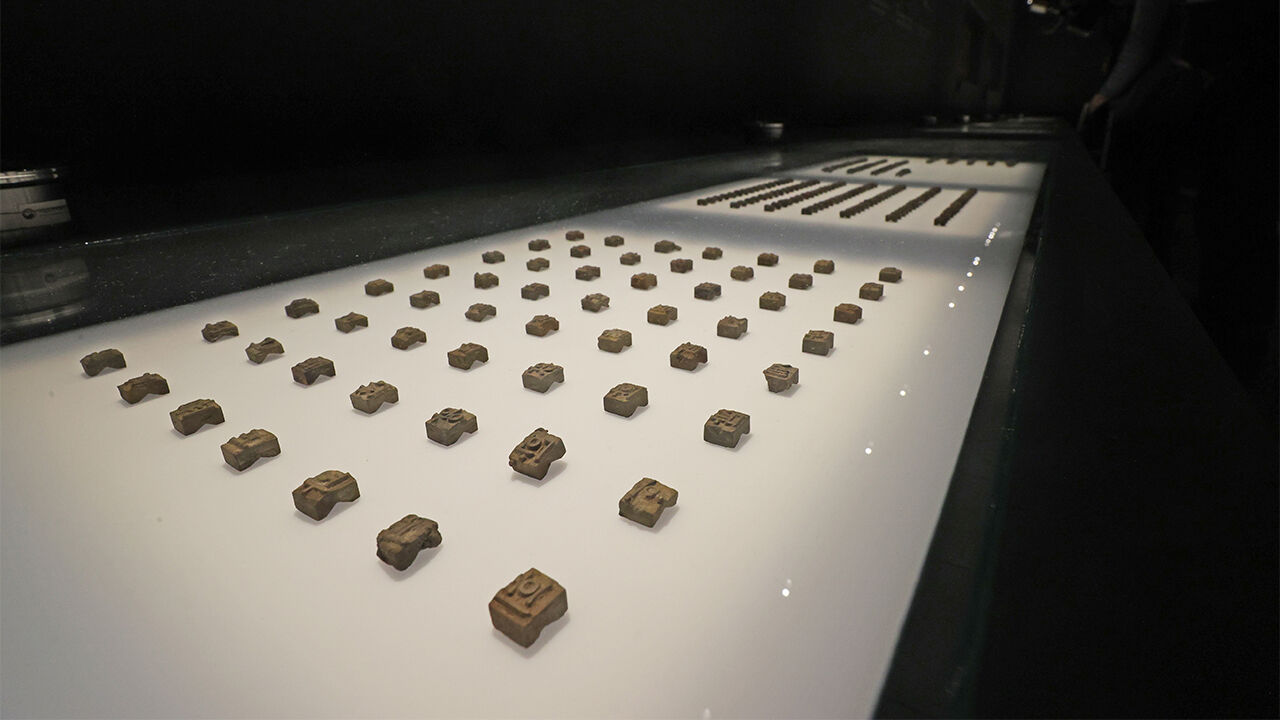
▲ Metal movable type unearthed in Insadong, Seoul
Research results have identified a new type of metal movable type among the Joseon Dynasty artifacts that drew significant attention after being discovered in large quantities in downtown Seoul about five years ago.
According to academic circles on July 8, Lee Jae-jeong, a former curator at the National Museum of Korea, stated in a paper published in the latest issue of "Journal of Bibliography," an academic journal by the Bibliographical Society of Korea, that "an examination of the metal type unearthed in the Gongpyeong district of Seoul has confirmed the presence of 'Gyechukja' (癸丑字), cast in 1493, for the first time."
In 2021, approximately 1,600 pieces of early Joseon Dynasty metal type, estimated to have been produced in the 15th and 16th centuries, were discovered in a mass find in the Insadong area near Tapgol Park in downtown Seoul.
The type, which was contained in a jar at the time of discovery, included the 'Gabinja' (甲寅字) made in 1434, the 'Eulhaeja' (乙亥字) cast in 1455, and the 'Eulyuja' (乙酉字) produced in 1465.
Metal movable type is typically named after the sexagenary cycle year in which it was cast.
Lee, an expert who has spent over 20 years organizing and researching movable type artifacts at the National Museum of Korea, analyzed the type by re-examining drawings and photographs based on the excavation report.
Lee first re-examined the types and quantities, focusing on artifacts whose forms could be identified, and revised the total count of individual type pieces from 1,650 to 1,657.
Lee focused on the type whose specific classification had not yet been clearly identified.
He concluded that 54 pieces in total—consisting of large and small type previously presumed to be Eulhaeja, Eulyuja, or Gyeongjaja (cast in 1420)—were highly likely to be Gyechukja.
The large Gyechukja type measures an average of 2.1 cm in width and 1.7 cm in height, while the small type measures approximately 1.0 cm in width and 1.3 cm in height.
"After reviewing and comparing them with Gyechukja-printed editions of 'Zizhi Tongjian Gangmu' (Comprehensive Mirror for Aid in Government) and 'Sinjeung Dongguk Yeoji Seungnam' (Revised Augmented Survey of the Geography of Korea), I found that there are characters identical to the type (unearthed in Insadong)," Lee explained.
In a phone interview, he said, "Gyechukja had a short period of use, and books printed with it are rare; until now, no physical examples had been confirmed."
He added, "Looking at materials printed with Gyechukja, the large type is extremely big compared to other types, and the ratio between large and small type also differs from other sets," noting that its characteristics are distinct.
Lee stated the significance of the research, saying, "I have confirmed that the casting dates of the metal type unearthed in the Gongpyeong district span approximately 60 years, from the Gabinja of 1434 to the Gyechukja of 1493."
Regarding the form of the metal type, Lee expressed the view that "since there is a clear distinction between the form of the Gabinja and those that followed, it is necessary to pay close attention to these changes."
He said, "While the back of the Gabinja comes in various forms, such as square grooves, cross-shaped grooves, and vertical tunnel shapes, the others are relatively consistent, with large and medium type featuring vertical tunnel shapes and small type featuring horizontal tunnel shapes."
He further judged that the form of the type likely changed because "while the form of the Gabinja was effective for improving typesetting speed, it was difficult to cast, which reduced efficiency."
However, Lee mentioned the inability to examine the physical type as a limitation of the research.
The metal type unearthed in Insadong was transferred to the National Palace Museum of Korea last year and is currently in storage.
The museum published a paper in the journal of the Korean Society of Conservation Science for Cultural Heritage last year analyzing the materials and production characteristics of the type, but follow-up research has not yet begun in earnest.
The research team noted that "given that the metal type was intentionally buried in a ceramic vessel and that post-processing, such as removing casting burrs from the surface of the type, was not performed, the possibility of their actual use is low."
Lee said, "I hope that in the future, we can attempt more precise verification by examining the physical type and comparing them with printed copies."
(Photo: Courtesy of National Palace Museum of Korea, Yonhap News)
※ Please note: This article was translated by AI and may contain errors.


 Video News
 Video News
 Video News
 Video News
 Video News