
 KOR
KOR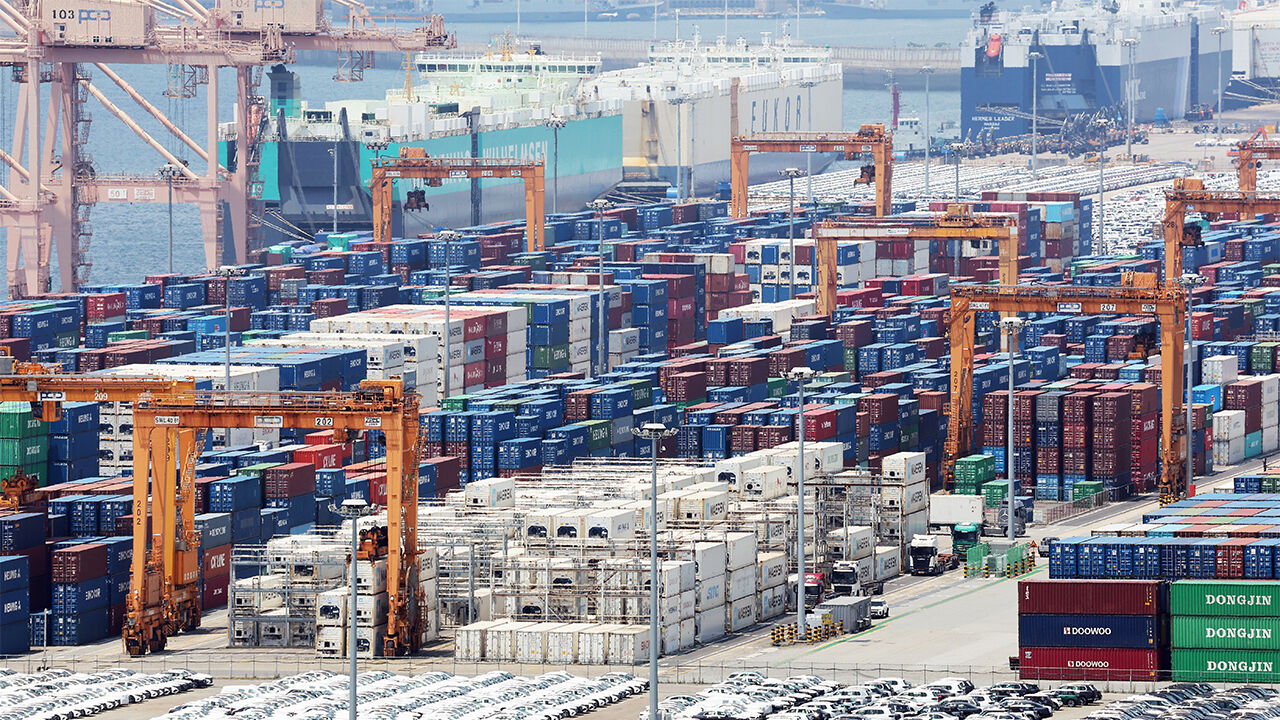
▲ Containers are stacked at Pyeongtaek Port in Gyeonggi Province on July 1.
The Organization for Economic Cooperation and Development (OECD) has maintained its economic growth forecast for South Korea this year at 2.6 percent.
The organization assessed that the Korean economy is showing signs of recovery, supported by measures such as the distribution of consumption vouchers, despite the impact of the martial law situation and the war in the Middle East.
While the consumer price inflation rate has hit the 3 percent range for two consecutive months, the OECD expects the annual rate for this year to remain in the 2 percent range.
According to the OECD Economic Survey of Korea 2026, released today (July 2), the organization stated that South Korea's gross domestic product (GDP) growth is projected to reach 2.6 percent this year and 1.9 percent next year, consistent with its forecast from a month ago.
The OECD analyzed that private consumption, government fiscal spending, and a sustained strong export performance driven by the semiconductor super-cycle will lead Korea's economic growth.
It evaluated that consumer sentiment, which had been dampened by the martial law declaration, has recovered due to expansionary fiscal policies, and that consumption vouchers have significantly contributed to the recovery of consumption and small business owners.
The report also analyzed that the negative impact of the Middle East war, which broke out early this year, was minimized through swift crisis response measures.
However, the OECD pointed out limitations, noting that the price ceiling on oil and cuts to fuel taxes entail fiscal costs and provide benefits even to high-income households.
Regarding expectations that the semiconductor super-cycle may soon end, Jon Pareliussen, head of the Korea-Sweden Desk at the OECD, stated, "I think it is premature," adding, "I believe Korea will continue to grow well."
Private consumption is expected to increase by 2.2 percent this year and 2.1 percent next year.
The forecast for government consumption was set at 2.9 percent and 2.1 percent, respectively.
Private investment is expected to shrink in the short term due to geopolitical uncertainties such as the war in the Middle East, but it is projected to rebound in the second half of the year.
Accordingly, gross fixed capital formation, which includes facility and construction investment, is expected to grow by 2.1 percent this year and 2.2 percent next year.
Export growth is projected to reach 6.0 percent this year before slowing to 1.9 percent next year, with its contribution to growth expected to moderate in the medium term.
The import growth forecasts for this year and next year were set at 4.4 percent and 2.1 percent, respectively.
The unemployment rate is expected to fall slightly to 2.8 percent this year and 2.7 percent next year, while consumer price inflation is projected at 2.6 percent and 2.2 percent.
The OECD diagnosed that while inflation is expected to rise for the time being due to higher energy prices, inflationary pressure from the demand side remains low.
It added, "Monetary policy should focus on stabilizing long-term inflation expectations rather than responding to temporary inflationary pressures caused by energy price shocks."
In this regard, the OECD specified in its report that the Bank of Korea should consider a short-term base rate hike of 25 basis points (1bp=0.01 percentage point).
(Photo: Yonhap News)
※ Please note: This article was translated by AI and may contain errors.


 Video News
 Video News
 Video News
 Video News
 Video News