
 KOR
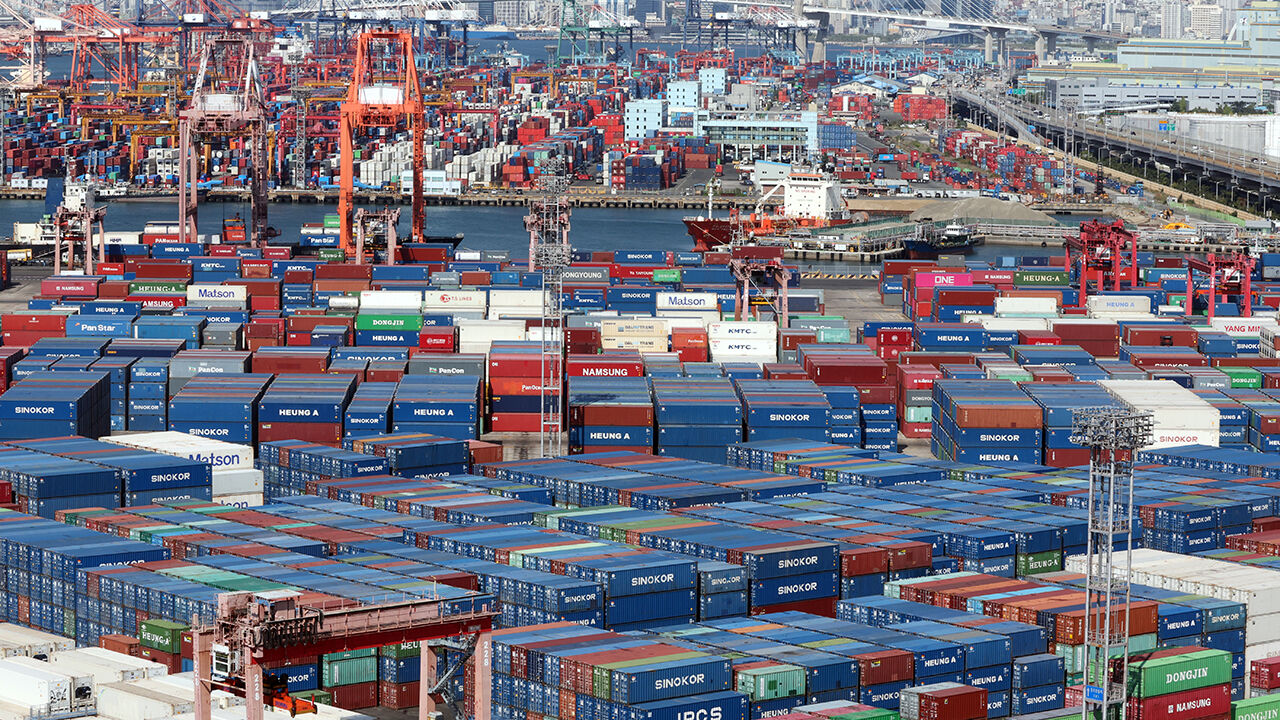
▲ Containers stacked at the Port of Busan
Driven by strong semiconductor exports, South Korea's current account surplus for September exceeded 60 billion dollars, marking an all-time high.
The cumulative surplus for this year has surpassed 340 billion dollars.
According to preliminary balance of payments data released by the Bank of Korea on the 5th, the current account surplus for September stood at 61.46 billion dollars (approx. 82.5 trillion won).
This surpasses the previous monthly record set in June of this year (49.73 billion dollars).
This is also the first time that the monthly current account surplus has exceeded 60 billion dollars.
The cumulative current account surplus from January to September of this year reached 340.66 billion dollars.
This is more than four times the figure from the same period last year (83.89 billion dollars).
The Bank of Korea expects this year's annual current account surplus to exceed the 450 billion dollars projected in the August economic outlook.
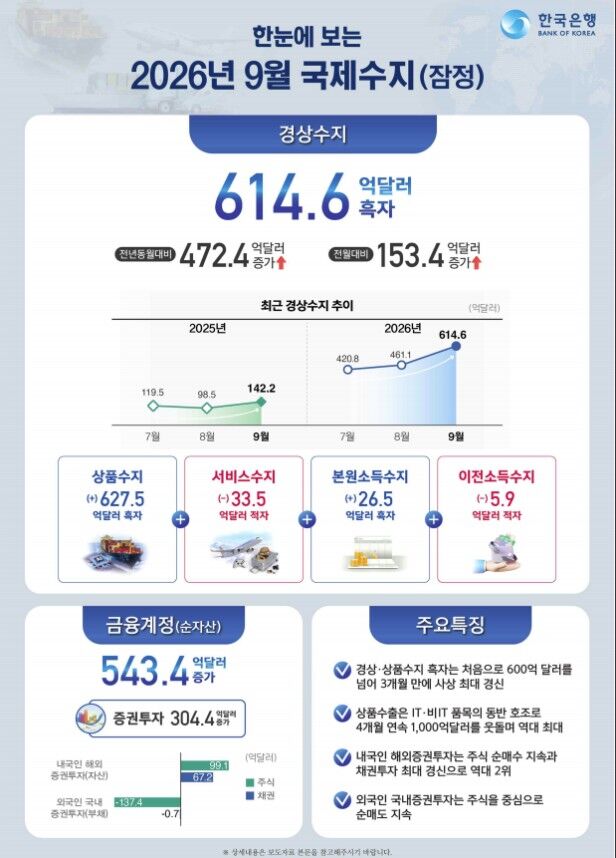
Breaking down the September current account by category, the goods balance recorded a surplus of 62.75 billion dollars.
This is also the largest surplus on record, surpassing the previous high in June (47.89 billion dollars).
Exports reached 130.72 billion dollars, surging 92.4% compared to a year earlier.
Both information technology (IT) and non-IT exports showed concurrent strength.
Goods exports exceeded 100 billion dollars for four consecutive months, reaching an all-time high.
By item, based on customs clearance, high growth rates were seen in computer peripheral SSDs (392.3%), semiconductors (260.3%), and petroleum products (73.3%).
By region, exports increased to the United States (136.9%), China (123.1%), Southeast Asia (113.2%), Japan (25.2%), and the eurozone (EU, 21.2%).
Exports decreased to the Middle East (-14.1%) and Central and South America (-3.6%).
Imports (67.97 billion dollars) also rose by 29.4%, but this growth rate was lower than that of exports.
Based on customs clearance, capital goods imports increased by 42.3%, centered on semiconductors (92.8%), semiconductor manufacturing equipment (49.2%), and information and communication devices (37.3%).
Raw material imports rose by 21.3%, mainly led by gas (42.5%), crude oil (38.4%), and coal (24.2%), while consumer goods imports increased by 2.0%.
The services account recorded a deficit of 3.35 billion dollars.
While the deficit size decreased compared to September of last year (-3.48 billion dollars), it increased compared to August of this year (-1.68 billion dollars).
Within the services account, the travel deficit stood at 770 million dollars in September, following August.
This was the result of concurrent declines in both outbound travelers (2.43 million to 2.26 million) and inbound travelers (2.24 million to 2.06 million).
The primary income account surplus widened from 1.92 billion dollars in August to 2.65 billion dollars in September.
As the seasonal effects of quarterly dividend payments for securities investments dissipated, the dividend income surplus increased from 1.18 billion dollars to 2.24 billion dollars.
Financial account net assets (assets minus liabilities) increased by 54.34 billion dollars, recording the largest increase on record.
The previous record high was in June of this year (46.71 billion dollars).
For direct investment, domestic overseas investment increased by 11.43 billion dollars, and foreign domestic investment increased by 6.52 billion dollars.
In portfolio investment, domestic overseas investment increased by 16.63 billion dollars, while foreign domestic investment decreased by 13.81 billion dollars, showing contrasting trends.
In particular, domestic overseas securities investment, which includes retail investors trading overseas (known as "Seohak ants"), recorded the second-largest scale on record following October of last year (17.29 billion dollars).
While overseas stock investments (9.91 billion dollars) maintained high levels, bond investments also recorded a record-high increase of 6.72 billion dollars.
Foreigners' domestic stock investments decreased by 13.74 billion dollars, and bond investments decreased by 70 million dollars.
(Photo provided by the Bank of Korea, Yonhap News)
※ Please note: This article was translated by AI and may contain errors.


 Video News
 Video News
 Video News
 Video News
 Video News