
 KOR
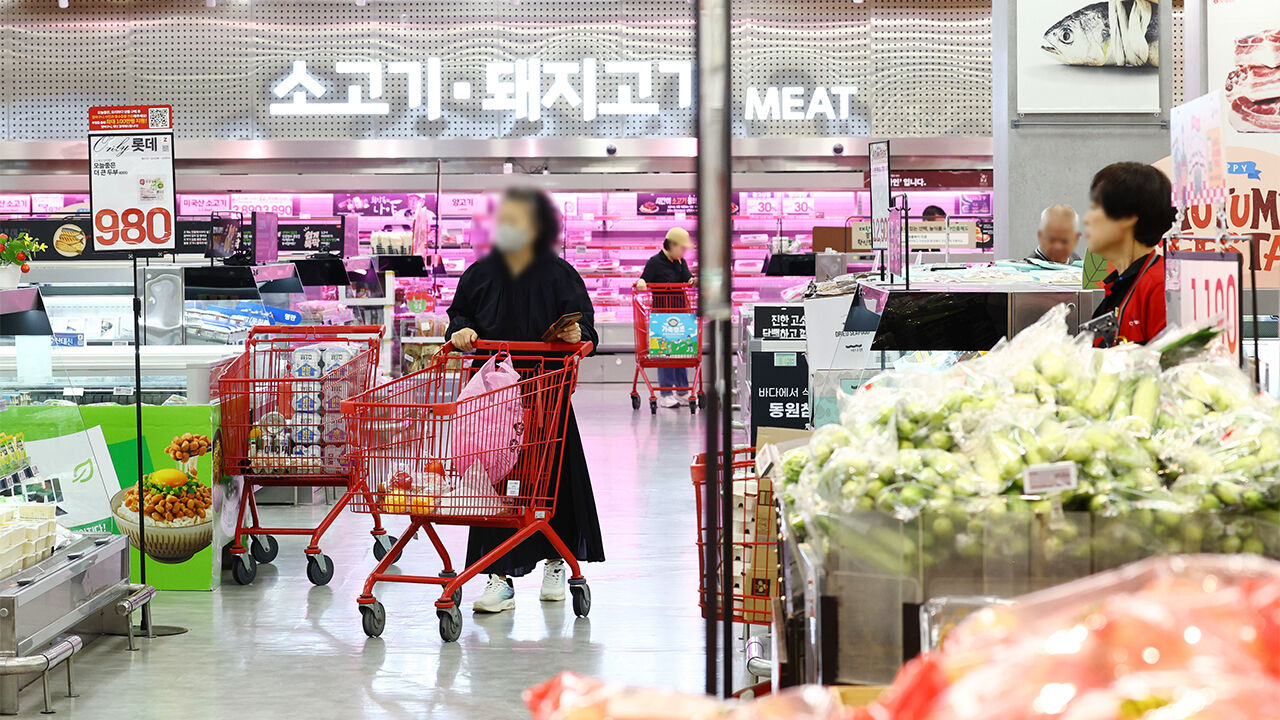
▲ Citizens shopping at a large discount store in Seoul
While solid economic growth continues, centered around the semiconductor sector, the warmth of recovery is struggling to reach domestic consumption.
Retail sales in the third quarter (July–September) turned negative compared to the same period last year for the first time in five quarters.
Sales at large discount stores fell for the 10th consecutive quarter, marking the longest downturn on record, while accommodation, food services, and wholesale and retail trade—sectors closely tied to domestic demand—experienced a simultaneous slump.
In contrast, production in the financial and insurance sector showed a high growth rate, and retail sales at duty-free shops also increased thanks to tourist demand, highlighting a stark temperature difference between industries and business types.
According to the National Data Office's Korea Statistical Information Service (KOSIS) and Industrial Activity Trends on November 1, the retail sales index (constant prices) for the third quarter decreased by 0.5% from a year earlier.
This marks the first decline in five quarters since a 0.1% drop in the second quarter of last year, with the contraction being the largest since the first quarter of last year (-0.8%).
The government attributed the downturn to a base effect stemming from the execution of livelihood recovery consumption coupons last year.
It explained that passenger car sales declined due to summer vacations and strikes in the automotive industry, and that durable goods consumption was pulled forward by home appliance refund events in the first half of the year.
In fact, durable goods retail sales in the third quarter dropped by 7.0% compared to the same period last year, with passenger cars falling by 11.3%.
However, even when excluding passenger cars, the retail sales index edged up by a mere 0.9% year-on-year.
Compared to the first quarter (2.5%) and second quarter (2.4%) of this year, this represents a sluggish growth pace.
Semi-durable goods such as clothing fell by 0.8% in the third quarter compared to last year, and only non-durable goods—driven by smaller purchases like food, beverages, and cosmetics—saw a 2.7% increase.
Looking at retail performance by business type, sales at large discount stores decreased by 1.9%.
Having started to decline in the second quarter of 2024 (-1.7%), sales have now fallen for 10 consecutive quarters.
This is the longest continuous decline since relevant statistics began being compiled in 2010.
In addition to the contraction of the supermarket industry itself due to the expansion of online shopping, store closures stemming from the Homeplus situation have overlapped, making it difficult for supermarket retail sales to recover.
Nevertheless, the contraction was smaller than in the previous second quarter (-9.4%), which had seen the largest drop on record.
On the other hand, retail sales at duty-free shops, frequented by tourists, rose by 3.0%, marking the largest increase in nine quarters since the second quarter of 2024 (7.9%).
Department store sales also grew by 4.3%, maintaining an upward trend for five consecutive quarters.
Fortunes also diverged across sectors within service industry production.
The overall service industry production index in the third quarter rose by 3.4% compared to the same period last year.
Among them, accommodation and food services, which are closely linked to domestic demand, dropped by 2.2%.
This is the first negative figure in five quarters since a decline in the second quarter of last year (-1.9%).
The contraction size was the largest since the first quarter of last year (-3.3%).
Wholesale and retail trade also dipped by 0.2%, returning to a downward trend for the first time in seven quarters since the fourth quarter of 2024 (-1.5%).
Conversely, production in the financial and insurance sector increased by 9.2% year-on-year.
This is the highest growth rate in 13 quarters since the second quarter of 2023 (9.5%).
Analysts attribute this increase in financial and insurance production to a buoyant stock market compared to last year and a significant surge in trading values.
Experts analyze that the widening temperature gap in domestic demand stems from the growth effect centered on semiconductors failing to sufficiently spread to households through employment and income.
The government similarly acknowledges that despite broader economic growth, burdens on people's livelihoods such as inflation persist, and structural issues like polarization across sectors remain.
In response, authorities stated that they will accelerate efforts to stabilize livelihoods and alleviate polarization so that the warmth of growth can spread to the lives of all citizens.
(Photo: Yonhap News)
※ Please note: This article was translated by AI and may contain errors.


 Video News
 Video News
 Video News
 Video News
 Video News