
 KOR
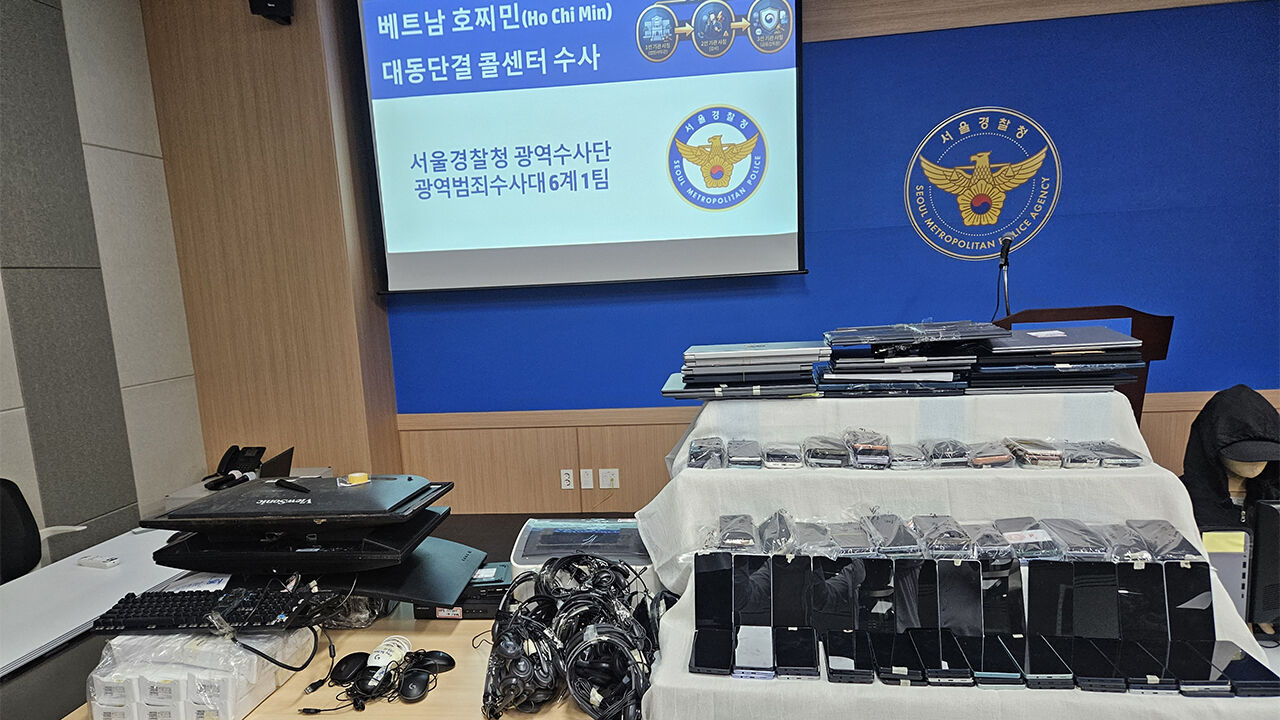
▲ Electronic devices used in the crimes
More than 30 members of a corporate-style phishing organization called "Daedongdan-gyeol," which swindled approximately 8.1 billion won, have been arrested.
The group had been operating out of its base in Ho Chi Minh City, Vietnam.
The Seoul Metropolitan Police Agency's Wide-Area Investigation Unit announced today (October 29) that it has apprehended 54 individuals, including a 44-year-old South Korean ringleader identified by the surname A, under charges of violating the Act on Prevention of Losses from Telecommunications-based Financial Fraud, and has arrested 37 of them.
Police also slapped 45 key suspects with additional charges of forming, joining, and engaging in a criminal organization, while securing 850 million won of their criminal proceeds through pre-indictment preservation for confiscation and collection.
The suspects are members of the criminal syndicate "Daedongdan-gyeol," which based its operations in Districts 1, 4, 7, and 9 of Ho Chi Minh City.
Between July 2024 and January of this year, they are accused of pocketing 8.1 billion won after approaching 110 victims while impersonating government officials such as prosecutors, court administrative officers, and Financial Supervisory Service (FSS) employees, telling them, "You are implicated in a crime and verification is required. We will place you under temporary protective measures."
Approximately 90 percent of all victims were in their 20s and 30s, targeting mostly young adults just entering society.
The crimes were carried out in three distinct stages.
The first-tier group, posing as court administrative officers, told victims that "court notices regarding crimes such as prostitution have been returned," luring them to access a fraudulently created website to secure their personal information and financial scale.
The second-tier group, sharing this intelligence and posing as prosecutors, isolated victims in accommodations such as lodging facilities under the pretext of "conducting temporary protective measures and investigations."
They effectively placed victims under confinement by calling them every hour to check their locations and blocking contact with the outside world.
Victims were prohibited from going to work or leaving without prior permission.
The syndicate displayed meticulous criminal methods, such as forcing victims to replace their mobile phones, install hacking apps, and read aloud fabricated arrest warrants multiple times, police explained.
Once psychological control over the victims was established by the first- and second-tier groups, they initiated the full-scale theft of money and valuables.
The third-tier group, impersonating FSS employees, instructed victims that "their accounts are tied to a case and require asset auditing," prompting them to reissue check cards or withdraw cash and store it in specific locations.
They were also coerced into purchasing and transferring virtual assets.
The crimes spanning tiers one through three took anywhere from six to seven hours to as long as two months.
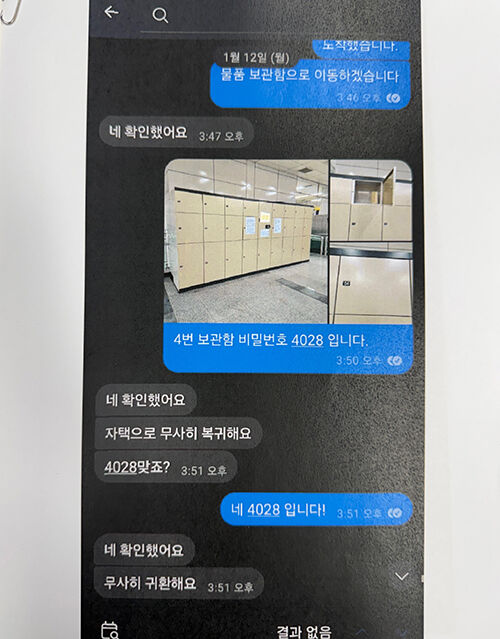
▲ Text message exchange between a victim and a third-tier syndicate member
The Daedongdan-gyeol organization was formed in July 2024 under the leadership of a Chinese ringleader identified as B.
B and South Korean ringleader A established the organization in District 7 of Ho Chi Minh City, recruiting lower-level members by drawing in senior and junior acquaintances from their local areas, as well as through internet advertisements and recruitment fixers.
When hiring members, they required applicants to submit a National Health Insurance qualification acquisition and loss confirmation certificate issued by the National Health Insurance Service to verify they were not undercover police officers.
To blend in with the local perception of people near their office in Vietnam, members were required to wear suits or shirts during commutes.
To maximize criminal proceeds, they even operated an incentive system that paid out 6 to 8 percent of profits as rewards.
Their crimes were uncovered in January of this year during an administrative inspection by Vietnamese public security.
Public security caught 29 South Roreans engaging in phishing crimes at an office in the Him Lam area of District 7, Ho Chi Minh City, and notified the South Korean Embassy in Vietnam.
In April, the Seoul Metropolitan Police Agency launched a joint investigation with Ho Chi Minh public security, the Vietnamese consul, and the National Police Agency's International Cooperation Division 1. Starting in August, they repatriated 25 of the 29 suspects detained in foreign national shelters to South Korea across eight operations, arresting them upon arrival.
Another 29 syndicate members who fled to avoid the Vietnamese public security investigation by transiting through Thailand, China, and Kazakhstan were also apprehended in South Korea.
The remaining accomplices, including the Chinese ringleader B, are currently being tracked.
Police emphasized, "Voice phishing crimes where individuals impersonate prosecutors or investigators to demand personal and financial information or extort money are occurring recently, requiring caution."
(Photo: Electronic devices used in the crimes, Yonhap News)
※ Please note: This article was translated by AI and may contain errors.


 Video News
 Video News
 Video News
 Video News
 Video News