
 KOR
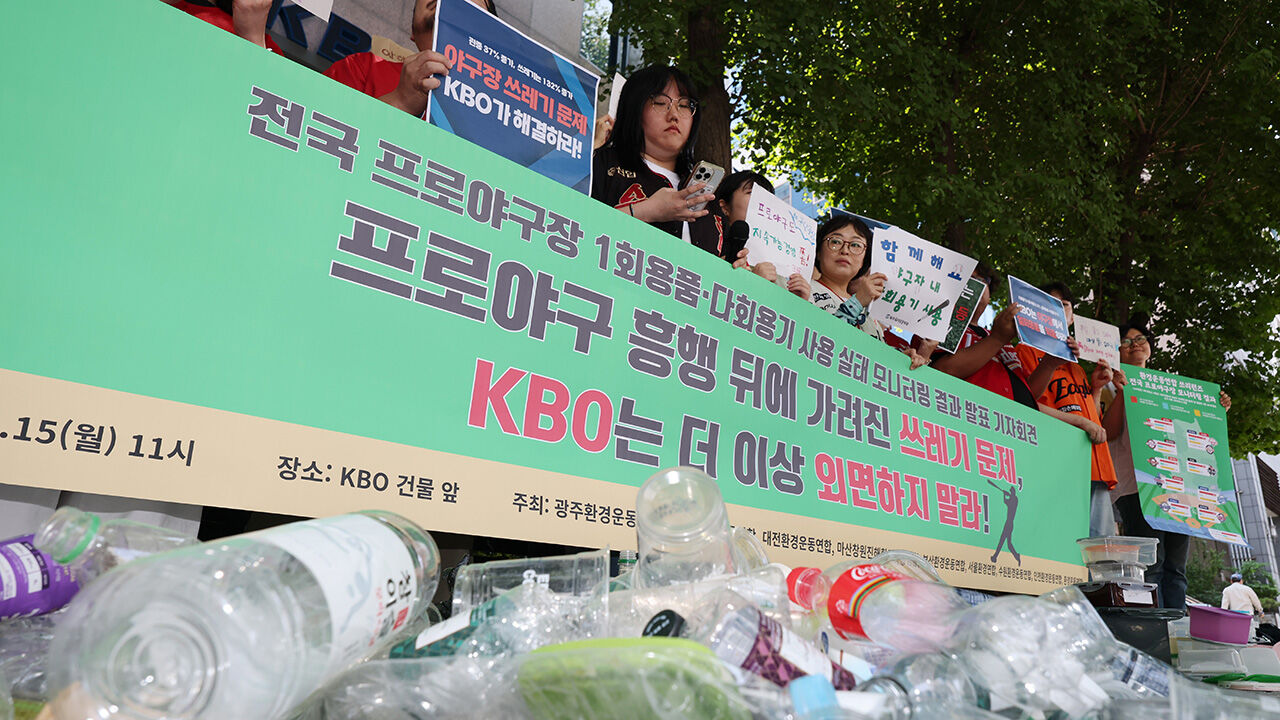
▲ Participants hold picket signs during a press conference announcing the monitoring results of single-use and reusable container usage at professional baseball stadiums nationwide, held in front of the KBO in Gangnam-gu, Seoul, on June 15.
While professional baseball attendance surged by 13% year-on-year to surpass 12 million for the first time last year, stadium waste generation jumped by 24%.
According to data submitted by the Ministry of Culture, Sports and Tourism and the Ministry of Climate, Energy and Environment to Representative Jin Sun-mee of the Democratic Party of Korea, a member of the National Assembly Culture, Sports and Tourism Committee, general waste generated at nine professional baseball stadiums nationwide totaled 2,931.7 tons last year.
This represents a 573.83-ton (24.3%) increase from 2,357.87 tons in 2024, and a 54.6% surge over two years compared to 1,895.9 tons in 2023.
Regular season attendance increased by 13.1% from 10,887,705 in 2024 to 12,312,519 last year.
This means the growth rate of waste generation outpaced the growth rate of spectators.
In particular, Jamsil Baseball Stadium, shared by the LG Twins and Doosan Bears, saw a surge in waste that is difficult to explain by mere attendance growth alone.
General waste at Jamsil rose by 132.2%, from 214.44 tons in 2023 to 497.94 tons last year.
During this period, home attendance for the two clubs during the regular season increased by 36.9%. Simply dividing the general waste by the number of spectators shows that per capita waste generation grew by 69.7%, from approximately 98.7g to 167.5g.
General waste generation at Daegu Samsung Lions Park also increased by 98.6%, from 218 tons in 2023 to 433 tons last year.
Busan Sajik Baseball Stadium saw a 61.2% increase from 254.87 tons to 410.94 tons over the same period.
Costs incurred for waste disposal and cleaning have also risen.
Excluding Gwangju-Kia Champions Field, which submitted its cost data as classified, the disposal and cleaning expenses for the other eight stadiums increased by 28.7%, from 3.50676 billion KRW in 2023 to 4.51393 billion KRW last year.
Cumulative costs from 2023 to 2025 reached a staggering 11.87314 billion KRW.
Consequently, while the introduction of reusable containers is expanding to reduce waste, there is a need to verify their actual reduction effectiveness.
Reusable containers are currently operated in 7 stadiums, and Samsung Lions Park and Sajik Baseball Stadium also plan to introduce them next year.
"We should not shift the responsibility for stadium waste issues solely onto the spectators," Representative Jin Sun-mee said, adding, "Clubs and in-stadium vendors must reduce the use of single-use items and establish an operational system that ensures proper collection of reusable containers."
She further emphasized, "Performance should be evaluated based on how much waste was actually reduced rather than how many stadiums have adopted reusable containers," and stressed that "the Ministry of Culture, Sports and Tourism, the Ministry of Climate, and the KBO must establish reduction targets and management standards for each stadium."
(Photo: Yonhap News)
※ Please note: This article was translated by AI and may contain errors.


 Video News
 Video News
 Video News
 Video News
 Video News