
 KOR
KOR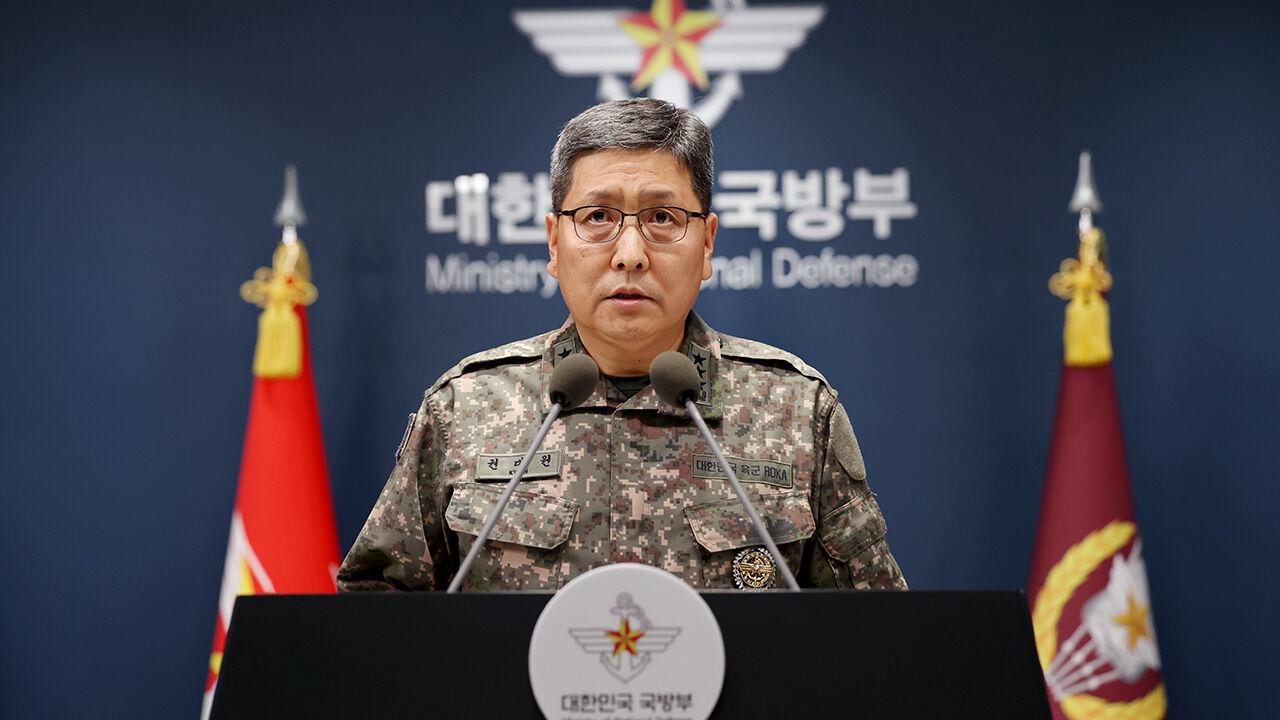
▲ Kwon Dae-won, Vice Chairman of the Joint Chiefs of Staff, announces the final findings of the joint on-site investigation task force regarding the Demilitarized Zone (DMZ) landmine explosion at the Ministry of National Defense in Yongsan-gu, Seoul, on October 5.
The South Korean military concluded today (October 5) that the explosion that occurred on September 21 in the Demilitarized Zone (DMZ) along the western front was caused by a landmine planted by North Korea south of the Military Demarcation Line (MDL).
Accordingly, the military launched a swift operation on the same day to clear the North Korean minefield south of the MDL that caused the blast.
This marks the South Korean military's first substantive measure in response to the North Korean landmine explosion in the DMZ.
During a briefing on the final investigation findings, Kwon Dae-won, Vice Chairman of the Joint Chiefs of Staff (JCS), stated, "Based on the findings of the joint investigation with the United Nations Command (UNC) and scientific evidence, we have made the final determination that our soldiers conducting normal DMZ operations south of the MDL were severely wounded by a plastic anti-personnel mine laid south of the MDL by North Korea under the pretext of so-called border fortification work."
Kwon explained that the military reached this conclusion by synthesizing the assessments of South Korean military authorities and the UNC regarding confirmed factors: the explosion site, the type and ownership of the mine, and whether the mine was deliberately planted.
First, regarding the blast site, an analysis using the Global Positioning System (GPS) confirmed that both the sites of the first and second explosions and an actual North Korean plastic anti-personnel mine discovered at the scene on September 29 were located south of the MDL.
Kwon said, "The UNC and the joint intelligence investigation team ultimately used GPS to confirm that all three points were located about 10 meters south of the MDL, determining that this constituted a violation of the Armistice Agreement."
In addition, primary and secondary chemical analyses conducted by the National Forensic Service on the injured soldiers' gear detected trinitrotoluene (TNT), thermosetting resin components, and brown foreign matter, which serve as evidence that the device was a North Korean landmine.
The National Forensic Service officially delivered these appraisal findings to the military authorities earlier this month.
Furthermore, a comparative analysis between fragments recovered from the wounded soldiers' bodies and North Korean plastic anti-personnel mines previously retrieved from the Imjin River reconfirmed that they were identical.
In addition, the military concluded from the investigation that the North Korean mines had been deliberately planted rather than washed down by floodwaters.
This conclusion was supported by testimony from soldiers at the scene who reported seeing mines buried at a depth of about 5 to 10 centimeters, as well as the fact that the North Korean plastic anti-personnel mine discovered at the site was also buried about 3 centimeters deep.
"The UNC also assessed that the mines had been deliberately emplaced and that the placement occurred more than 12 months ago," Kwon added. "Considering the spacing and interval distance between the actual mine discovered and the blast craters, it was determined to be a typical planted North Korean mine rather than a drifted one."
Following this conclusion, the military initiated an operation to clear North Korean landmines around the explosion site at around 12:51 p.m. today.
"The purpose of this operation is to remove the minefield planted south of the MDL by North Korea in violation of the Armistice Agreement," Kwon emphasized. "It was carried out safely while observing the Armistice Agreement and preparing measures to prevent accidental clashes through close coordination with the UNC."
Yang Jin-hyeok, Director of Operations at the JCS, explained, "As an effective measure in response to the casualties suffered by our troops, this operation removes North Korean mines confirmed by the UNC to be located south of the MDL."
The military warned that it will continue mine-clearing operations if North Korea does not voluntarily remove the minefields it planted south of the MDL.
"The military strongly urges North Korea to offer a sincere apology even now to our soldiers wounded in this landmine explosion and to immediately remove the landmines laid in violation of the Armistice Agreement," Kwon stressed.
(Photo: Yonhap News)
※ Please note: This article was translated by AI and may contain errors.


 Video News
 Video News
 Video News
 Video News
 Video News