
 KOR
KOR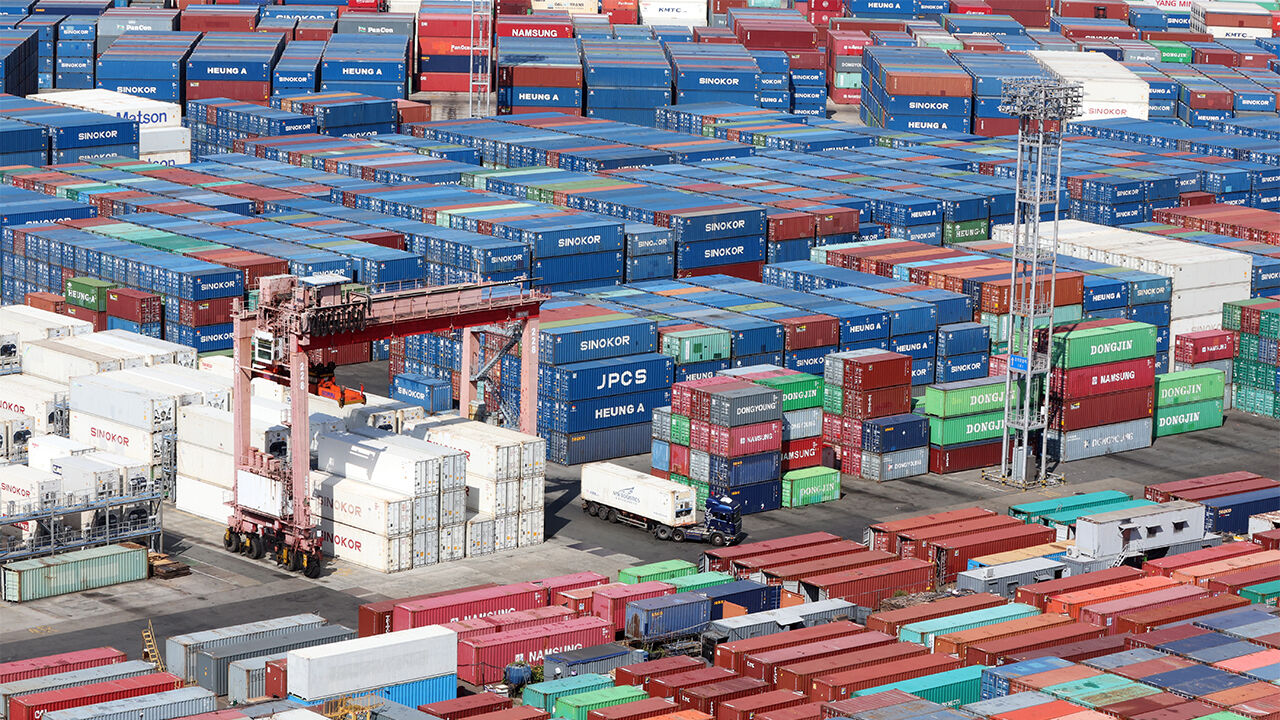
▲ Import and export cargo piled up at the Sinseondae Pier of Busan Port on the 6th of last month.
The Organisation for Economic Co-operation and Development (OECD) has raised South Korea's economic growth forecast for this year to the mid-to-high 3% range, lifting its projection by 1.1 percentage points in just three months.
Reflecting expectations that international energy prices, such as oil, will rise higher than previously projected, the inflation outlook has been adjusted upward to 3%.
In its Interim Economic Outlook report released today (the 23rd), the OECD projected South Korea's economic growth rate for this year at 3.7%.
The projection in June was 2.6%.
The OECD's newly released growth forecast for this year is higher than those of domestic and international institutions such as the Bank of Korea (3.3%), the Korea Development Institute (KDI, 3.2%), the Asian Development Bank (ADB, 3.2%), and Moody's (3.5%).
It is at a similar level to optimistic major investment banks (IBs) such as JPMorgan (3.8%), Citi (3.7%), and Bank of America (3.6%).
The OECD projected South Korea's growth rate for next year at 2.6%.
This is also a 0.7 percentage point upward revision from the June forecast of 1.9%.
![OECD Economic Outlook [Growth Rate] (Photo courtesy of the Ministry of Finance and Economy, Yonhap News)](https://img.sbs.co.kr/newimg/news/20260923/202225369_1280.jpg)
The Ministry of Finance and Economy explained that for this year's growth rate, South Korea's projection received the largest upward revision among G20 member countries in both the June and September outlooks.
The projection for next year was also revised upward by the largest margin in the September outlook.
Regarding South Korea, the OECD stated, "Strong export and production growth will lead growth this year, and a moderate recovery in consumption will continue next year."
An official from the Ministry of Finance and Economy noted, "The OECD confirmed South Korea's economic growth performance of 3.8% in the first half of this year and also reflected customs-cleared export growth trends up to the 10th of this month," adding, "It determined that this momentum will continue as export growth expands further, alongside increases in investment and production."
The inflation forecast for this year was revised upward to 3.0%, a 0.4 percentage point increase from three months ago.
Next year's inflation outlook was presented at 2.7%, up 0.5 percentage points compared to the June forecast.
Analysts attribute the OECD's upward revision of inflation to the significant upward adjustment in growth forecasts and higher projections for international energy prices compared to June.
However, inflation is projected to remain below the G20 average (4.1% for this year, 3.6% for next year).
![OECD Economic Outlook [Growth Rate] (Photo courtesy of the Ministry of Finance and Economy, Yonhap News)](http://img.sbs.co.kr/newimg/news/20260923/202225369_1280.jpg)
The OECD raised the global economic growth forecast for this year by 0.1 percentage point to 2.9%, while lowering next year's forecast by 0.1 percentage point to 3.0%.
It projected that current high international energy prices will gradually stabilize after the fourth quarter.
Downside risks to the global economy cited include sustained increases in energy prices, supply shocks from worsening weather conditions such as El Niño, and additional rises in long-term government bond yields, while the early resolution of the Middle East conflict was mentioned as an upside risk.
The expansion of AI could serve as an additional upside factor in terms of investment and production, but the OECD pointed out that close monitoring is required regarding concerns over the profitability of related companies and high leverage reliance.
In addition, the OECD emphasized the need for monetary policies to stabilize inflation expectations, targeted and temporary energy-related support policies, and structural reforms to enhance potential growth rates.
(Photo courtesy of the Ministry of Finance and Economy, Yonhap News)
※ Please note: This article was translated by AI and may contain errors.


 Video News
 Video News
 Video News
 Video News
 Video News