
 KOR
KOR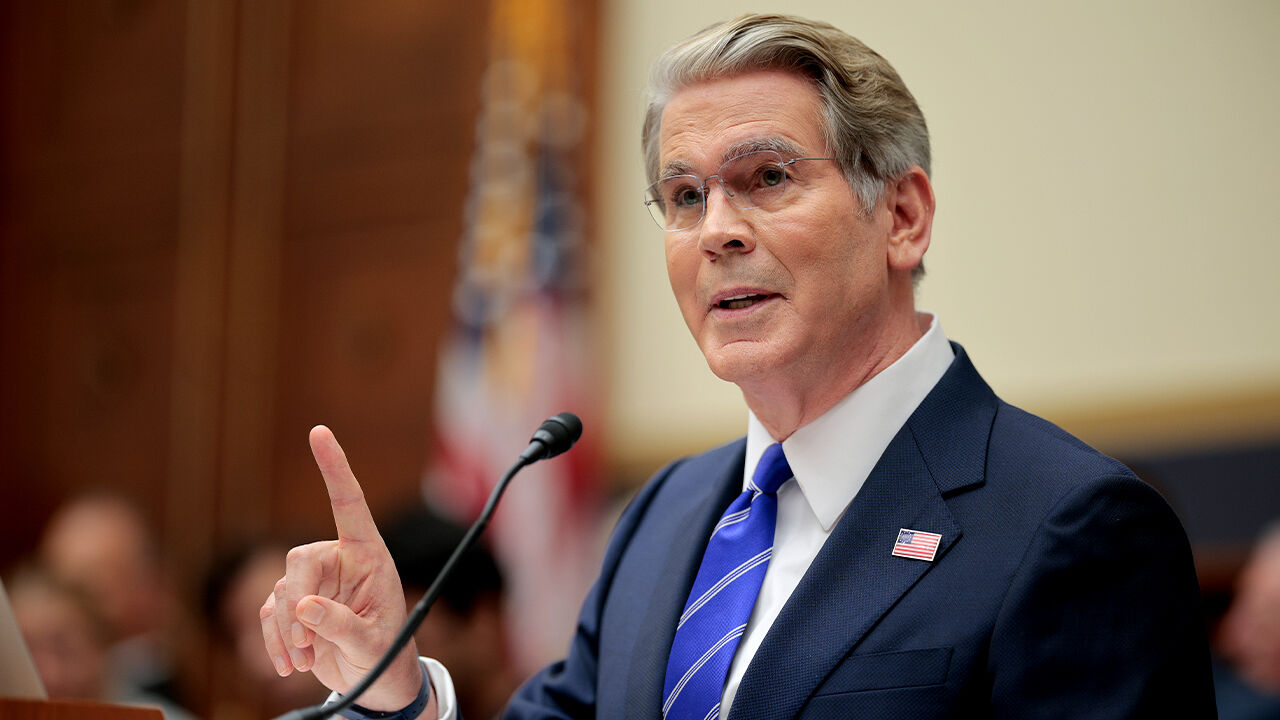
▲ U.S. Treasury Secretary Scott Bessent attends a House hearing.
U.S. Treasury Secretary Scott Bessent stated on the 15th (local time) that the recent sharp surge in U.S. Treasury yields is due to "global issues."
Reuters and Bloomberg reported that Secretary Bessent made the remarks to reporters ahead of a hearing before the House Financial Services Committee.
The 10-year U.S. Treasury yield, a global benchmark for interest rates, briefly surpassed 5.04% on this day, reaching its highest level in 19 years.
During the hearing, Secretary Bessent diagnosed that the rise in Treasury yields, along with other factors, "reflects the need to address the (U.S.) fiscal deficit."
In the market, the surge in oil prices due to the war with Iran, a funding competition triggered by artificial intelligence (AI) investments, and the fiscal deficit exceeding $40 trillion are being cited as factors driving up Treasury yields.
While acknowledging concerns over the fiscal deficit, Secretary Bessent defended President Donald Trump's initiative—promised at the Republican National Convention on the 9th to 10th—to pay $5,000 per adult if Republicans win.
He stated, "Putting more money into the pockets of the American people should be everyone's goal," adding, "I believe there are ways to do that without impacting the fiscal deficit."
Assessing the Treasury's two buyback operations conducted to stabilize Treasury yields as successful, Secretary Bessent emphasized, "There were scenarios of what would have happened had we not done so."
He further claimed that since President Donald Trump took office, the (U.S. bond market) has performed the best among advanced economies.
Secretary Bessent stated that the market intervention carried out jointly with Japan at the end of July to boost the Japanese yen, which had fallen to a 40-year low, served U.S. interests and that the amount injected by the U.S. was merely "nominal."
He explained, "A stronger yen is favorable for U.S. exports, and a stronger yen means the Japanese government does not need to sell U.S. assets to secure funds for foreign exchange market intervention."
He added that the U.S. was able to "send a signal supporting Japan's policies" simply through a nominal scale of intervention.
'Japan's policies' is believed to refer to the monetary tightening (interest rate hikes) in Japan urged by Secretary Bessent.
Bloomberg reported that observers estimate the U.S. Treasury spent less than $1 billion on the yen market intervention at the time, while Japan injected a record $96.4 billion over a month starting from late July.
Secretary Bessent announced that he will meet with Chinese Vice Premier He Lifeng this weekend to coordinate the agenda for the U.S.-China summit, planning to discuss U.S. financial sanctions against Iran as a key issue.
He said, "We have sanctioned three banks (including those in Russia). We have had very good private discussions with China, and I look forward to continuing those discussions when I meet with my Chinese counterpart, Vice Premier He, this weekend."
Reuters recently reported that Iran bypassed sanctions on its oil sales by using barter-like methods to purchase billions of dollars worth of goods, including military equipment, from China.
President Trump has invited Chinese President Xi Jinping and his wife for a state visit to the U.S., and has publicly disclosed that the summit is scheduled to take place in Washington, D.C. on the 24th to 25th.
The Chinese side has not yet officially confirmed the summit.
(Photo: Getty Images)
※ Please note: This article was translated by AI and may contain errors.



 Video News

 Video News
 Video News