
 KOR
KOR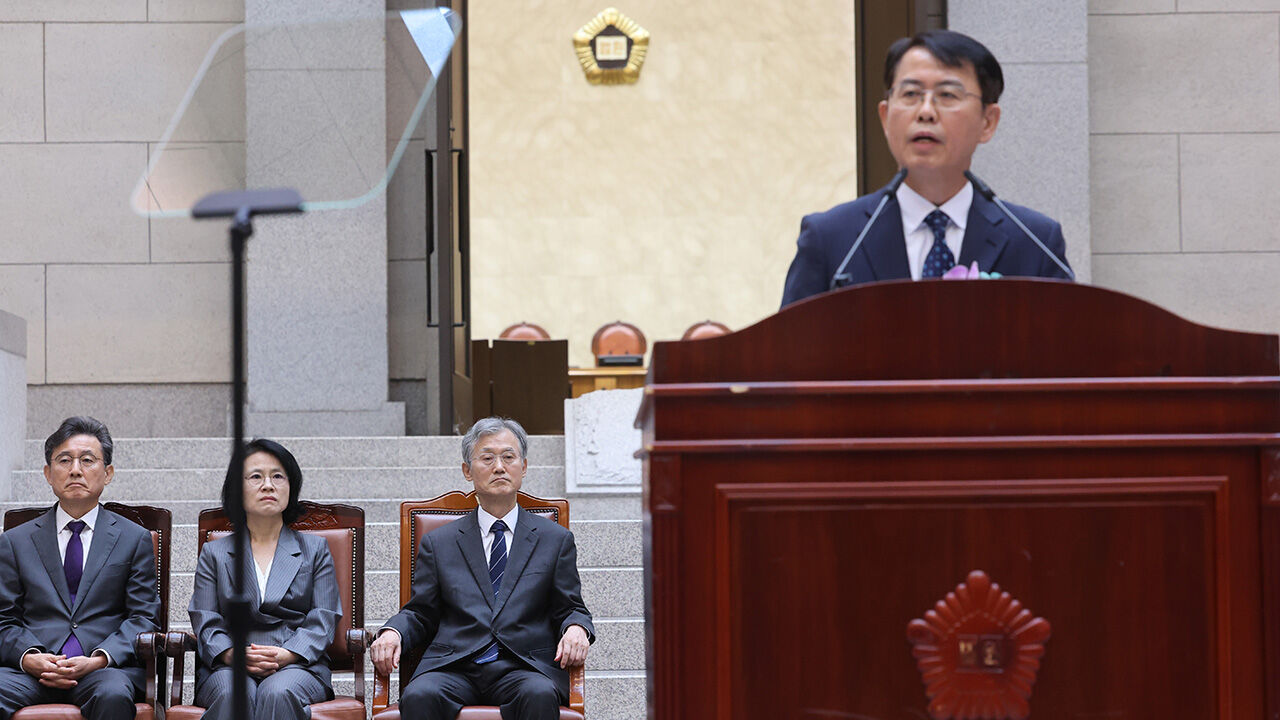
▲ Justice Lee Heung-goo attends his retirement ceremony at the Supreme Court in Seocho-gu, Seoul, on the 7th.
Supreme Court Justice Lee Heung-goo (63, Judicial Research and Training Institute Class 22) completed his six-year term and retired today (the 7th), stating, "The judiciary must actively lead changes to ensure the public does not suffer harm following the 'three judiciary bills' (the Act on the Crime of Distorting the Law, trial appeals, and the expansion of Supreme Court justices)."
During his retirement ceremony held at the central hall of the Supreme Court building in Seocho-gu, Seoul, this morning, Justice Lee shared his final remarks, saying, "We must strive to transform distrust in the court into trust."
Justice Lee stated, "The three judiciary bills will significantly alter the long-standing trial system, as well as the status and structure of the Supreme Court," adding, "It is shocking and regrettable that the legislative process proceeded without adequately reflecting the opinions of the court."
He went on to emphasize, "However, as the judiciary, which has been delegated judicial power by the sovereign people, we have the responsibility to review the system as a whole and actively lead changes so that no citizens suffer harm in the future."
"We must not forget that behind this legislation lie the public's long-standing complaints and distrust regarding trials," Justice Lee explained, adding, "This is generally about trials that are unfair or lacking in diligence, trials that fail to properly understand the lives of the parties involved or lack expertise, and trials that do not provide sufficient explanation."
He then noted, "The direction of the judiciary's change should be to shed its remaining authoritarian image, conduct more professional, transparent, and persuasive trials, and further respect the public's right to trial."
Regarding trial appeals and the crime of distorting the law, he said, "While they will act as significant limitations on the duties of courts and judges, they will not bring about fundamental changes to our status and role," adding, "Such external environments must be overcome as judges carry out their trials without wavering."
On the expansion of Supreme Court justices, he stated, "It will fundamentally transform the structure and functions of the Supreme Court, as well as the structure of the entire court system," and added, "In this era of change, we must begin pondering what kind of court we dream of and want to build, and find answers through the power of collective intelligence."
He also emphasized that the Supreme Court must recover its original function of setting standards for legal issues demanded by the times.
He pointed out, "The biggest problem of the Supreme Court lies in a system where it cannot escape from a flood of cases," and added, "The reality is that we lack the capacity to perform policy functions, such as acting as the brain of the entire court system—timely identifying legal issues that must be resolved in this era, promptly presenting standards, and properly establishing and solving short- and long-term tasks."
He stated, "We must boldly break away from the supplementary function of fact-finding trials where too many resources are currently being invested, ensure that high courts ultimately shoulder that role, and create an appellate court structure with enhanced expertise and transparency," emphasizing, "The proper positioning of the Supreme Court and fact-finding courts is an urgent task that must be resolved."
Justice Lee also remarked, "Watching the series of events that unfolded after the December 3 emergency martial law, I often felt that the court failed or was unable to properly convey its stance to the public during a national crisis," adding, "To gain trust, we must communicate most appropriately at the times it is needed most, and well explain and convey what judgment and will the judiciary holds."
He stated, "Distrust of the court is becoming increasingly severe, and demands for criticism and change are fierce," and added, "To replace distrust with trust, rather than resenting this situation, we need a future-oriented attitude and effort to humbly acknowledge and resolve its causes."
Quoting a verse by the Persian poet Saadi, he said, "The saying that one has no qualification to be called a judge if they cannot feel the suffering of others is something we, who handle human trials, must engrave deep in our hearts."
Supreme Court Justice Lee Heung-goo was appointed in September 2020 during the Moon Jae-in administration upon the recommendation of former Chief Justice Kim Myeong-su.
A native of Tongyeong, South Gyeongsang Province, he graduated from Seoul National University's Department of Public Law and began his judicial career in 1993 at the Southern Branch of the Seoul District Court.
He is a so-called "regional judge" (hyangpan) who spent most of his judicial career in local areas such as Busan, Changwon, and Daegu.
He has a history of participating in Our Law Research Center, known as a group of progressive judges.
In May of last year, at the time of the Supreme Court full bench's final ruling on Lee Jae-myung's trial regarding violations of the Public Official Election Act, he left a dissenting opinion alongside Justice Oh Kyung-mi against the majority opinion favoring a guilty-intent remand.
Amid a situation where a vacancy for the successor of former Supreme Court Justice Noh Tae-ak has persisted for over half a year due to differences of opinion between the presidential office and the judiciary, Justice Lee Heung-goo is also leaving the Supreme Court today without the nomination process for his successor being finalized.
As a result, a two-vacancy system for Supreme Court justices will continue for the time being.
Kim Sung-soo, nominated as the successor to Supreme Court Justice Lee Heung-goo, is currently undergoing confirmation hearing procedures.
In the case of the successor to former Supreme Court Justice Noh Tae-ak, Chief Justice Cho Hee-dae nominated Sohn Bong-ki in writing on the 18th of last month without reaching an agreement with the presidential office.
In response, the presidential office requested a re-nomination ten days later on the 28th.
As a blow to appellate trials is inevitable if the conflict is not resolved soon, prospects suggest that Chief Justice Cho will express his stance regarding the presidential office's request for re-nomination sometime this week.
(Photo: Yonhap News)
※ Please note: This article was translated by AI and may contain errors.




 Video News

 Video News
 Video News