KOR
KOR
▲ Bereaved family members look at photos of people killed by floods in Kathmandu, Nepal, to help identify victims.
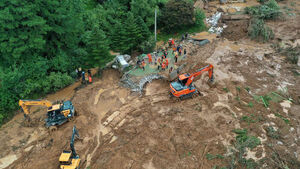
As the death toll surges from massive floods that recently struck the Himalayan mountainous region along the Nepal-China border, a shortage of morgue space has led to ongoing difficulties in identifying the bodies.
According to Nepali media outlets such as Online Khabar and The Kathmandu Post on the 29th (local time), a massive flood that swept through the central Bagmati Province on the 26th has killed 579 people in Nepal alone so far.
Combined with the 7 deaths reported from a debris flow linked to a glacier collapse that triggered the floods in Gyirong County, Xigaze, in the Tibet Autonomous Region of China near the border, the total death toll across both countries currently stands at 586.
With the death toll surging daily, hospitals in the Chitwan district of Bagmati Province, which suffered heavy damage from the massive flood, no longer have space to accommodate bodies.
It is reported that bodies recovered from the flood sites are pouring into Bharatpur Hospital in the Chitwan district.
By the evening of the 27th, 137 bodies had arrived, and another 50 bodies were transferred to the hospital the following day.
Bishwabandhu Bagale, the medical director of Bharatpur Hospital, explained, "Our hospital's mortuary freezers can only accommodate 24 bodies," adding, "Most of them are usually filled with unidentified bodies, leaving only about 2 to 4 spaces open."
He lamented, "We do not have the capacity to manage bodies on this scale during a major disaster."
The hospital's morgue and autopsy room have already reached full capacity since the 27th, and some bodies are being placed in hospital hallways or outdoors under waterproof tarps.
There are also bodies left loaded in vehicles as they could not be moved to the autopsy room.
Due to the high temperatures currently in the Chitwan district, bodies recovered on the 27th that could not fit into the freezers have already begun to decompose.
Director Bagale expressed concern, saying, "Not all bodies started decomposing at the same time, but due to the extreme heat, the decomposition of the bodies (that could not fit into the freezers) is progressing rapidly."
Because the current of the floods was strong enough to destroy concrete bridges, the conditions of the bodies recovered from the accident sites vary widely.
As a result of Chinese scientists comprehensively analyzing satellite data and field footage, the moving speed of the glacier and rock mixture mass that caused the massive flood is estimated to have reached approximately 50 meters per second, or about 180 kilometers per hour.
While some bodies remain intact, others were recovered after being submerged in muddy water or thick mud for a long time, leaving them already decomposing or severely damaged.
The hospital's forensic team, assisted by other hospitals, is continuously conducting examinations and identification work focusing on undamaged bodies without rest to identify them, but they are facing overwhelming limitations.
Bodies whose initial identification is completed in this region are moved to government offices and then handed over to the bereaved families, while DNA samples are collected and preserved for unidentified bodies.
The problem is that the number of missing persons currently reported in Nepal is nearing 2,000, raising the high possibility that the number of bodies to be recovered will continue to surge going forward.
The Nepali government stated that it is currently housing victims' bodies in 16 hospitals and is considering setting up temporary facilities if necessary.
Samir Adhikari, a spokesperson for Nepal's Ministry of Health, explained that while "the capacity of all hospitals nationwide exceeds 600 bodies," some hospitals are located too far from the accident sites to accommodate the bodies.
(Photo: AP, Yonhap News)
※ Please note: This article was translated by AI and may contain errors.




 Video News