
 KOR
KOR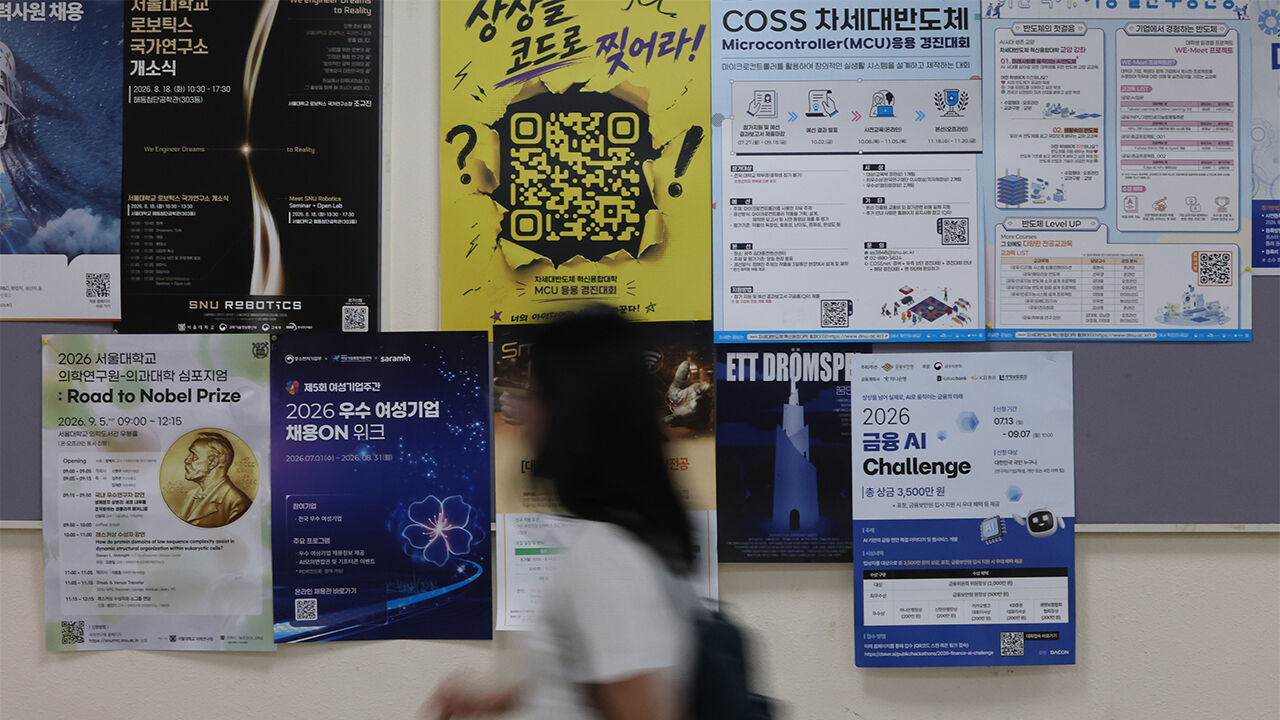
▲ An informational poster regarding AI-related events is posted on a university bulletin board in Seoul on the 18th. (Photo: Yonhap News)
The government is establishing an all-care system to support young people through every stage, from job hunting and employment to career management and growth.
Vocational training in cutting-edge and emerging industries favored by young people will be significantly expanded, alongside the operation of a matching platform that connects trained youth with companies.
After employment, the system will also assist with career development and asset building.
Through these measures, the government expects youth employment to increase by at least 90,000 next year.
The government finalized the Youth Job Recovery Plan containing these measures during the Emergency Economic Headquarters Meeting and Economic Ministers' Meeting held today (the 28th) and chaired by Deputy Prime Minister and Minister of Economy and Finance Koo Yun-cheol.
The government aims to nurture more than 300,000 professional personnel in high-tech industries and sectors preferred by youth by 2030.
This scale is over 100,000 larger than the 200,000 plus alpha presented at the fiscal strategy meeting last month.
Plans are underway to train 80,000 more personnel next year than this year.
Specifically, the expansion will cover vocational training in high-tech industries such as artificial intelligence and semiconductors, high-skilled personnel via specialized universities and graduate schools, and practical workers through vocational high schools and polytechnics.
In particular, Youth New Deal projects—such as the K-New Deal Academy led by major corporations and boot camps—will be substantially expanded.
The K-New Deal Academy is planned to grow from 10,000 participants this year to 50,000 next year.
To ensure that participation goes beyond training and leads to actual employment and startups, a Youth Playground will also be newly established.
Serving as a matching platform connecting youth participating in government training programs with companies and public institutions, it will provide opportunities for project execution, work experience, mentoring, entrepreneurship, and networking.
Support for finding a first job will also be reinforced.
The existing National Employment Support System will be overhauled to create the First Youth Job Support System, expanding eligibility to youth with no prior work experience.
The job-seeking promotion allowance will also be raised from 600,000 won to 650,000 won.
Support for both youth and companies through the Youth Job Leap Incentive will be expanded.
For youth, eligibility will extend beyond those employed outside the capital region to include some workers in the capital area, while the support amount for non-capital region youth will increase from a maximum of 7.2 million won over two years to up to 18 million won.
For companies, eligibility will widen so that mid-sized companies in the capital area and large corporations outside the capital area can also receive the Youth Job Leap Incentive when hiring youth who have completed job competency programs.
The government will also directly engage in job creation.
By 2030, it aims to create over 200,000 private and public sector jobs and nurture more than 100,000 young entrepreneurs.
Next year, the plan is to arrange approximately 50,000 more private and public jobs than this year.
Kang Ki-ryong, First Vice Minister of Economy and Finance, stated, "We expect a job creation effect of over 90,000, combining 40,000 people—about half of the 80,000 youth trained next year—with 50,000 private and public sector jobs."
Career management following employment will also be strengthened.
Career mentoring will be provided to young workers in their early employment stages to help them adjust to workplaces and develop careers, while education such as vocational training and work-study parallel programs will be expanded for employees at small and medium-sized enterprises (SMEs) and mid-sized companies.
The existing Job Competency Bank system will be expanded and reorganized into the tentatively named Career Bank.
By adding freelance activity histories and work experience data to existing information such as national technical qualifications and training records, the system is designed to allow youth to manage their diverse careers and job competencies in one place.
To reduce the burden of training costs on SMEs when young workers who built their careers there move to major corporations, the government will push to add provisions related to job transitions and relocations into the permitted uses of the Large-Small Business Win-Win Cooperation Fund.
To help young employees at local SMEs build assets, a preferential track for local SME workers will be newly established in the Youth Future Savings product, and the government matching rate will be raised from 12% under the existing SME-preferential type to 25%.
The target recipients, frequency, and fields of the Youth Culture and Arts Pass will also be expanded.
The government explained that young people employed at local SMEs will receive up to 750,000 won per month through the Youth Job Leap Incentive and around 200,000 won per month through the Youth Future Savings, bringing the combined support effect to around 1 million won per month over two years.
Vice Minister Kang explained, "Given that there is about a 1 million won gap between the actual wages received by young people working at SMEs and their desired wages, this means the government will bridge that gap for the initial two years."
The government plans to materialize the support scale and implementation timing for each detailed project through next year's budget proposal and other measures.
(Photo: Yonhap News)
※ Please note: This article was translated by AI and may contain errors.



 Video News
 Video News
 Video News
 Video News
 Video News