
 KOR
KOR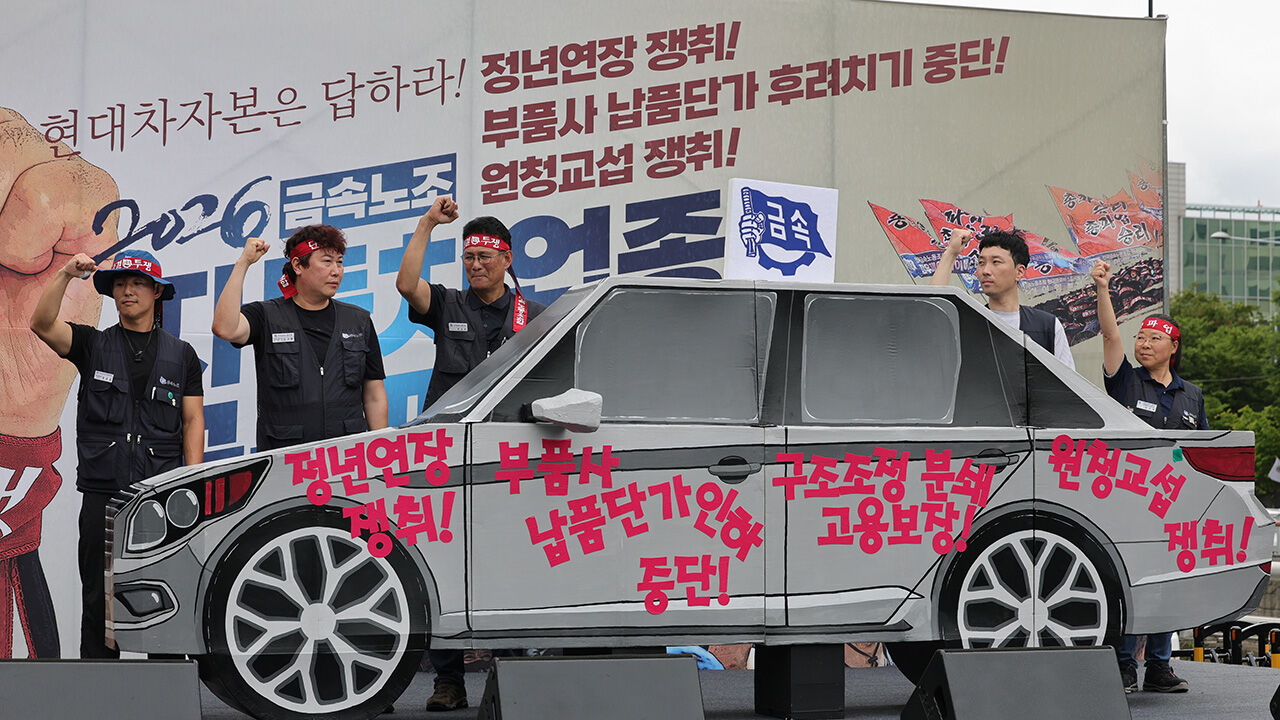
▲ Members of the Korean Metal Workers' Union perform during a joint auto industry strike rally held in front of Hyundai Motor's headquarters in Seocho-gu, Seoul, on the 21st.
The Korean Metal Workers' Union held a rally in front of Hyundai Motor's headquarters today (the 21st), pressing management to accept key demands including extending the retirement age and fulfilling prime contractor bargaining.
Around 2 p.m. that day, the metal workers' union held a strike resolution rally on the street in front of the Hyundai Motor Group headquarters in Seocho-gu, Seoul, under the banner of "Winning the extension of the retirement age at Hyundai Motor Group, halting the squeeze on auto parts supply prices, and winning prime contractor bargaining."
According to the organizers, an estimated 3,000 people gathered, including local union chapter heads nationwide, union members from national auto parts companies, and affiliates of Hyundai Motor Group.
Police unofficial estimates put the number of participants at 2,500.
Participants held pickets bearing phrases such as "Extend the retirement age and raise supply prices" and chanted slogans like "Win the extension of the retirement age" and "Win prime contractor bargaining."
This rally took place amid auto industry strikes unfolding across the country since the previous day.
According to the metal workers' union, 12,000 workers went on strike the previous day in regions where auto parts makers are concentrated, such as Gyeongju, South Chungcheong Province, Daejeon, and North Chungcheong Province, as well as some Hyundai Mobis production plants and Ulsan Glovis parts and logistics operations.
The union stated that with the participation of all 38,000 members of the Hyundai Motor union (the Hyundai Motor Chapter of the Metal Workers' Union) on this day, the scale of the strike increased to 50,000 workers.
The metal workers' union argued that Hyundai Motor is exploiting parts makers and subcontractors at the top of the supply chain by forcing them to cut costs.
At the same time, it publicly pressured the company to fulfill demands including winning prime contractor bargaining, halting the squeeze on parts supply prices, and extending the retirement age at Hyundai Motor Group.
It also warned that if these demands are not met, it will launch a general strike on the 26th.
Park Sang-man, head of the metal workers' union, said in his opening address, "Subcontracted workers cannot change even a single restroom or safety measure in a dangerous process with their own hands. Prime contractor bargaining under the Yellow Envelope Act is not a special favor; it is a matter of common sense."
He continued, "Whose responsibility is the massive income gap between retirement and receiving the National Pension? In a transition period where AI and robots threaten jobs, employment stability and extending the retirement age are not just issues for our aging generation."
Lee Jong-chul, head of the Hyundai Motor union chapter, and Kang Seong-ho, head of the Kia Corporation union chapter, took the stage one after another to express their support for the joint strike.
Lee said, "We are carrying out a total of 120 hours of general strike action. The strike itself is not the purpose, but rather to demand fair compensation for the efforts of our union members."
This is the first time this year and in 10 years that the Hyundai Motor union has gone on an 8-hour full-scale strike.
Kang said, "Management is using the unstable external environment as an excuse to trample on our demands, hiding behind the 'Yangjae-dong guidelines' to evade responsibility. We issue a warning to Yangjae-dong. If you deceive the 100,000 workers of Hyundai Motor Group, we will retaliate with a powerful general strike."
Through its dispute mediation committee that day, the Kia union resolved to launch partial strikes lasting two to four hours by work shift for three days from the 26th to the 28th.
If the strike actually takes place, it will break the record of "five consecutive years of dispute-free settlements" maintained by Kia management and labor since 2021.
(Photo: Yonhap News)
※ Please note: This article was translated by AI and may contain errors.



 Video News
 Video News
 Video News
 Video News
 Video News