
 KOR
KOR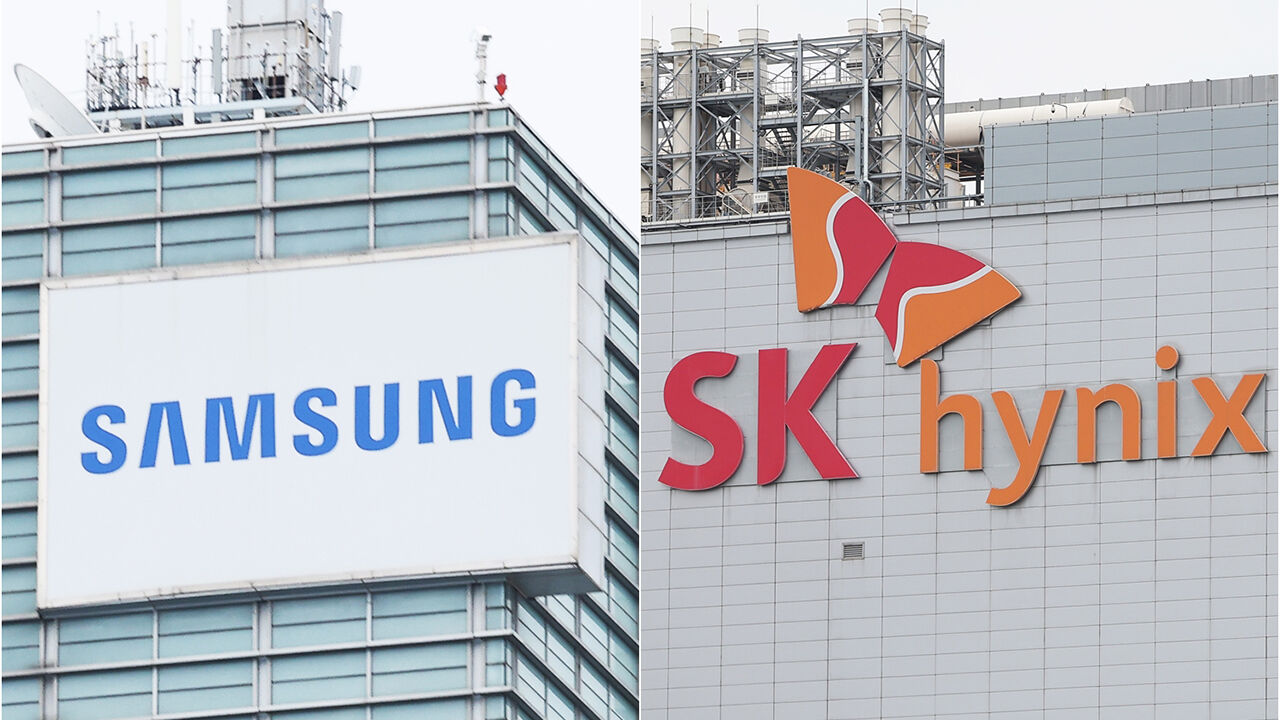
Samsung Electronics and SK Hynix have significantly improved their financial soundness as their earnings surged in the first half of this year, driven by soaring sales of High Bandwidth Memory (HBM) and general-purpose DRAM.
In just half a year, the two companies increased their cash, cash equivalents, and short-term financial products by nearly 120 trillion won, successfully securing overwhelming financial firepower to gain an upper hand in the global facility investment competition.
According to the industry, Samsung Electronics recently disclosed in its semi-annual report that its total cash, cash equivalents, and short-term financial products stood at 189.953 trillion won as of the end of the first half of this year, an increase of about 64 trillion won from the end of last year (125.8214 trillion won).
SK Hynix also increased its cash and cash equivalents by over 53 trillion won during the same period, going from 34.9423 trillion won at the end of last year to 87.9579 trillion won.
Combined, the cash, cash equivalents, and short-term financial products of both companies reached 277.9109 trillion won in the first half.
Compared to the end of last year, this is an increase of approximately 117 trillion won in just six months.
At the same time, SK Hynix saw its borrowings decrease.
In the first half of this year, borrowings stood at 18.5866 trillion won, down 3.6613 trillion won from the previous year.
It is analyzed that fueled by high profitability, the company filled its coffers while rapidly paying off borrowed funds.
Earlier this year, SK Hynix announced a goal at its shareholders meeting to secure 100 trillion won in net cash.
Net cash is calculated by subtracting borrowings from cash and cash equivalents, and SK Hynix's net cash for the first half of this year stood at 69.3693 trillion won.
Samsung Electronics and SK Hynix posted operating profits of 146.72 trillion won and 98.1529 trillion won, respectively, in the first half of this year alone.
The two companies rewrote history with a combined operating profit approaching 250 trillion won.
This was driven by increased sales and sharp price hikes across memory products such as HBM, DRAM, and NAND, supported by major big tech companies' AI infrastructure investment trends.
Attention is now focused on whether the combined cash and cash equivalents of the two companies could reach 400 trillion won in the second half, a period expected to yield even higher operating profits than the first half.
The securities industry projects that the two companies will post a combined operating profit approaching 200 trillion won in the third quarter.
As the global semiconductor industry recently moves to aggressively expand facility investments, Samsung Electronics and SK Hynix are also focusing on increasing production capacity through semiconductor fab expansions based on their hefty investment reserves.
Samsung Electronics plans to establish new memory semiconductor bases in Yongin and the Honam region, alongside expanding its Pyeongtaek campus.
Samsung Electronics executed a total of 28.1 trillion won in facility investments (CAPEX) in the first half.
SK Hynix is currently constructing its first fab at the Yongin Semiconductor Cluster and plans to invest a total of 54 trillion won in its second fab and the M17 NAND production base to be built in Cheongju.
(Photo: Yonhap News)
※ Please note: This article was translated by AI and may contain errors.
Samsung, SK Hynix Grow Cash Reserves by Over 117 Trillion Won in 6 Months



Trending Now
-
 Video News
Gained Popularity, Struck by Mess: Rotten Odors and Maggots in Valleys
-
Video News
Captured on CCTV: Months of Abuse Fully Exposed
-
Video News
Two Bodies Found, Believed to Be Married Couple... Wildfires Rage Across Borders
-
Video News
"Men Get Double": Controversial 'Property Distribution' Ends Up in Court
-
Video News
Kim Min-seok Elected New Democratic Party Leader: Will There Be Policy Shifts on Real Estate and More? (Full Video)
 Video News
 Video News
 Video News
 Video News
 Video News