
 KOR
KORFollowing our comprehensive analysis of this year's budget, we have been running a series of reports checking whether taxpayers' money—such as for public servant training and wildfire recovery projects—is being properly used. This time, we looked into the budget for "temple experiences," which receives massive tax infusions under the pretext of preserving traditional culture and promoting cultural tourism. First, the Templestay program, which receives tens of billions of won every year.
Reporter Bae Yeo-un investigated sites built and repaired with taxes that have either closed down or are hard to find.
[Reporter Bae Yeo-un]
This is the exclusive Templestay building located in a corner of Silleuksa Temple in Yeoju, Gyeonggi Province.
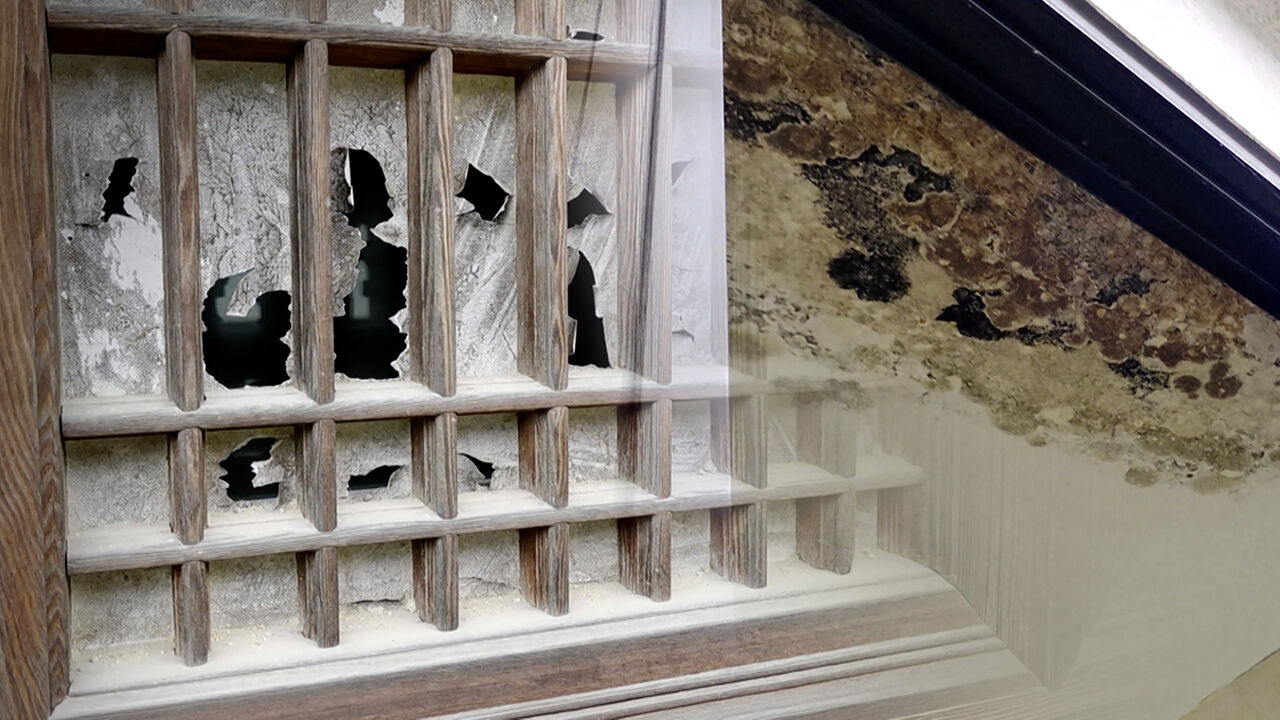
The paper doors are torn, and spiderwebs fill the eaves underneath the roof.
An unpleasant, pungent odor fills the underground dining hall.
[Ugh, it smells like mold….]
Though the building was constructed using a combined 750 million won in national and local government funds, the Templestay program has not been operated for five years since 2021, which was during the COVID-19 pandemic.
When asked why,
[Silleuksa Temple Official: Because of water leaks, the ceiling is even caving in, so how could we serve meals there?]
However, the national funds received under the pretext of repairing the building total approximately 380 million won across four separate occasions.
This means they shut down because they failed to fix the leaks despite repairing it multiple times with national money.
[Silleuksa Temple Official: We can't just take out loans to pay for repairs and run it, can we?]
A designation can be revoked if a Templestay is not held more than twice a month, but the competent authority stated that it would take action only after five years had passed.
[Ministry of Culture, Sports and Tourism Official: I think we need to decide within this year whether to remove it from the registered temples for operation or allow it to resume operations.]
Places like this exist elsewhere as well.
Banyasa Temple in Yeongdong, North Chungcheong Province.
A subsidy of 500 million won was poured into it under the name of Templestay.
Yet the newly built experience hall is nowhere to be found within the temple grounds.
It only appears after crossing a stream and walking up a forest trail for over 10 minutes.
Without any directional signs, it is not even easy to find.
The door is locked tight, and looking through the window, the construction protective material remains unpeeled.
Checking the building registry shows it was completed in July of last year, but finding any traces of use is difficult.
The temple side stated that they use the space only when there are group participants.
[Banyasa Temple Official: I heard the frequency of use is not that high. It's a building built with national funds, so not being able to utilize it is somewhat problematic. We are looking for ways to utilize it well.]
Over the past 20 years, national funds poured into Templestays alone have exceeded 380 billion won.
For the past decade or so, it has been around 23.0 billion won annually, and this year it increased to 27.0 billion won.
(Camera Reporter: Seol Min-hwan, Video Editor: Park Na-young, Design: Seo Seung-hyun, VJ: Kim Jun-ho)
---
[Anchor]
While leaving facilities built with taxes neglected like this is a problem, there are also places where Templestays are pushed to the background while profits are reaped through cafes under personal names.
Reporter No Yu-jin investigated on-site.
[Reporter No Yu-jin]
The Templestay experience hall at Jingwansa Temple in Seoul.
This is a building constructed with 3.1 billion won in subsidized taxes combined from the Ministry of Culture, Sports and Tourism, the Seoul Metropolitan Government, and Eunpyeong District.
However, the first floor, which is crowded with customers even on weekdays, is operating as a cafe.
[Cafe Official: (May we perhaps get to meet the owner?) Our representative is a monk.]
The business license registration name for the cafe belongs to the former head monk, rather than the religious corporation or the representative of Jingwansa Temple.
An individual is running a profit-making business inside a building built with taxes.
The business plan submitted initially stated that the first floor would house an exhibition promotion hall, a temple food experience hall, and a tourist information center for foreigners.
However, it turned out completely different from the plan, operating as a cafe selling coffee and other items.
Jingwansa Temple maintains that there is no problem, stating that the Seoul Metropolitan Government approved it and that the profits are used for Templestay operational costs and other expenses.
[Jingwansa Temple Official: When profits are generated there, those profits are used as operational costs. That's the kind of financial resource it is, and that's how we received business approval.]
The Seoul Metropolitan Government, the authority granting approval, also takes a nonchalant stance.
[Seoul Metropolitan Government Official: Detailed contents of business execution can change during the design process, and we didn't view that as such a major change.]
However, experts' opinions differ.
[Song Jin-ho / Guest Research Fellow, Korea Civil Budget Center: Just wrapping it up by saying that the profits generated from the cafe are simply being used well for the Templestay does not mean it went through a legitimate procedure.]
Although Seoul Metropolitan Government guidelines also stipulate that the occurrence of profits and the entity to which they belong must be clearly determined, there is no mention of profit funds anywhere in the subsidy decision document.
There is neither a way to verify whether the profits are used for Templestays nor any grounds for sanctions.
This contrasts sharply with the Ministry of Culture, Sports and Tourism specifying conditions that subsidies must be used strictly for the purpose of operating Templestays.
Furthermore, Jingwansa Temple receives separate Templestay operation support funds from the Ministry of Culture, Sports and Tourism and Seoul Metropolitan Government every year.
The operation support funds received just last year amounted to about 100 million won.
The problem is that while receiving budgets as budgeted, Templestays are actually being pushed aside.
Last month, there was not a single day with programs available for the general public.
[Jingwansa Temple Templestay Official: (Are you not holding any in July?) In July, we had work… we had a schedule, so it's on August 5.]
Even then, it opens only once a month.
The rule stating that single-day programs must be held at least four times a month has become meaningless.
Thirteen out of 159 government-supported Templestay temples nationwide find it difficult even to take reservations on their official websites.
[Ministry of Culture, Sports and Tourism Official: If operations do not normalize, we are seriously considering measures beyond existing evaluations, such as exclusion from designated temples...]
The Ministry of Culture, Sports and Tourism stated that it will launch an on-site inspection.
(Camera Reporter: Seol Min-hwan, Video Editor: Lee Hong-myung, Design: Kim Min-young, VJ: Kim Jun-ho)
※ Please note: This article was translated by AI and may contain errors.



 Video News
 Video News
 Video News
 Video News
 Video News