
 KOR
KOR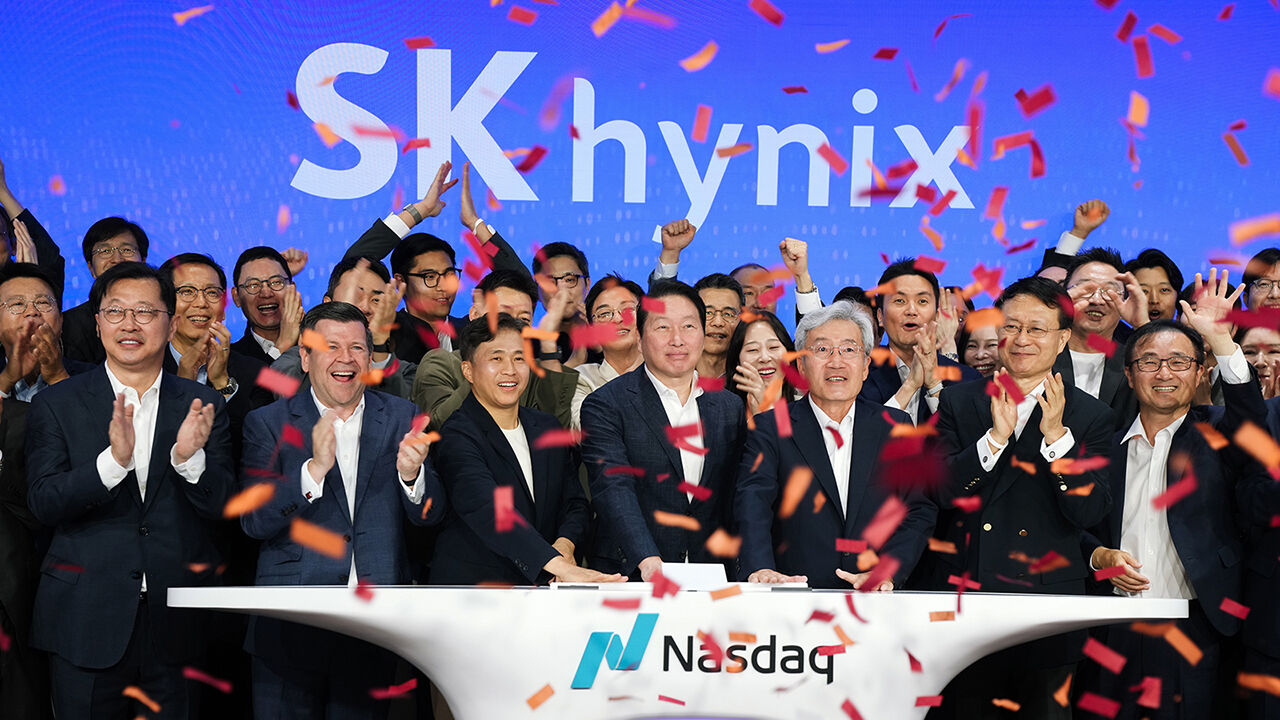
▲ SK Hynix announces the commencement of its NASDAQ ADR trading
The Bank of Korea (BOK) has clearly drawn a line against the so-called semiconductor peak theory, which suggests that the semiconductor market has already passed its zenith.
According to a written response submitted by the BOK to Representative Park Sung-hoon of the People Power Party on July 13, the central bank attributed the reason why the semiconductor market has not declined to a supply-side advantage in the market.
The BOK stated that "while semiconductor demand has increased significantly due to AI infrastructure investment, the pace of supply expansion remains slow."
Regarding semiconductor demand, the BOK noted, "This expansionary phase differs from past cycles in that it is driven by competitive corporate investment, with expectations for fundamental changes in the industrial ecosystem following the spread of AI."
On the supply side, the bank assessed that "it takes a considerable amount of time to mass-produce products due to the technical difficulties of high-performance items," adding that "the pace of supply expansion is more constrained than in the past, as the market is led by custom products such as High Bandwidth Memory (HBM)."
Considering these factors, the BOK concluded that "the global semiconductor market is expected to continue its expansionary trend for a considerable period."
The BOK analyzed that "the current semiconductor market is showing a strong trend that far exceeds past expansionary periods, driven by robust global artificial intelligence (AI) infrastructure investment, such as in data centers."
The BOK assessed that the current semiconductor market expansion phase has lasted for 40 months since March 2023.
This already exceeds the average duration of 29 months for the five expansionary periods between 2000 and 2020.
By citing the opinions of overseas investment banks (IBs), the BOK repeatedly suggested that the expansion of the semiconductor market remains valid.
The BOK stated, "While there is uncertainty surrounding the speed, scope, and profitability of AI technology expansion, major IBs such as JPMorgan, Goldman Sachs, and Morgan Stanley generally forecast that the global semiconductor market will remain strong at least until next year."
This is interpreted as a step further from the BOK's previous assessment that the semiconductor market expansion would continue until this year.
Previously, Lee Ji-ho, Assistant Governor of the BOK (then Director General of the Research Department), mentioned in an economic outlook briefing in November last year that "the semiconductor cycle will continue a bit more until next year (2026)," adding, "I am not sure if it will go until 2027."
Former BOK Governor Rhee Chang-yong said at a press conference in January regarding the 'AI bubble theory,' "No matter who becomes the winner in the AI industry, semiconductors must be used," and added, "I think the outlook for related industries is good, at least within a one-year horizon."
This change in stance is interpreted as a result of considering recent semiconductor export performance that exceeded expectations.
The year-on-year growth rate of semiconductor exports based on customs clearance reached 171.4% in April and 167.7% in May.
It is estimated that the growth trend steepened further in June, when monthly exports surpassed 100 billion dollars.
BOK Governor Shin Hyun-song is expected to mention the recent economic situation and the outlook for the semiconductor market at a press conference following the Monetary Policy Board meeting on July 16.
(Photo: Provided by SK Hynix, Yonhap News)
※ Please note: This article was translated by AI and may contain errors.



 Video News
 Video News
 Video News
 Video News