
 KOR
KOR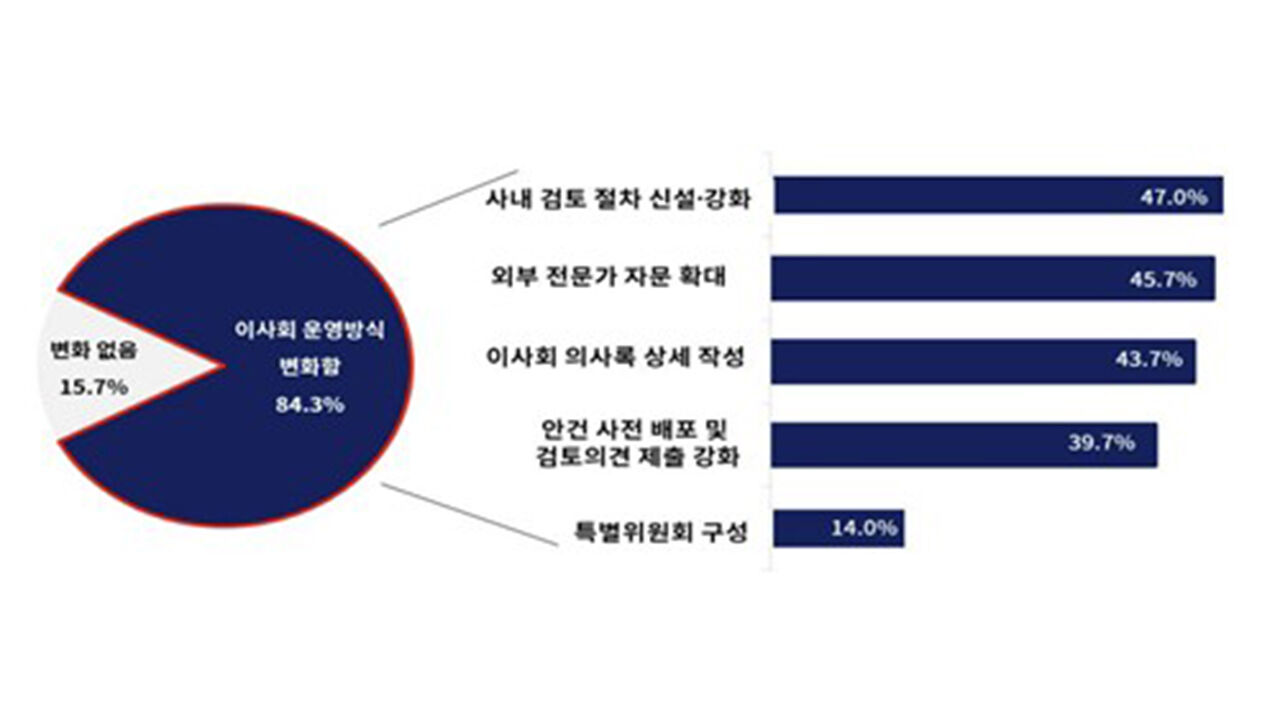
▲ Korea Chamber of Commerce and Industry (KCCI) Survey on Changes in Business Environment and Support Tasks One Year After Commercial Act Amendment
One year after the implementation of the amended Commercial Act, which includes the expansion of directors' fiduciary duties, a survey shows that 8 out of 10 listed companies have changed their board operation methods, signaling shifts across the overall corporate management environment.
According to the Survey on Changes in Business Environment and Support Tasks for Institutional Settlement One Year After the Commercial Act Amendment, conducted by the Korea Chamber of Commerce and Industry (KCCI) on 300 listed companies (50 with assets of 2 trillion won or more, 250 with less than 2 trillion won) and released today (July 12), 84.3% of responding companies stated that there have been changes in their board operation methods since the amendment.
Specifically, the most common response was the establishment or strengthening of internal review procedures centered on legal and compliance teams (47.0%), followed by increased consultation with external experts (45.7%), more detailed documentation of board meeting minutes (43.7%), and strengthened pre-review procedures for agenda items (39.7%).
While companies acknowledged the positive effects of the Commercial Act amendment, they also assessed that management burdens have increased.
While 39.6% of responding companies noted positive impacts, such as increased accountability in decision-making and transparency in corporate governance, 22.4% responded that burdens such as increased compliance costs and delayed decision-making have grown.
Concerns regarding litigation have also risen.
More than half (53.7%) of the respondents said that concerns over lawsuits, such as shareholder derivative suits and claims for damages, have increased since the expansion of directors' fiduciary duties.
Furthermore, 21.7% revealed that they have experienced delays, suspensions, or cancellations of major decisions, such as investments or business restructuring, due to intensified legal reviews.
Among these, issues related to new investments, such as new business projects and mergers and acquisitions (M&A), accounted for the highest proportion at 30.8%.
Regarding follow-up systems, such as the mandatory electronic general shareholders' meetings and the expansion of the ratio of independent directors set to take effect in January next year, it was found that a significant number of companies are still in the preparation phase.
Among companies subject to the mandatory electronic general shareholders' meetings, only 16.0% have completed the establishment of an operating system, and 52.8% of companies subject to the increase in the ratio of independent directors stated that they are currently in the process of selecting candidates.
Companies pointed out that policy supplementation, such as the preparation of specific guidelines on directors' fiduciary duties and the codification of the business judgment rule, is necessary for the new Commercial Act system to take root.
Choi Eun-rak, Head of the Research Division at KCCI, stated, "Companies have been striving to comply with the system by changing their board operation methods," adding, "Specific guidelines that reflect field cases and policy support to alleviate practical burdens are needed."
(Photo: Provided by KCCI, Yonhap News)
※ Please note: This article was translated by AI and may contain errors.



 Video News

 Video News
