
 KOR
KOR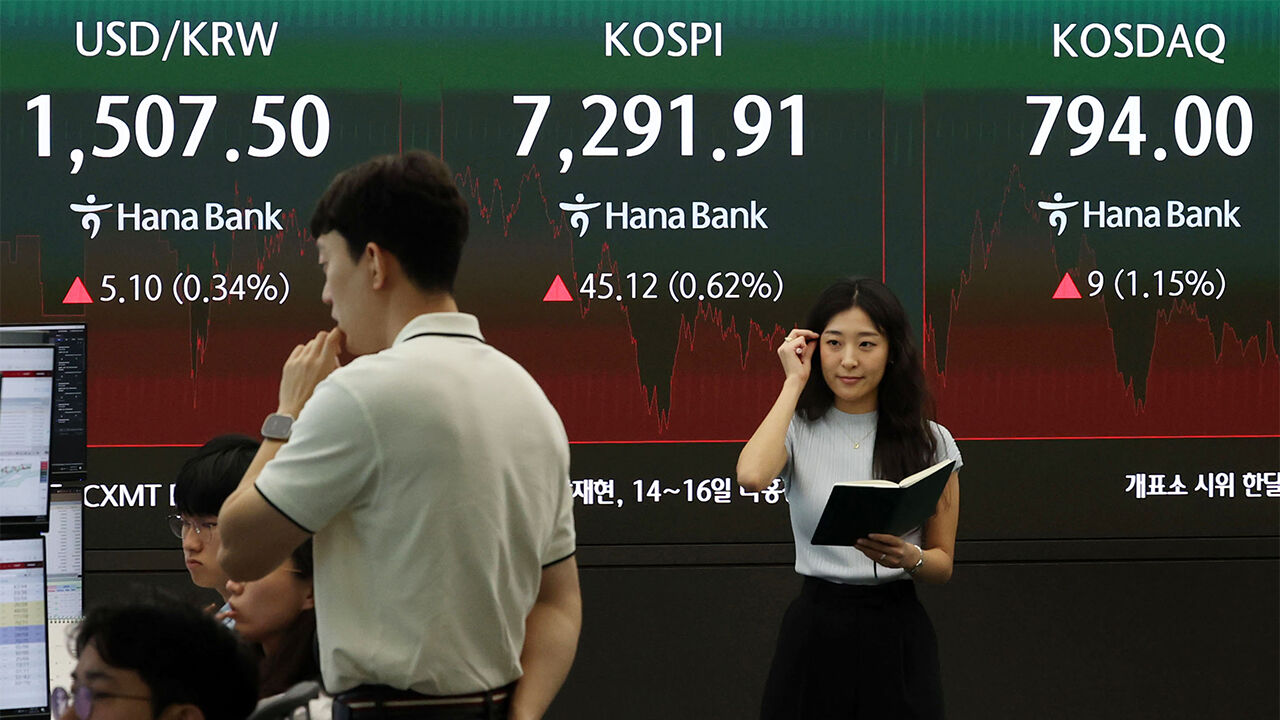
▲ The KOSPI closed at 7,291.91 on July 9, up 45.12 points (0.62%) from the previous trading day. In the Seoul foreign exchange market, the won-dollar exchange rate closed at 1,506.1 won, up 7.6 won from the previous day's closing price at 3:30 p.m. Pictured is the dealing room at Hana Bank headquarters in Jung-gu, Seoul, on July 9. (Photo: Yonhap News)
The KOSPI, which had experienced sharp declines for two consecutive days, saw a volatile session on July 9 before closing with a slight gain.
On this day (July 9), the KOSPI closed at 7,291.91, up 45.12 points (0.62%) from the previous day.
The index started the day at 7,486.64, up 239.85 points (3.31%) from the previous close, and maintained its upward momentum early on.
During the session, it jumped as much as 4.10% to 7,543.86, briefly surpassing the 7,500 mark.
However, it later gave up those gains, turned downward, and fell to the 7,000 range, hitting 7,063.76.
After fluctuating for some time, it finished the day in slightly positive territory.
This marks the first gain in four trading sessions.
The KOSPI 200 Volatility Index (VKOSPI), often referred to as the Korean fear index, closed at 85.48, down 2.75% from the previous day.
However, it reached as high as 89.64 during the day, remaining at a high level near the 90 mark.
In the Seoul foreign exchange market, the won-dollar exchange rate stood at 1,506.1 won as of 3:30 p.m., up 7.6 won from the previous day's base rate.
The index was able to rebound on this day after falling 4.91% and 5.35% over the past two days, respectively, thanks to buying by foreigners and institutions.
Foreigners were net buyers in the KOSPI market for the second consecutive day, with a net purchase of 143.4 billion won.
Institutions also showed a net buying trend of 1.2872 trillion won.
Conversely, individual investors were the sole net sellers, offloading 1.3274 trillion won, which limited the KOSPI's gains.
Foreigners also showed a net buying trend of 125.1 billion won in the KOSPI 200 futures market.
Overnight, U.S. President Donald Trump, while visiting Ankara, Türkiye, to attend the NATO summit, caused market anxiety by mentioning the possibility of additional strikes, stating that the memorandum of understanding (MOU) on ending the war signed with Iran "seems to be over."
However, anxiety appeared to subside somewhat as President Trump subsequently remarked that he "does not think" the war with Iran "will start again."
The domestic stock market started the day with upward potential as bargain hunting flowed into semiconductor stocks that had recently declined.
However, geopolitical tensions rose during the session as news broke that air raid sirens had been sounded in Bahrain and Qatar, and a missile alert had been triggered in Kuwait.
Lee Kyung-min, a researcher at Daishin Securities, explained, "The domestic stock market started higher due to bargain hunting in the semiconductor sector, but it fluctuated due to the lack of clear direction caused by persistent noise from the Middle East and supply-demand volatility."
He added, "As short-term noise continued and investor sentiment withered, the market saw weakness across sectors."
Semiconductor bellwether Samsung Electronics closed at 278,000 won, up 0.18%.
After starting with a 3.96% surge and briefly jumping to 291,500 won during the session, it later turned downward and gave up its gains.
SK Hynix showed a relatively steep upward trend, closing at 2,186,000 won, up 5.30% from the previous session.
The stock price, which soared 7.32% from the opening, recovered to as high as 2,270,000 won during the session.
This appears to be driven by expectations for the listing of SK Hynix's American Depositary Receipts (ADR) scheduled for the 10th.
On the 8th (local time), Bloomberg reported that demand for SK Hynix's ADRs exceeded the public offering volume by more than seven times.
If the offering price is set based on the previous day's closing price (2,076,000 won), the fundraising scale is expected to be 24.5 billion dollars (approximately 37.14 trillion won), which would be the second-largest U.S. listing by a foreign company in history, following Alibaba (25 billion dollars).
Among other top market-cap stocks, SK Square (4.49%), Samsung Electro-Mechanics (0.95%), KB Financial Group (0.23%), SK (2.35%), and Hana Financial Group (0.25%) were strong.
On the other hand, Hyundai Motor (-3.68%), LG Energy Solution (-0.63%), Samsung Life Insurance (-5.78%), Samsung C&T (-4.18%), Samsung Biologics (-2.79%), and Kia (-7.65%) closed lower.
By sector, telecommunications (3.60%), electrical and electronics (2.21%), and manufacturing (1.17%) rose, while insurance (-5.51%), transportation equipment and parts (-4.36%), and entertainment and culture (-4.28%) fell significantly.
The KOSDAQ index closed at 794.00, up 9.00 points (1.15%).
Although it recorded a gain in terms of the closing price, it still failed to reclaim the 800 mark.
The index opened at 792.99, up 7.99 points (1.02%), and fluctuated in early trading.
It briefly recovered the 800 mark during the session, which had collapsed the previous day for the first time in about 10 months.
EcoPro (1.79%), Rainbow Robotics (0.58%), Jusung Engineering (11.50%), and Kolon TissueGene (0.34%) rose, while Alteogen (-4.31%) and EcoPro BM (-0.98%), which rank first and second in market capitalization on the KOSDAQ, as well as ABL Bio (-1.23%), LeadiChem Bio (-1.83%), and EO Technics (-0.72%) fell.
The trading value for the KOSPI and KOSDAQ markets on this day was recorded at 39.5046 trillion won and 5.8715 trillion won, respectively.
The total trading value for the pre-market and main market of the alternative trading system Nextrade was 18.5125 trillion won.
※ Please note: This article was translated by AI and may contain errors.


 Video News
 Video News
 Video News
 Video News
 Video News