
 KOR
KOR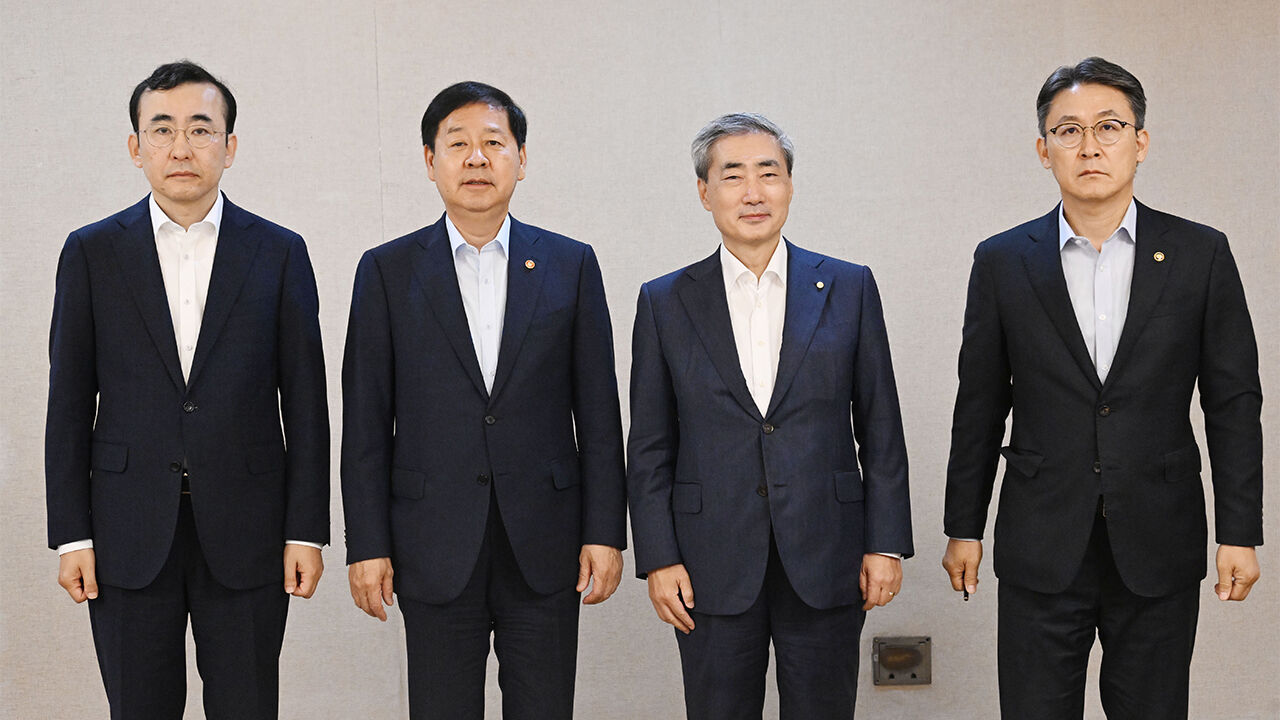
▲ From left: Lee Se-hoon, Senior Deputy Governor of the Financial Supervisory Service; Koo Yoon-cheol, Deputy Prime Minister; Shin Hyun-song, Governor of the Bank of Korea; and Kwon Dae-young, Vice Chairman of the Financial Services Commission, gather at the Government Complex Seoul in Jongno-gu, Seoul, on the 8th.
Major economic and financial policy-making institutions decided today (July 8) to closely monitor risk factors that could trigger excessive volatility in the stock market.
The Ministry of Economy and Finance reported that at a market inspection meeting presided over by Deputy Prime Minister and Minister of Economy and Finance Koo Yoon-cheol at the Government Complex Seoul, participants assessed that the recent stock market has experienced increased volatility due to profit-taking and rebalancing sales by foreign and institutional investors, as well as global AI economic outlooks.
The meeting was attended by Bank of Korea Governor Shin Hyun-song, Financial Services Commission Vice Chairman Kwon Dae-young, and Financial Supervisory Service Senior Deputy Governor Lee Se-hoon.
Regarding the foreign exchange market, participants evaluated that volatility has expanded due to stock sales driven by the increased value of foreign-held stocks, as well as a strong dollar and a weak yen.
They anticipated that the 24-hour operation of the Seoul foreign exchange market, which began on July 6, would significantly enhance the convenience of won trading. They also decided to substantially strengthen the 24-hour monitoring system to respond to potential volatility during nighttime hours.
Furthermore, they decided to finalize and announce a roadmap for the internationalization of the Korean won within this month to promote the convertibility of the currency and its use in current and capital account transactions.
While the volatility of government bond yields has eased somewhat this month, participants decided to closely monitor the market and adjust the issuance ratio of long-term government bonds, considering supply and demand conditions, as potential changes in domestic and international monetary policy stances could act as risk factors.
Participants noted that while the economic upturn continues, with exports and the current account reaching record highs, domestic financial and foreign exchange markets are showing high levels of volatility due to expectations of rising global policy interest rates and the continued outflow of foreign capital.
They agreed to keep a close watch on the possibility of renewed geopolitical tensions and to operate macroeconomic policies in a harmonious manner, taking into account growth, inflation, financial market stability, and the livelihoods of the people, while striving to ensure market stability across all sectors.
(Photo: Provided by the Ministry of Economy and Finance, Yonhap News)
※ Please note: This article was translated by AI and may contain errors.


 Video News
 Video News
 Video News
 Video News
 Video News