
 KOR
KOR
▲ Oh Sang-hoon, Director General of the Property Taxation Bureau at the National Tax Service, announces the results of an investigation into real estate tax evasion suspects at the Government Complex Sejong on July 7.
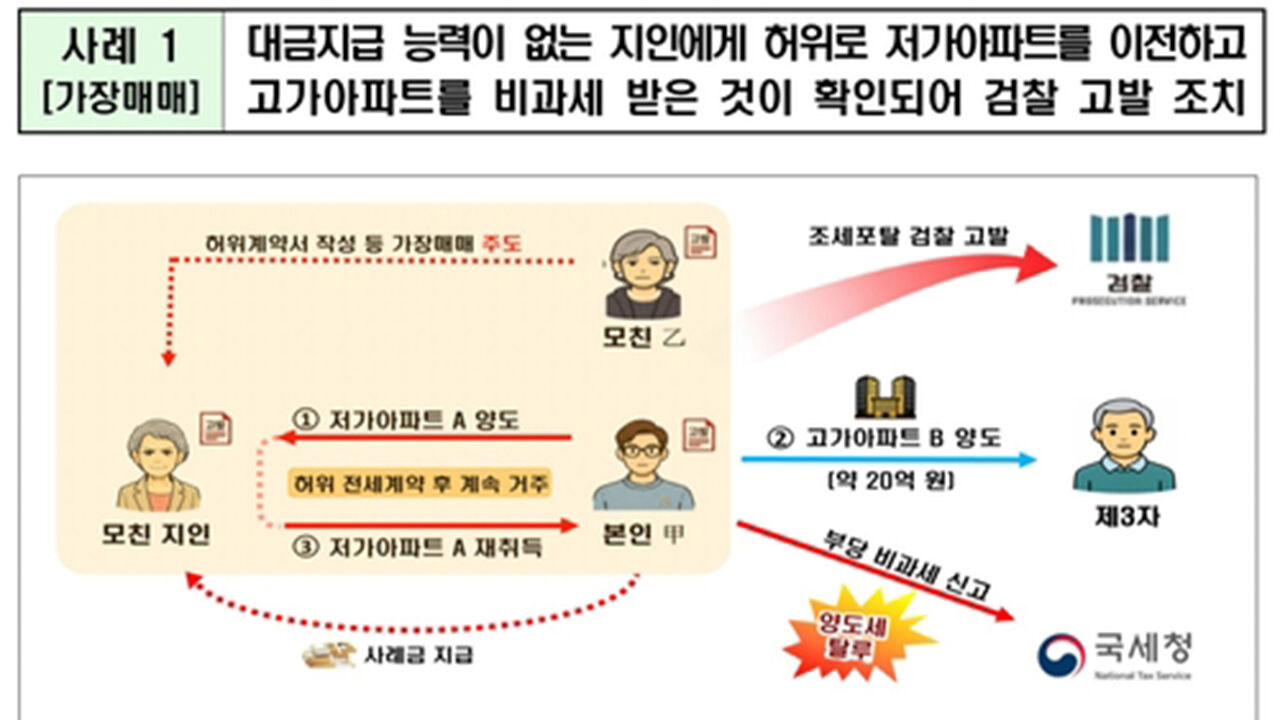
Person A, who owned two homes, sold the lower-priced apartment to a friend of their mother.
A then sold their high-priced apartment for 2 billion won and reported capital gains tax by applying the tax exemption for single-home owners.
However, the transaction with the mother's friend was, in fact, a sham.
After the transfer, A signed a fake jeonse (lump-sum deposit rental) contract to continue living in the same house and even paid the friend hundreds of thousands of won in monthly fees as compensation for assisting with the tax evasion before eventually taking the title back.
A was caught by the National Tax Service (NTS) and was ordered to pay 1 billion won in capital gains tax, including heavy surcharges.
In addition, A, their mother who orchestrated the fake deal, and the mother's friend are now facing prosecution investigations for tax evasion.
Person B acquired multiple properties, including an apartment worth 4 billion won in the Gangnam area of Seoul that was slated for reconstruction.
The NTS grew suspicious because the scale of the property acquisitions was too large compared to B's reported income, and an investigation revealed that funds from a livestock wholesale business operated by B's spouse had been funneled into the purchases.
Expanding the scope of the investigation, the NTS found that approximately 3 billion won in slush funds, created through unreported sales, had been transferred to B.
The NTS collected 3.1 billion won in taxes, including corporate tax for the omitted sales and gift tax on the funds B used to acquire the properties.
The NTS announced on July 7 that it had launched a simultaneous investigation into 104 individuals suspected of real estate tax evasion last October. As of today, the agency has uncovered 73.1 billion won in total tax evasion by about 80 people and has collected 31.8 billion won in taxes.
For cases where tax evasion was confirmed through fraud or other illegal means, the NTS imposed a penalty tax for underreporting equivalent to 40 percent of the evaded amount.
Furthermore, in accordance with the Punishment of Tax Evaders Act, the agency referred 6 people to the prosecution and issued notification orders to 4 others to pay a total of 700 million won in fines.
The NTS took disciplinary action not only against the primary offenders but also against related parties, such as A's mother.
Person C, also a two-home owner, used a friend of their husband to conduct a sham sale to qualify for tax exemptions. C was ordered to pay approximately 600 million won in capital gains tax and was referred to the prosecution.
Investigations revealed that before selling a 1.5 billion won detached house, C manipulated financial records by funneling transaction funds to the husband's friend through another acquaintance to make it appear as though the apartment had been sold to the husband's friend.
Person D, in their 30s, acquired a large 4 billion won apartment in northern Seoul and spent hundreds of millions of won on interior renovations alone.
Although D stated in the funding plan that the purchase was made entirely with savings, D was selected for investigation due to a lack of verifiable income sources.
The investigation found that D had been operating an unregistered travel agency that arranged accommodations, dining, duty-free shopping, and tours for foreigners, and had failed to report 6 billion won in cash income.
D was ordered to pay 2.5 billion won in value-added tax and comprehensive income tax.
The NTS also uncovered gift tax evasion by foreign nationals, often referred to as "black-haired foreigners" (Korean-born individuals with foreign citizenship).
Person E and their foreign spouse jointly purchased two high-priced apartments in the Mapo, Yongsan, and Seongdong (Ma-Yong-Seong) districts for 3 billion won, despite having no intention of living there.
It was confirmed that E, a homemaker with no source of income, had received the entire amount for the property purchase and interior costs as a gift from their spouse but failed to report the gift tax.
Consequently, E was required to pay 400 million won in unpaid taxes.
"Parental help" was also detected.
Person F, in their 40s, who pays 7 million won in monthly rent for a high-priced apartment along the Han River in Gangnam, was found to have acquired billions of won worth of stocks and was spending hundreds of millions of won on living expenses annually.
The investigation confirmed that F had received approximately 2 billion won from their parents and was ordered to pay a total of 1.3 billion won in gift tax.
The NTS also notified local governments regarding 20 individuals found to have violated the Real Name Real Estate Act, such as through title trusts, so that fines and criminal penalties could be imposed.
The NTS plans to continue its strong response by identifying tax evasion risks early throughout the entire process of real estate transactions—including acquisition, ownership, and disposal—and conducting tax audits when evasion is confirmed.
In particular, as there are concerns that gift transactions may increase following the resumption of heavy taxation on multi-home owners, the agency intends to verify whether there are any illicit gifts, such as undervaluing gifted assets or having someone else pay the gift tax.
The NTS plans to thoroughly verify tips received through the "Real Estate Tax Evasion Reporting Center" to collect evaded taxes while promptly paying rewards to informants.
Oh Sang-hoon, Director General of the Property Taxation Bureau at the NTS, emphasized, "Blocking real estate tax evasion is a way to establish tax justice and serves as a starting point for restoring stability and trust in the housing market. We will uphold the principle that 'tax evasion will always be caught.'"
(Photo: Provided by NTS, Yonhap News)
※ Please note: This article was translated by AI and may contain errors.


 Video News


 Video News
 Video News