
 KOR
KOR
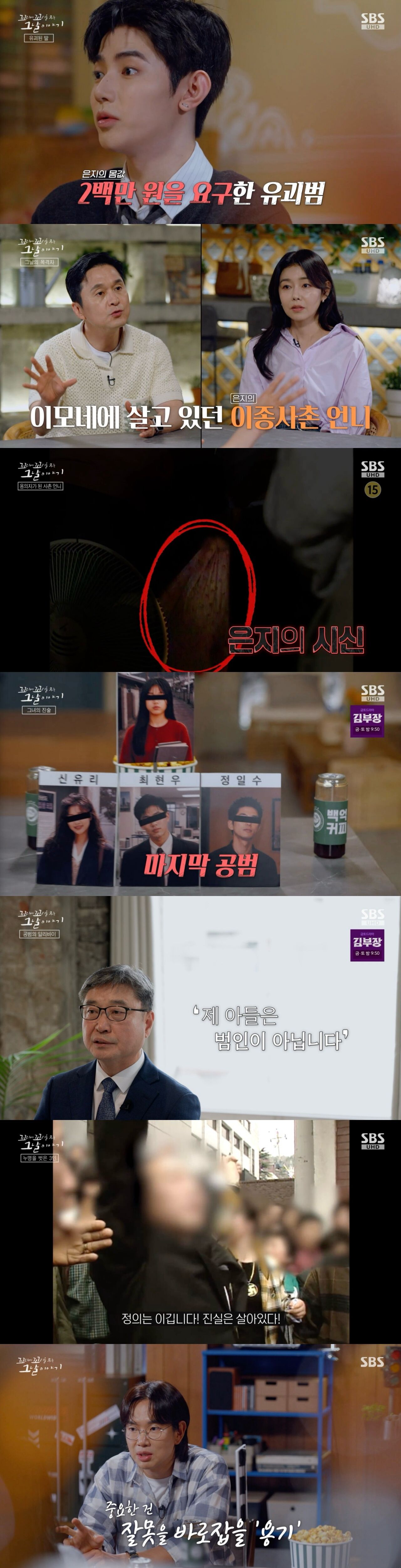
On the July 2 episode of SBS's "Tail-Biting Story" (Gorealra), the show explored the day of the Busan elementary school kidnapping and murder under the subtitle, "The Four Kidnappers - Who Is Lying?"
In October 1994, a family in Busan received a threatening phone call from a kidnapper demanding 2 million won in cash for the return of their daughter.
Detectives launched an investigation to find the kidnapper, focusing on a witness account stating that the child had been seen with a woman in her 20s just before disappearing. The fact that the child appeared to be smiling led investigators to suspect that the culprit might be a relative.
The police identified the victim's cousin, Na Gyeong-ae, as the prime suspect. However, Na vehemently denied the allegations, and the case seemed to hit a dead end.
Then, Na Gyeong-ae's father called the police station, reporting a foul, rotting odor coming from his daughter's room. The smell was traced to a quilt bundle inside Na's room, where the body of the kidnapped victim, Eun-ji, was discovered, shocking everyone.
Only then did Na Gyeong-ae confess to the crime. However, she claimed, "Choi Hyun-woo told me to kidnap her just to get money. I never intended to kill her," pointing to the existence of accomplices. She identified three people as her accomplices.
The individuals she named were 23-year-old office worker Choi Hyun-woo, her friend and college student Shin Yu-ri, and Choi's friend, 23-year-old Jeong Il-su.
Na claimed that she had planned the crime out of curiosity after seeing news about the "Jijonpa" gang. She notably stated that Choi Hyun-woo had been the one to initiate the plan.
According to Na, the other three, all from wealthy families, agreed to the kidnapping to earn money for entertainment expenses. She claimed that while they initially had no intention of killing the child, Shin Yu-ri suggested it out of fear that the child would reveal their identities, and the other three agreed.
Na alleged that they parked the car in a suitable location to commit the murder, while she and Shin kept watch. She claimed that Choi strangled the victim in the car, Jeong loaded the body into the trunk, and the body was abandoned at her home the following day.
The police immediately arrested the three alleged accomplices, and the case sparked national outrage.
However, some time later, the accomplices claimed their innocence, stating they had nothing to do with the case and had alibis for the day of the incident. Jeong Il-su even shocked investigators by stating that he had met Na Gyeong-ae and Shin Yu-ri for the first time at the police station after his arrest.
The police, however, insisted that their claims were false and that their alibis were fabricated, presenting evidence to support this.
Given the conflicting statements, the judge decided to proceed with caution and conducted an on-site re-examination.
It was revealed that the murder scene identified by Na was actually a location with such heavy traffic that a car could not have been parked there for even a minute. When the judge pressed Na on this, she changed her story, claiming she did not know where the murder took place, which undermined the credibility of her previous statements.
Subsequently, additional evidence supporting the alibis of the three accomplices emerged. In particular, it was proven that Choi Hyun-woo was in Daegu, not Busan, on October 9, the day he allegedly plotted the crime, marking a turning point in the case.
The Busan Bar Association formed a fact-finding committee to investigate the truth. They uncovered the identity of a third party who had manipulated the case from behind the scenes, using Na Gyeong-ae.
A witness named Oh, who had been questioned by the police for a different case at the station handling the Eun-ji case, happened to see Choi Hyun-woo and Jeong Il-su. He witnessed detectives swearing at and brutally beating the two men until their statements matched, telling them, "There are too many inconsistencies in your statements. You need to align them."
The fact-finding committee discovered that all the accomplices except Na Gyeong-ae had given false statements due to police violence. They also found that six witnesses had provided false testimony due to coercive investigations. This proved that the alibis of the three accomplices had not been fabricated; the police had simply refused to believe them from the start.
It was also revealed that the police had failed to properly preserve the quilt, a crucial piece of physical evidence, and had not tested it for fingerprints or DNA.
The committee filed complaints against 14 police officers involved in the torture. Seven were found to have committed wrongdoing, and three were convicted.
However, it was revealed that not only the police but also the prosecution had coerced the three individuals through violence and threats to fabricate statements. Journalists who uncovered these facts exposed the ugly actions of the police and prosecution.
The prosecution pressured newspapers and reporters through acquaintances and even summoned and sued some journalists, but they did not back down. The reporters continued to publish evidence proving the accomplices' alibis.
One reporter who worked to uncover the truth at the time remarked, "I wasn't afraid. I thought we could win. I wrote the articles with the mindset that this had to be uncovered."
The trial proceeded amidst a battle over the truth, with a total of 98 witnesses called—the highest number in the history of criminal trials in Korea.
One day before the sentencing hearing in February 1995, prosecutors pressured Judge Park to postpone the ruling. However, Judge Park ignored them, deciding that the case could no longer be delayed.
Despite numerous pressures to block the trial, Judge Park did not waver. He hid on a small island near the courthouse to wait for the sentencing time and arrived at the courtroom right on schedule.
Judge Park sentenced Na Gyeong-ae, who had kidnapped and killed her cousin, to death, and acquitted the other three defendants. The prosecution, however, immediately appealed, claiming there was no room for reconsideration.
On December 8, 1995, the Supreme Court delivered its verdict. It commuted Na Gyeong-ae's sentence from death to life imprisonment, citing signs of remorse, and upheld the acquittal of the other three. Thanks to the efforts of many, the three innocent young men were cleared of their false charges.
Judge Park noted that there remains an unresolved question in the case: Why did Na Gyeong-ae drag those three specific people into the crime?
The program tracked another truth from 30 years ago. In May 1994, five months before the incident, Na Gyeong-ae and Shin Yu-ri had met Choi Hyun-woo by chance.
The three later went on a trip to Masan. There, Na Gyeong-ae was devastated to see Choi Hyun-woo kiss Shin Yu-ri on the cheek.
Na had felt an attraction to Choi from the moment she first met him, but he had shown interest in Shin, not her. Having experienced a similar situation before where a man she had a crush on liked Shin, the repetition of this event left her feeling humiliated.
In fact, the person Na had originally intended to name as an accomplice was not Jeong Il-su, but Park Dong-su, the man she had a crush on. Na had framed the men she had unrequited feelings for, along with the woman they liked, with a horrific false accusation.
The broadcast also analyzed Na Gyeong-ae's statements and estimated that the Busan elementary school kidnapping and murder was likely a crime committed by Na alone. However, this remained a mere estimation. Because the golden time for the investigation was missed early on, the case remains a partially unsolved mystery forever.
Thanks to those who fought for the truth, the three accomplices were cleared of their false charges. However, if the prosecution had chosen a reinvestigation instead of an appeal, if the police had properly verified the suspects' alibis, and if Na Gyeong-ae had told the truth, the full truth behind Eun-ji's death might have been revealed.
The program concluded by emphasizing that the most important thing is the courage to correct mistakes, the courage to apologize, acknowledge the truth, and start over.
Reported by Kim Hyo-jung | Produced by SBS Entertainment News
※ Please note: This article was translated by AI and may contain errors.





 Video News
 Video News