
 KOR
KOR
▲ Rescue workers and volunteers look at a building that collapsed due to an earthquake in Caracas on the 29th (local time).
The roaring sound of cranes, the thud of hammers striking concrete, the hurried footsteps of volunteers moving debris, the mournful yet intermittent sounds of crying from here and there, and the buzzing sound of a rescue worker’s welding torch cutting through stone in a straight line with a red glow.
In the chaotic and deafening noise of the earthquake recovery site, all this clamor, sighing, regret, and weeping seemed to be sucked into a black hole, instantly fading into silence.
"Please be quiet for a moment. I think there is a baby in here."
Soon after, rescue workers laid a green blanket down next to the building debris.
Everyone at the scene watched the rescue operation in deathly silence.
However, hope, which seemed incredibly close, turned out to be infinitely far away.
In the face of an uncontrollable natural disaster like an earthquake, even harboring a small hope was not easily granted to humans.
People began to whisper again, and the crane started moving with a thunderous noise.
The baby was not found.
The green blanket was removed from the site.
This was in front of the Edificio Lita in the San Bernardino area of Caracas, Venezuela, which collapsed due to a series of earthquakes on the 29th of last month (local time).
Even past 9:00 p.m. on this day, five days after the accident, volunteers and rescue workers were still clearing debris and searching for survivors.
However, no one had heard news of any survivors being rescued.
Carlos Martinez, a volunteer, said, "I have been working through the night for five days, but we have only been able to pull out 20 bodies from the rubble."
He then trailed off, adding, "It has been five days since the building collapsed, so the chances of survival are slim, but..."
Local experts estimated that the collapsed Edificio Lita was a structure built before 1967.
They reasoned that because authorities banned placing water tanks on rooftops after a major earthquake hit Caracas in 1967, the presence of one on the roof suggested it was built before that time.
At the very top of the unrecognizable building debris, a water tank stood in a desolate state, half-broken.
The situation for the buildings next to Edificio Lita did not look much better.
Yellow tape marked "Do Not Enter" blocked the entrances to these buildings.
The exterior walls were severely damaged, and the buildings remained empty as all residents had evacuated.
A tent village had formed quite a distance away from the buildings.
One evacuated resident, who wished to remain anonymous, said, "It is very difficult right now, but seeing the volunteers who have gathered to lend a helping hand gives me some strength."
There were hundreds of volunteers in the vicinity of this neighborhood alone.
Even as it approached 10:00 p.m., they were distributing food they had packed to rescue workers, participants in the operation, and those waiting at the scene to help in any way they could.
One volunteer said, "We are working about three times harder than usual."
The area around the collapsed Edificio Lita was filled with cracked buildings, and tents were scattered everywhere.
Not far from here, at Altamira Square and its surrounding areas, police were controlling access.
One police officer warned, "Do not go in, as the buildings could collapse."
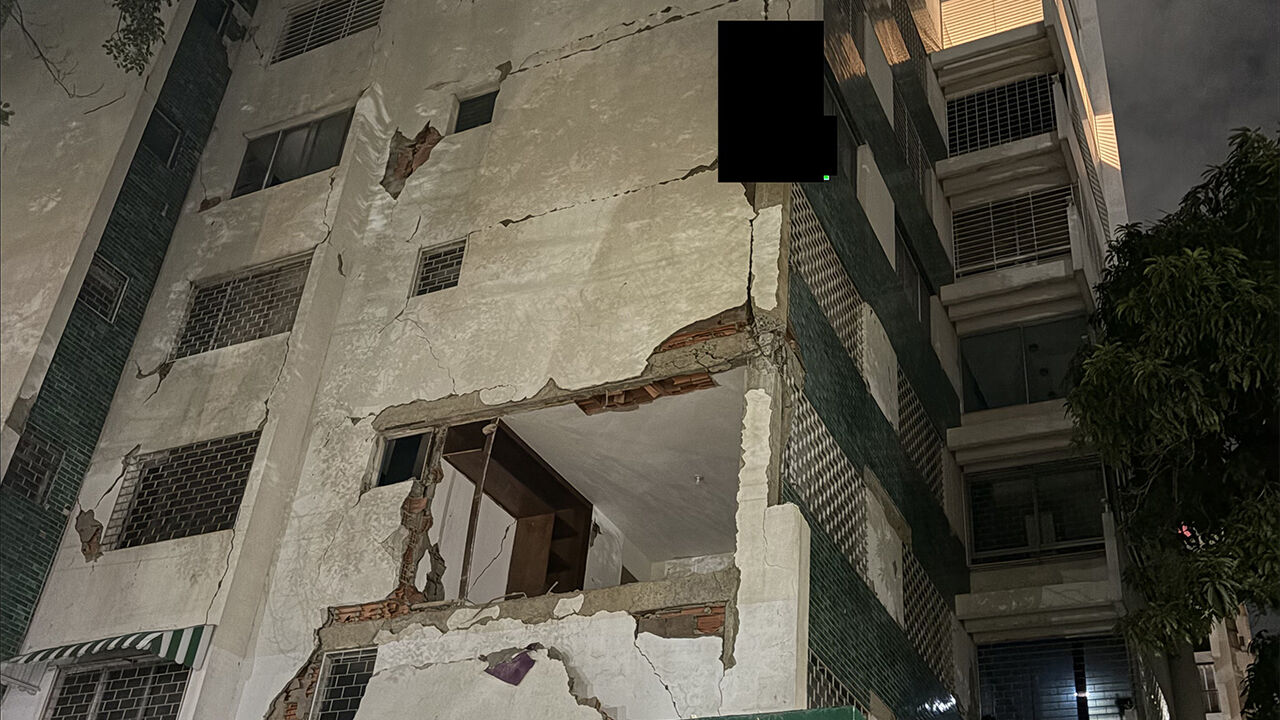
An apartment where a Korean family lived was also on the verge of collapse.
The family said they were planning to move soon.
Just one block away from this apartment was the 22-story building "Residencia Petunia," which suffered the most damage in the Altamira area.
Police and fire authorities were strictly controlling access to this building, but after hearing that we had traveled a long way to report on the earthquake damage in Venezuela, they guided us inside after some deliberation.
The building was already unrecognizable due to the series of earthquakes.
Only piles of dirt, stone debris, and the skeletal steel bars that once served as the building's frame faintly revealed its former appearance.
In front of this massive pile of rubble, even excavators seemed useless.
(Photo: Yonhap News)
※ Please note: This article was translated by AI and may contain errors.

 Video News

 Video News

