
 KOR
KOR![Are There Precedents for Integrating Military Academies? "A Twin to Japan's National Defense Academy" [Reporter's Notebook]](https://img.sbs.co.kr/newimg/news/20260628/202196972_1280.jpg )
▲ On May 27, Defense Minister Ahn Gyu-baek visited the Korea Military Academy in Nowon-gu, Seoul, to hear opinions from cadets regarding the integration of military academies.
There is significant public opposition to the Ministry of National Defense's push to merge the Army, Navy, and Air Force academies into a single institution, tentatively named the National Armed Forces Military University. Following the alumni associations of the Korea Military Academy, those of the Naval and Air Force academies have reportedly also solidified their opposition, labeling the move a hasty integration. Meanwhile, a national petition calling for the impeachment of Defense Minister Ahn Gyu-baek is nearing 200,000 signatures, and signs of dissent have emerged even within the Democratic Party.
Since the integration of military academies is a campaign pledge and a national policy task of President Lee Jae-myung, the government and the ruling party are expected to push forward with the plan. However, the concerns raised by the alumni associations regarding a rushed process appear to hold weight. Among nations with significant scale and security vulnerabilities similar to South Korea, only Japan and Germany utilize integrated military academy systems to train officers. Notably, both are defeated nations from World War II that face severe military constraints domestically and internationally. Critics argue that South Korea should not be imitating the officer training methods of these defeated nations.
The recommendation put forth by the public-private-military joint special advisory committee, which operated directly under the Defense Minister, suggests integrated education for the first and second years, followed by branch-specific education for the third and fourth years. This is remarkably similar to the academic system of Japan's National Defense Academy, a model that is difficult to adopt due to national sentiment. When pursuing new policies like the integration of military academies, one would expect case studies and preliminary research to have been conducted. There is growing concern that the advisory committee or the Ministry of National Defense may be proceeding in a hasty manner, bypassing such essential procedures.
"Branch Separation from Second Year" (Japan) vs. "General Academic Education After Branch Training" (Germany)
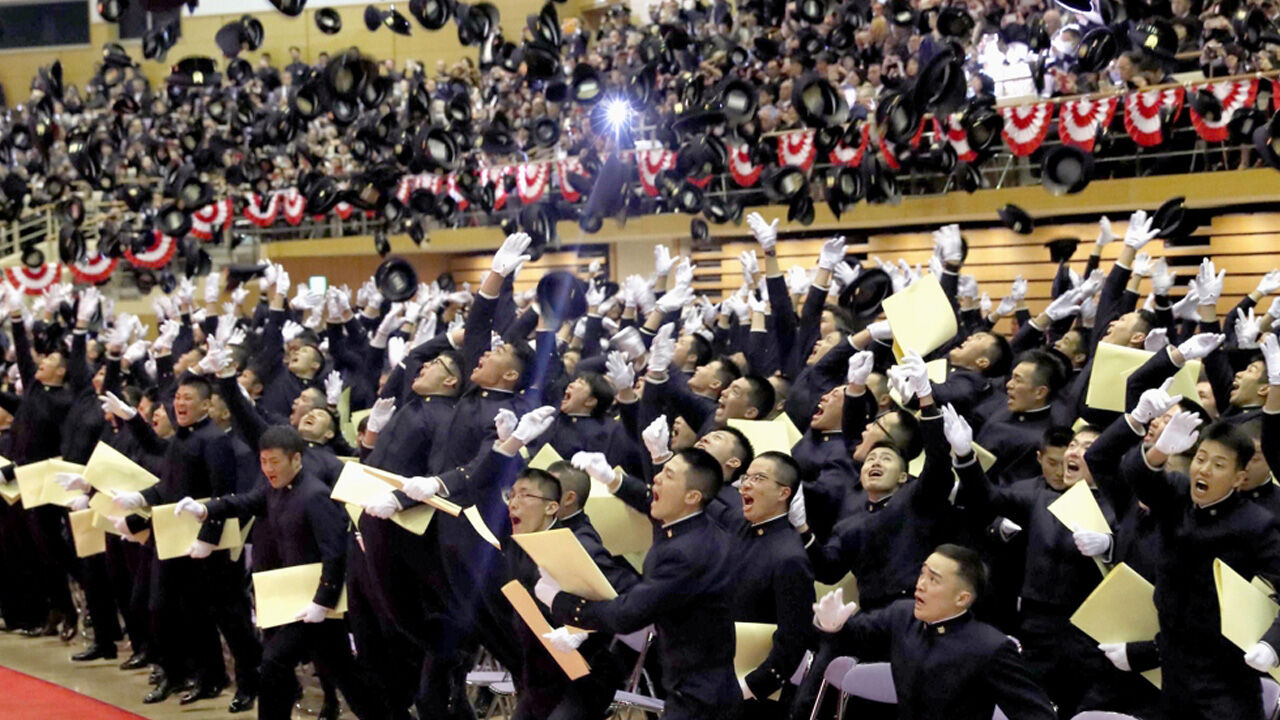
▲ Graduates perform a cap-tossing ceremony at the Japan National Defense Academy graduation ceremony in 2019.
The first-year curriculum at the National Defense Academy focuses on general liberal arts. Students are taught liberal arts subjects, foreign languages, physical education, and defense studies unrelated to specific military branches. Upon advancing to their second year, students select their military branch—Ground, Maritime, or Air—and their major.
A retired Army officer who studied at Japan's National Defense Academy explained, "The National Defense Academy is an educational institution established to support the policy of exclusive defense, joint operations under the U.S.-Japan alliance, and crisis management." He noted that it is an educational system designed to guarantee minimal defense capabilities in a situation where security leadership has been ceded to the United States. In other words, it was born under circumstances vastly different from those of South Korea, which leads its own security while facing North Korea.
Germany also reorganized its officer training system after its defeat in World War II. Before the war, each branch recruited soldiers and provided intensive training and education for two to three years to produce officers. After the defeat, the system shifted to one of "military education and training followed by general education." After selecting their branch, officer candidates receive military education and training at branch-specific institutions for over a year to become military experts. Subsequently, they earn bachelor's and master's degrees in pure civilian disciplines at the Bundeswehr University.
A retired Army general, known as part of the group that studied at the German military academy, pointed out, "Germany's officer training system emerged from its unique environment after the war, characterized by a decline in the perception of officers and a sharp drop in applicants." He added, "The core of the German system is the incentive offered by the Bundeswehr University, where one can earn a bachelor's or master's degree equivalent to those in the civilian sector, unlike before the war." In terms of military training and the awarding of civilian degrees, there is no fundamental difference from South Korea's current military academies.
"Integrated Academy Plan is a Fraternal Twin to Japan's National Defense Academy"
No matter how one looks at it, it resembles Japan's National Defense Academy. The only difference is whether the branch-neutral education lasts for one year or two. The advisory committee reportedly maintains that they "never referred to Japan's National Defense Academy." If that is the case, it implies that the committee failed to conduct sufficient preliminary research for policy development. Had they reviewed even a few international cases of integrated military academies, they would have naturally avoided a 2+2 network-style integration that looks like a fraternal twin to the Japanese model.
If the Ministry of National Defense rejects the Japanese-style integration, the alternative is an academic system where branch-specific training and education occur first, followed by integrated education. This, too, is the German model of a defeated nation, making it burdensome to emulate. The German incentive of awarding civilian degrees is already a system in place at South Korean military academies, offering no differentiation. A key official at the Ministry of National Defense lamented, "Whichever path the integrated military academy takes, it appears to be an imitation of officer training from defeated nations. In particular, the advisory committee's recommendation is very similar to the Japanese model," adding, "It is difficult to find a model for an integrated military academy worth referencing from normal nations that are free from such historical backgrounds and prioritize security."
Attention is focused on what kind of integrated military academy plan the Ministry of National Defense will present. Many observers predict that it will be difficult to avoid the academic frameworks of Japan or Germany in the broader picture. If they choose the German model, they will face criticism for following the path of a defeated nation without any tangible benefits; if they choose the Japanese model, they may invite controversy over "pro-Japanese tendencies within the Ministry of National Defense" in addition to the charge of imitating a defeated nation. Minister Ahn Gyu-baek faces a heavy burden.
※ Please note: This article was translated by AI and may contain errors.

 Video News
 Video News


![Park Hang-seo Apologizes Before Cameras Following National Team's World Cup Elimination [Sports Mug]](http://img.sbs.co.kr/newimg/news/20260629/202197073_300.jpg) Video News
Video News