
 KOR
KOR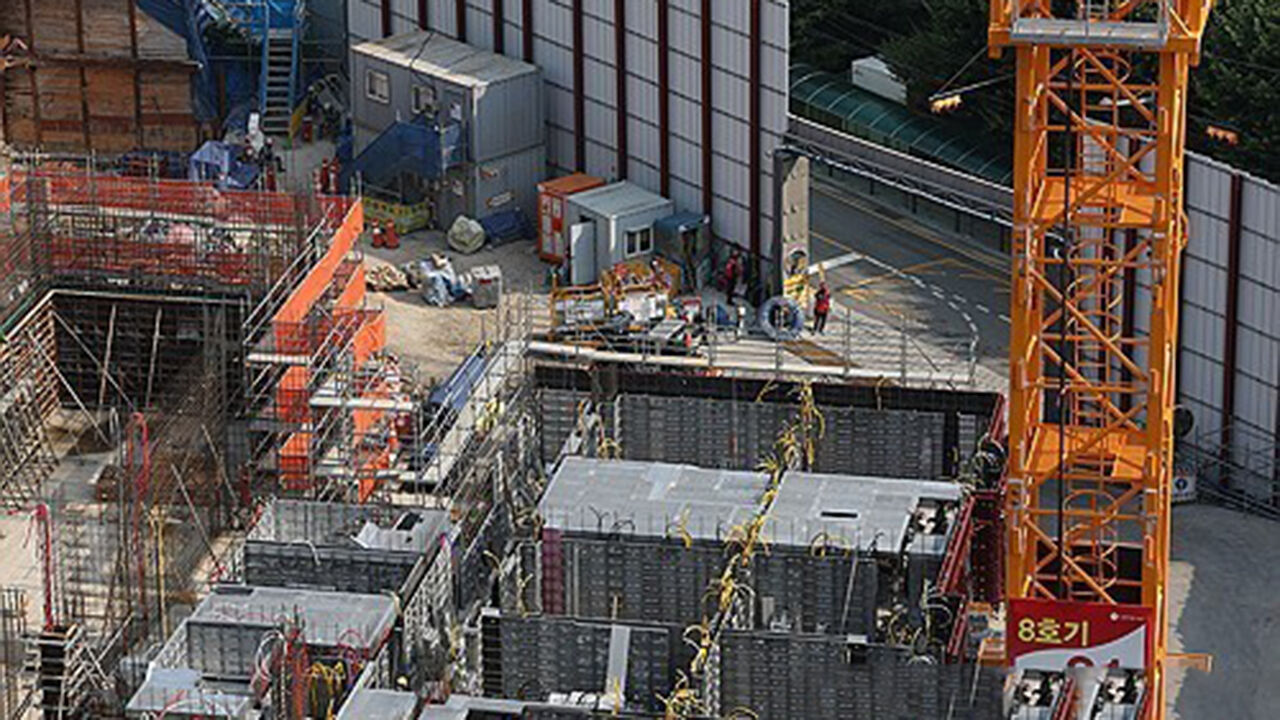
▲ A construction site for an apartment complex in Seoul
Construction output has declined for 24 consecutive months compared to the same month of the previous year, marking the longest period of contraction since records began, surpassing the streaks seen during the Asian financial crisis and the global financial crisis.
According to the National Statistical Office's Korean Statistical Information Service (KOSIS) and the National Assembly Budget Office's "Industry Trends & Issues" report on Sunday (June 28), construction output (at constant prices) fell by 5.5% in April this year compared to the same month last year.
By sector, building construction output decreased by 6.4%, and civil engineering output fell by 2.8%.
Construction output has declined year-on-year for 24 straight months since May 2024.
This is the longest period of decline since the relevant statistics were first compiled in July 1997.
The streak has now surpassed the 7-month decline during the Asian financial crisis and the 12-month decline during the global financial crisis.
While construction output statistics have been recorded since July 1997, year-on-year comparisons have been possible since July 1998.
Even accounting for the statistical gap during the early stages of the Asian financial crisis, the consecutive decline period at that time was analyzed to be shorter than the current one.
Experts point to the sharp rise in construction costs following the COVID-19 pandemic and the tightening of the real estate project financing (PF) market as the primary causes of the prolonged slump.
Park Sun-gu, head of the Economic and Financial Research Division at the Construction & Economy Research Institute of Korea, said, "As liquidity was released globally during the COVID-19 period, raw material prices and labor costs rose, leading to a significant increase in construction costs. Furthermore, since the Legoland incident in 2022, the tightening of the PF market has made financing difficult, prolonging the slump in the construction industry."
However, Park predicted that construction output could shift to a year-on-year increase starting in the second half of the year, as leading indicators such as construction orders have shown signs of a rebound this year.
He added, "Even if it shifts to a year-on-year increase in the second half, this is largely due to the base effect from last year's poor performance. While the indicators may improve, the actual business conditions felt by the construction industry will likely remain difficult."
The Bank of Korea also expects a slow recovery for the construction sector.
In its economic outlook report released last month, the Bank of Korea projected that construction investment would increase by 0.6% this year, supported by the base effect from last year's 9.8% decline.
This figure is 0.4 percentage points lower than the 1.0% forecast made in February.
The growth rate for construction investment next year is also projected to remain at 1.5%.
The Bank of Korea stated, "While investments related to artificial intelligence (AI), such as semiconductor plants and data centers, as well as social overhead capital (SOC) investments, will partially mitigate the construction slump, the recovery is expected to fall short of initial projections due to rising construction costs and supply chain disruptions for building materials."
(Photo: Yonhap News)
※ Please note: This article was translated by AI and may contain errors.

![Park Hang-seo Apologizes Before Cameras After World Cup Elimination [Sports Mug]](http://img.sbs.co.kr/newimg/news/20260629/202197073_300.jpg) Video News
Video News
![Déjà Vu of a 2014 Nightmare: How to Avoid Repeating the Same Failures [Letter from Guadalajara ③]](http://img.sbs.co.kr/newimg/news/20260629/202197055_300.jpg)
 Video News
 Video News
 Video News